
水利基础设施

Search documents
赛莱默2025财年营收利润双增,2026年展望积极
Jing Ji Guan Cha Wang· 2026-02-11 20:42
Core Viewpoint - Xylem (XYL.US) reported solid performance in Q4 and for the full fiscal year 2025, maintaining a positive outlook for 2026 [1] Financial Performance - Full-year revenue reached $9.035 billion, a year-over-year increase of 5.51%; Q4 revenue was $2.397 billion, up 6.16% year-over-year [2] - Full-year net income attributable to shareholders was $0.957 billion, reflecting a 7.53% year-over-year growth; Q4 net income was $0.335 billion, with a net profit margin of 13.98% [2] - Adjusted earnings per share were $3.92 for the full year and $1.37 for Q4, both showing year-over-year improvements [2] Operational Metrics - The full-year gross margin was 38.46%, while the operating profit margin for Q4 improved to 14.68% [3] - The company offset some cost pressures through productivity optimization and price management, raising the adjusted EBITDA margin guidance to 21.3%-21.8% for the year [3] Business Development - All four business segments (Water Infrastructure, Applied Water, Measurement & Control Solutions, Water Solutions & Services) achieved revenue growth [4] - The North American market performed particularly well, with a 11% organic growth in the Measurement & Control Solutions segment, increasing backlog orders to approximately $5 billion [4] Cash Flow and Dividends - Full-year operating cash flow was $1.241 billion, with free cash flow at $0.873 billion [5] - The board declared a quarterly dividend of $0.40 per share, totaling $1.60 for the year, with a payout ratio of 40.82% [5] Future Outlook - The company anticipates continued mid-single-digit revenue growth in 2026, aiming to further optimize profit margins through operational model transformation (e.g., 80/20 strategy) [6] - Management emphasized strong global demand for water infrastructure, particularly in smart metering and sustainable water solutions [6]

“十四五”水利建设投资5.68万亿元
Zhong Guo Zheng Quan Bao· 2026-01-09 20:45
Group 1 - The core viewpoint of the articles highlights the significant progress in China's water conservancy infrastructure, with a total investment of 5.68 trillion yuan during the 14th Five-Year Plan period, and an expected investment of 1.28 trillion yuan by 2025, which will create 3.15 million jobs [1][2] - The construction of 181 major water conservancy projects has commenced, which is an increase of 65 projects compared to the previous five-year plan, with 94 projects completed and operational [1] - The national water network now covers 80.3% of the country's land area, providing essential water security for major strategic implementations and economic zones [1] Group 2 - By the end of 2025, the irrigated area of arable land is projected to reach 109 million acres, an increase of over 5.3 million acres from the end of the 13th Five-Year Plan, contributing to 80.76% of grain production [2] - The Ministry of Water Resources plans to focus on enhancing food security and agricultural water efficiency through the modernization of irrigation systems and the implementation of a comprehensive agricultural water-saving policy [2][3] - Major irrigation projects, such as the new large-scale irrigation areas in Guangdong and Jiangxi, are set to be developed, with a design irrigation area exceeding 6 million acres [3]
我国水安全保障能力全面提升——“十四五”以来新开工重大水利工程172项
Jing Ji Ri Bao· 2025-09-30 02:50
Core Insights - The Chinese government has made significant progress in water conservancy development during the "14th Five-Year Plan" period, with investments exceeding 5.4 trillion yuan, marking a 1.6 times increase compared to the "13th Five-Year Plan" [1] Group 1: Investment and Infrastructure - Water conservancy construction investment reached over 1 trillion yuan for the first time in 2022, continuing a three-year trend of breaking historical records [1] - A total of 172 major water conservancy projects have been initiated since the start of the "14th Five-Year Plan" [1] - By the end of last year, China had built 95,000 reservoirs, 200 large and medium-sized water diversion projects, and 6,924 large and medium-sized irrigation areas, forming the world's largest and most comprehensive water conservancy infrastructure system [1] Group 2: Flood Control and Disaster Management - The water and drought disaster prevention system has been continuously improved, successfully managing floods on 3,981 rivers that exceeded warning levels [1] - The proportion of flood disaster losses to GDP decreased from 0.28% during the "13th Five-Year Plan" to 0.18% [1] Group 3: Agricultural Support and Food Security - The water conservancy sector has strengthened water security for food production, focusing on major grain-producing areas with 30 significant water diversion and key water source projects [2] - Over the past five years, 1,959 large and medium-sized irrigation areas have undergone modernization, adding and restoring over 20 million acres of irrigated land [2] Group 4: Ecological Restoration and Community Benefits - The "Mother River Revival Action" has been implemented, restoring several rivers that had been dry for decades, achieving a 98.6% compliance rate for ecological flow standards in key rivers and lakes [2] - The water conservancy department has supported 122 happiness river and lake construction projects, creating green industrial chains and ecological agriculture, enhancing community welfare [3] - The Hu Creek watershed in Zhejiang has seen a revenue increase of over 13 billion yuan, growing by 18.7% year-on-year due to the integration of water and tourism [3]
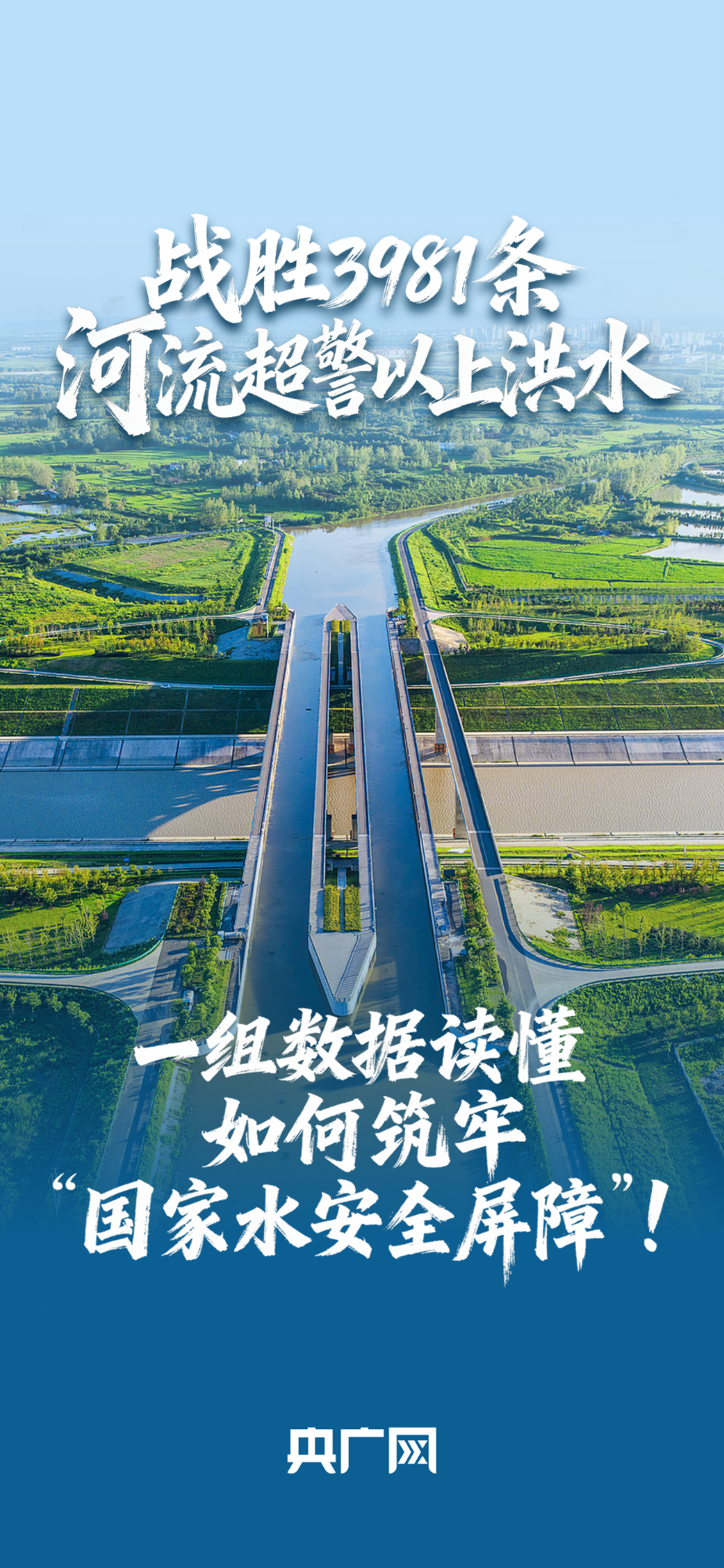
数读“十四五”答卷丨战胜3981条河流超警以上洪水!一组数据读懂如何筑牢“国家水安全屏障”!
Yang Guang Wang· 2025-09-30 00:59
Core Viewpoint - The press conference highlighted the achievements in high-quality water conservancy development during the 14th Five-Year Plan period, emphasizing the construction of major water projects and improvements in ecological flow standards. Group 1: Major Water Projects and Investments - A total of 172 major water conservancy projects have commenced construction [9] - The investment in water conservancy construction reached a historical record of over 1 trillion yuan in 2022, with an expected total investment of over 5.4 trillion yuan during the 14th Five-Year Plan, which is 1.6 times that of the previous plan [5] - By the end of 2024, the national water network coverage rate is expected to reach 80.3%, with irrigated farmland area reaching 1.09 billion mu [18] Group 2: Ecological and Structural Improvements - The ecological flow compliance rate for key rivers and lakes has reached 98.6% [14] - Major water diversion projects and irrigation areas have been established, including 200 large and medium-sized water diversion projects and 692 irrigation areas [11] - The country has implemented the Mother River Revival Action, restoring several rivers that had been dry for decades [14] Group 3: Disaster Prevention and Management - The water and drought disaster prevention system has been continuously improved, successfully overcoming floods in 3,981 rivers exceeding warning levels [20] - The proportion of flood and drought disaster losses to GDP has decreased from 0.28% during the 13th Five-Year Plan to 0.18% [21]

水利基础设施现代化加快推进(奋勇争先,决战决胜“十四五”)
Ren Min Ri Bao· 2025-07-06 22:36
Group 1 - The core viewpoint emphasizes the importance of water resource management and infrastructure development in China, highlighting significant investments and projects aimed at enhancing water supply and safety [1][2][4]. - The Guangdong water resource allocation project, which includes the "Yuehai Huanbei No. 5" tunneling machine, has completed 95 kilometers of tunnel excavation with a total investment of 137 billion yuan [1]. - The national water network construction has accelerated, with over 1 trillion yuan invested in water infrastructure over the past three years, and a water supply capacity exceeding 900 billion cubic meters [2]. Group 2 - The modernization of irrigation systems, such as the Qingtongxia irrigation district, has improved water delivery efficiency, resulting in increased crop yields [3]. - The government is increasing investment in over 1,000 irrigation modernization projects, with the total irrigated area reaching over 108 million acres [3]. - The construction of the Jingling Reservoir in Zhejiang is being supported by innovative financing mechanisms, including the use of a real estate investment trust for water infrastructure [5]. Group 3 - The integration of water networks with other infrastructure systems, such as electricity and transportation, is crucial for supporting industrial transformation and modernization [6][7]. - The Ministry of Water Resources is committed to implementing a comprehensive water management strategy to ensure high-quality development and water security in China [7].
山西省水利工程建设工作会议在太原召开
Shui Li Bu Wang Zhan· 2025-03-31 03:22
Core Insights - The meeting emphasized the importance of accelerating water conservancy infrastructure construction in 2025, which is a critical year for the "14th Five-Year Plan" and laying a solid foundation for the "15th Five-Year Plan" [2] Group 1: 2024 Water Conservancy Construction Overview - In 2024, the province's water conservancy projects will fully implement the decisions made by the provincial party committee and government regarding water management, achieving over 20 billion yuan in investments [1] - Key water conservancy projects exceeded annual targets, with significant breakthroughs in both large and small water network projects, and comprehensive progress in the reinforcement of medium and large-scale dangerous reservoirs [1] Group 2: Strategic Focus for 2025 - The focus will be on key water conservancy projects to leverage investment for economic growth, employing a comprehensive approach to project management and monitoring [2] - There will be an emphasis on enhancing water security capabilities through the acceleration of water network and reservoir reinforcement projects [2] - Quality and safety management in water conservancy construction will be prioritized to create high-quality projects, with a push for national awards and standardized management practices [2] - Market regulation will be strengthened to optimize the business environment for water conservancy, including oversight of bidding processes and worker wage payments [2] - The meeting highlighted the need for deepening party building efforts to ensure the integrity and quality of water conservancy projects [2]