消费级AI

Search documents
2025 ToC AI产品:仅有3%用户愿意付费,29%的父母每天使用
Founder Park· 2025-06-30 11:47
Core Insights - The report by Menlo Ventures reveals that over 61% of American adults have used AI in the past six months, indicating a significant shift in consumer behavior towards AI integration in daily life [5][6][10] - Despite the high usage rates, only 3% of users are willing to pay for AI services, leaving a substantial market gap of $420 billion [6][13] - The report identifies key opportunities in personalized scenarios where AI penetration is still low, suggesting a focus for entrepreneurs [3][9] Market Overview - The consumer AI market has grown to a $12 billion industry within just two and a half years since the launch of ChatGPT [10][13] - With an estimated 1.7 to 1.8 billion global users, the market potential is vast, but the current revenue generation is significantly lagging behind potential [6][13] - The report highlights that 81% of the revenue in the consumer AI market is captured by general AI assistants, with ChatGPT alone accounting for approximately 70% of consumer spending [41][43] User Demographics - The report reveals unexpected user demographics, with millennials (ages 29-44) being the heaviest users of AI, contrary to the assumption that younger generations would dominate [16][19] - Parents are identified as "super users," with 79% having used AI, and 29% using it daily, significantly higher than non-parents [25][30] - High-income households show a higher AI usage rate, with 74% of families earning over $100,000 using AI compared to 53% of those earning under $50,000 [20][21] Usage Patterns - AI is predominantly used for routine tasks, with email writing being the most common application at 19% of users, followed by task management and research [50][51] - The report indicates that while AI is widely used, the depth of adoption in specific tasks remains shallow, suggesting that there is room for growth in specialized applications [52][55] - AI's role in creative expression is significant, with over 51% of creators using AI for writing, and 38% for presentations, indicating a strong market for creative AI tools [59][63] Opportunities for Growth - The report identifies five key areas where AI can create value: routine tasks, health management, learning and development, interpersonal connections, and creative expression [44][46] - There is a notable gap in AI adoption in health management, with only 20% of those seeking health information using AI, highlighting a potential market opportunity [71][72] - The report emphasizes the need for AI tools that can effectively address high-friction, high-trust tasks, as these areas present significant opportunities for specialized AI solutions [76][80] Future Trends - The report predicts a shift towards professional tools becoming mainstream, moving away from general assistants [86] - It anticipates that AI will evolve from task-oriented tools to comprehensive workflow automation, enhancing user experience [86] - The emergence of voice AI and physical AI in homes is expected to further integrate AI into daily life, creating new market opportunities [86]



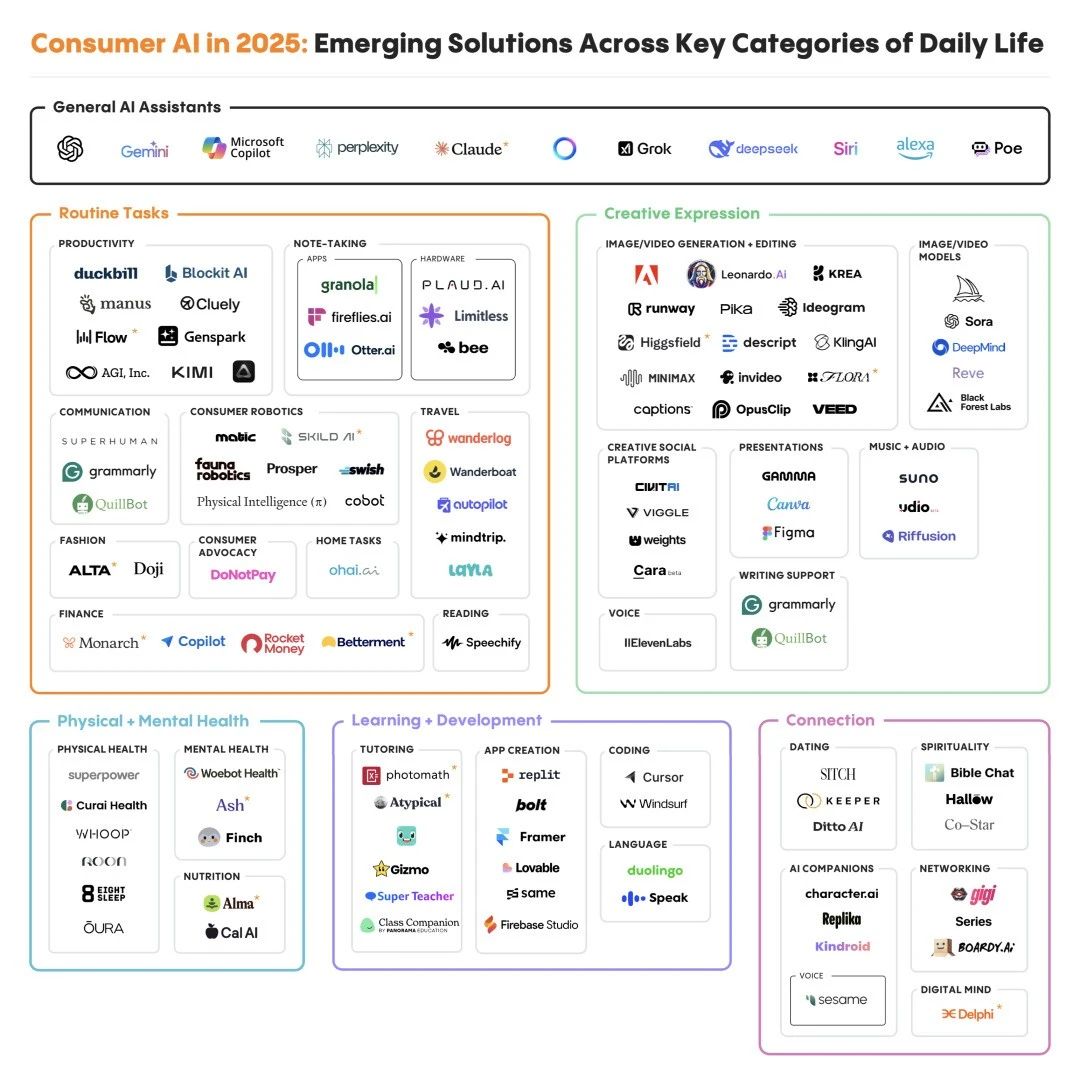
“父母”竟是超级用户?——2025消费级AI用户行为全景图 | Jinqiu Select
锦秋集· 2025-06-29 13:29
Core Insights - The report reveals that over 61% of American adults have used AI in the past six months, indicating a significant shift in consumer behavior towards AI adoption [4][8] - Despite the high usage rates, only 3% of users are willing to pay for AI services, leaving a substantial market gap of $420 billion [8][11] - The report emphasizes that personalized scenarios with low AI penetration are key opportunities for entrepreneurs to explore [3][7] Market Overview - The consumer AI market has reached a size of $12 billion, with an estimated 1.8 billion global users, of which 500 to 600 million are daily users [4][11] - The report highlights a stark contrast between the high user base and low monetization, with only 3% of users converting to paid services [11][12] - The enterprise AI market has seen a significant increase in spending, reaching $13.8 billion, which is over six times the previous year [11] User Demographics - The report identifies surprising user demographics, showing that Millennials (ages 29-44) are the heaviest users of AI, contrary to the expectation that younger generations would dominate [13][16] - Parents are emerging as "super users," with 79% having used AI, and 29% using it daily, significantly higher than non-parents [22][26] - The report notes that AI usage is highest among students and high-income households, with 85% of students using AI tools [17][18] Usage Patterns - AI is predominantly used for routine tasks, with email writing being the most common application at 19% usage among American adults [47][49] - The report categorizes AI applications into five core areas: Routine Tasks, Physical and Mental Health, Learning and Development, Connection, and Creative Expression [42][44] - Despite the broad range of applications, the depth of AI adoption in any single task remains shallow, indicating that AI is not yet a daily necessity for most users [50][51] Opportunities for Growth - The report identifies significant opportunities in high-frequency, high-friction, and high-trust tasks where AI can provide substantial value [75][81] - Areas such as health management, financial management, and personalized learning show low AI adoption rates despite high demand, indicating potential market gaps [82] - The report suggests that specialized tools that address specific user needs could thrive in the current landscape dominated by general AI assistants [37][41] Future Trends - The report anticipates a shift towards professional tools becoming mainstream, moving away from general assistants [93] - It predicts that future AI will transition from task-oriented to workflow automation, allowing for more complex processes to be managed by AI [93] - The emergence of social AI tools that facilitate connections and relationships is also highlighted as a growing trend [93]

喝点VC|a16z最新洞察:消费级AI根本没有护城河?真正的护城河是势能,关键在于能多快占领用户心智
Z Potentials· 2025-06-27 03:31
Core Insights - The core argument of the article is that in the rapidly evolving consumer AI landscape, traditional moats based on technological barriers are no longer effective. Instead, success hinges on the speed of product iteration, creative distribution capabilities, and the ability to capture user attention quickly [2][3]. Group 1: Importance of Early Distribution - Early distribution is crucial in the consumer AI sector, where the pace of change is so rapid that building products in a slow and orderly manner is nearly impossible. The key is how quickly a company can launch products, attract user attention, and occupy user minds [3][8]. - Traditional marketing strategies are becoming less effective, and companies must break the mold to achieve sustained user retention in consumer AI [3][4]. Group 2: Strategies for Success - Companies that understand the dynamic nature of the industry and build their products around it, such as Perplexity, Lovable, Replit, and ElevenLabs, are beginning to distance themselves from competitors [6][8]. - Effective distribution strategies observed include hosting hackathons as public showcases to gain visibility and engagement [6][7]. Group 3: Innovative Engagement Tactics - ElevenLabs hosted a global hackathon that showcased its AI voice platform, leading to significant social media buzz and exposure [7]. - Lovable organized a live competition between a designer using Webflow and one using its AI design assistant, effectively demonstrating the product's capabilities while engaging the audience [9]. Group 4: Collaborative Approaches - Companies are increasingly forming partnerships to create "Starter Packs" that combine multiple AI tools, enhancing user experience and demonstrating collaborative potential [11][12]. - These collaborations not only provide functional value but also enhance brand credibility through social endorsement [13]. Group 5: Leveraging Influencers and Community - Engaging influential creators and developers within niche communities can effectively amplify product visibility and adoption, moving away from traditional influencer marketing [14]. - Early access to products for influential users can lead to authentic recommendations that resonate within specific communities [14]. Group 6: Transparency and Public Engagement - Companies are adopting a "Build in Public" approach, sharing product progress and user data openly, which fosters a sense of community and encourages user engagement [18][19]. - This transparency can create a competitive atmosphere where companies motivate each other to showcase their growth and innovations [19].