空气质量改善

Search documents
去年广州空气优良天数比例达93.4% 连续三年超九成
Xin Lang Cai Jing· 2026-01-07 00:39
Core Viewpoint - Guangzhou is projected to achieve comprehensive air quality standards by 2025, with a good air quality day ratio of 93.4% and an average PM2.5 concentration of 21.5 micrograms per cubic meter, maintaining the best status among national central cities [1] Group 1 - The air quality during the National Games in Guangzhou was consistently good, with an average PM2.5 concentration of 18 micrograms per cubic meter, marking the first time in five years that it achieved a "single-digit" figure [1] - On the opening day of the event, the PM2.5 daily average concentration was recorded at 15 micrograms per cubic meter, with levels dropping to 8 micrograms per cubic meter during the opening ceremony [1] Group 2 - Guangzhou is focusing on PM2.5 control as a primary strategy, implementing a comprehensive action plan that includes 92 key tasks across nine areas to improve air quality [1] - The city has enacted strict regulations, including a full ban on black smoke vehicles, prohibition of high-emission machinery, and restrictions on National III diesel trucks [1] - The green travel ratio in the central urban area has reached 82%, successfully meeting the goals set for the 14th Five-Year Plan [1] Group 3 - The Guangzhou Ecological Environment Bureau has enforced the "100% compliance" requirement for construction sites, conducting over 39,000 inspections to control dust pollution [2] - Measures include enhanced road watering to mitigate dust and a quarterly update of pollution weather response plans, promoting regional cooperation in the Guangdong-Hong Kong-Macao Greater Bay Area for PM2.5 control [2]
蓝天成常态!海淀空气质量,实现“四个首次”
Xin Lang Cai Jing· 2026-01-05 09:28
Core Viewpoint - In 2025, Haidian District achieved significant milestones in air quality improvement, marking a historic breakthrough with multiple indicators reaching new heights, emphasizing the commitment to "ecological priority and green development" [1][3][12] Group 1: Air Quality Achievements - The annual average concentration of PM2.5 in Haidian dropped to 25.7 micrograms per cubic meter, breaking the critical threshold of 30 micrograms for the first time, with a year-on-year decrease of 16.0%, the largest improvement in the city [5][8] - The number of days with good air quality reached 310, surpassing 300 days for the first time, with an increase of 17 days from the previous year, resulting in a good air quality ratio of 85.2% [6][8] - All six major pollutants (PM2.5, PM10, SO₂, NO₂, CO, O₃) achieved national standards for the first time, marking a historic milestone in air quality management [8] Group 2: Pollution Reduction Strategies - In structural reduction, Haidian focused on green transformation in the transportation sector, achieving a 61.8% ratio of new energy vehicles, an increase of 25.8 percentage points from the beginning of the year [10] - In engineering reduction, 158 new green enterprises were established, with a total of 197 green enterprises in the district, raising the green enterprise ratio to 40.4% [10] - In management reduction, the average road dust load decreased to 0.31 grams per square meter, a year-on-year decline of 32.6%, with significant reductions in dust pollution from construction sites and roads [11]

精抓细抠到0.1微克 北京“抠”出常态蓝
Xin Lang Cai Jing· 2026-01-04 19:01
Core Viewpoint - Beijing has achieved significant improvements in air quality by 2025, with PM2.5 annual average concentration dropping to 27 micrograms per cubic meter, marking a milestone in air pollution control efforts [3][4][6]. Group 1: Air Quality Improvements - The annual average concentration of PM2.5 in Beijing decreased by 11.5% compared to the previous year, achieving a level below 30 micrograms for the first time [3][4]. - The number of days with good air quality reached 311, an increase of 21 days year-on-year, resulting in a good air quality rate of 85.2% [3][4]. - The number of heavy pollution days was reduced to 1, the lowest since monitoring began, down from 58 days in 2013, representing a reduction of 98.3% [4][6]. Group 2: Pollution Reduction Metrics - Major pollutants saw significant reductions: PM2.5 down 69.8%, PM10 down 55.6%, NO2 down 60.7%, and SO2 down 84.9% from 2013 levels [4][6]. - PM2.5 good air quality days increased from 55.9% in 2013 to 95.3% in 2025, with a notable stretch of 227 consecutive days of good PM2.5 levels from March to October 2025 [4][6]. Group 3: Strategies and Technologies - Beijing's air quality improvement is attributed to precise pollution control measures, including the "1 microgram" and "0.1 microgram" action plans, focusing on meticulous pollution source management [6][7]. - The city has implemented a comprehensive air quality monitoring network, integrating data from various sources to enhance pollution tracking and response capabilities [7][10]. - Local emission reductions contributed over 50% to air quality improvements, with regional cooperation accounting for 30%-40% of the progress [8][9]. Group 4: Future Challenges and Goals - Future air quality management will face challenges due to weather variability, necessitating continued efforts in emission reductions and technological advancements [10][12]. - The revised air quality standards set for 2026-2030 will require PM2.5 annual and daily limits of 30 and 60 micrograms per cubic meter, respectively, pushing for further improvements [11][12]. - The goal is to transition from "luxury blue skies" to "everyday blue skies," aiming for air quality to become a standard aspect of daily life [11][12].
27.0微克/立方米,首“破30”!北京重污染日基本消除!
Xin Lang Cai Jing· 2026-01-04 05:30
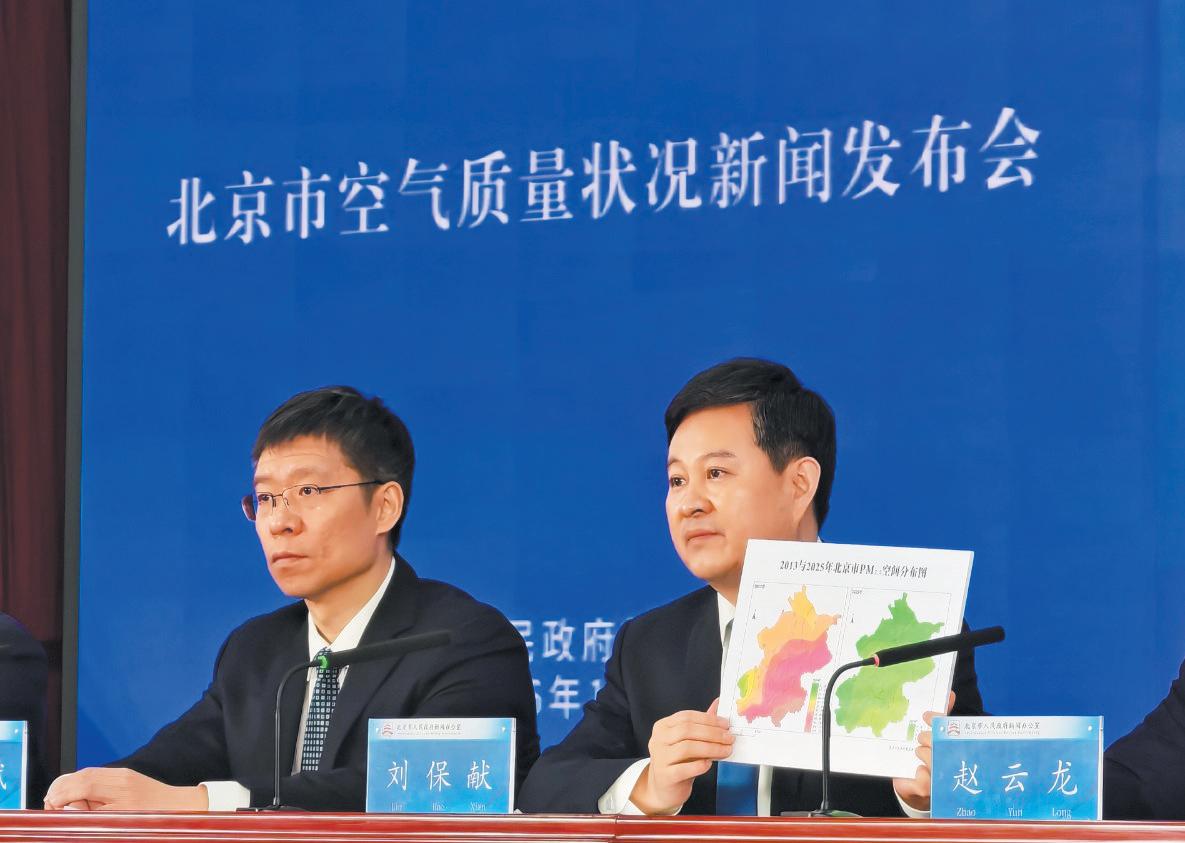
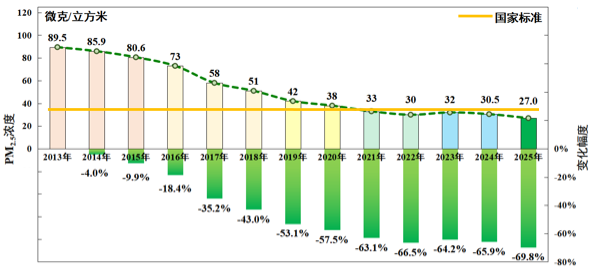
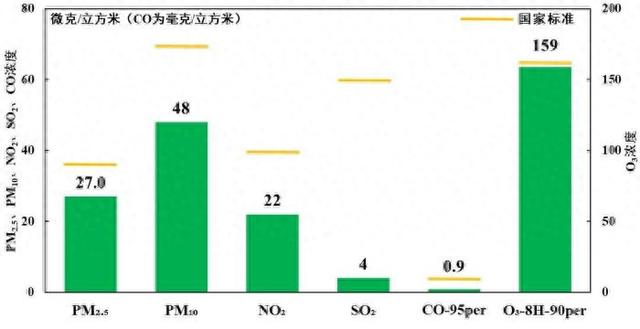
本文转自【北京晚报微信公众号】; 1月4日,北京市人民政府新闻办公室举行北京市空气质量状况新闻发布会。 北京市生态环境局介绍,2025年北京的空气质量再创佳绩,PM2.5年均浓度达到27.0微克/立方米,首次"破30";空气质量优良天比率首次超八成;重污染 日基本消除。 2013-2025年北京市PM2.5浓度及累计变幅 北京市PM2.5实现稳定达标。北京市开展大气污染防治以来,PM2.5保持长期改善趋势,从2013年的89.5微克/立方米,降至2025年的27.0微克/立方米,降 幅达69.8%。其中,"十四五"时期,北京市PM2.5年均浓度连续五年达到国家标准并屡创新低,在2021年首次达到国家标准后,2025年较2020年再降三 成。经过多年努力,北京市PM2.5已经实现稳定达标。 主要污染物大幅改善。与2013年相比,2025年北京市主要污染物PM2.5、PM10、NO2、SO2年均浓度分别下降69.8%、55.6%、60.7%、84.9%,空气质量 显著改善。重污染日由2013年的58天,大幅减少至2025年的1天,降幅高达98.3%,重污染日基本消除。 2013-2025年北京市主要污染物浓度及降 ...
北京重污染日基本消除
Jing Ji Guan Cha Bao· 2026-01-04 03:39
Core Viewpoint - Beijing aims to achieve significant improvements in air quality by 2025, with PM2.5 annual average concentration reaching 27.0 micrograms per cubic meter, marking a breakthrough below 30 [1] Group 1: Air Quality Improvement Goals - By 2025, the proportion of days with good air quality in Beijing is expected to exceed 80% for the first time [1] - Heavy pollution days are projected to be virtually eliminated [1] Group 2: Historical PM2.5 Trends - Since the initiation of air pollution control measures, Beijing has seen a long-term improvement in PM2.5 levels, decreasing from 89.5 micrograms per cubic meter in 2013 to 27.0 micrograms per cubic meter by 2025, a reduction of 69.8% [1] - During the 14th Five-Year Plan period, Beijing's PM2.5 annual average concentration has consistently met national standards and set new lows, achieving compliance for five consecutive years [1] - After first meeting national standards in 2021, the PM2.5 level is expected to decrease by an additional 30% by 2025 compared to 2020 levels [1]
2025年北京PM2.5年均浓度首次“破30” 蓝天成常态
Xin Lang Cai Jing· 2026-01-04 03:30
Core Insights - Beijing's PM2.5 annual average concentration reached 27.0 micrograms per cubic meter in 2025, marking a significant milestone as it is the first time it has fallen below 30 micrograms, representing an 11.5% year-on-year decrease [2][4] - The air quality in Beijing achieved comprehensive compliance with national standards, with all six major pollutants meeting the required levels [2][4] Group 1: Air Quality Improvement - The annual average concentrations of other major pollutants also improved, with PM10 at 48 micrograms, NO2 at 22 micrograms, and O3 at 159 micrograms, showing year-on-year decreases of 11.1%, 8.3%, and 7.0% respectively [2] - Sulfur dioxide (SO2) and carbon monoxide (CO) concentrations remained extremely low at 4 micrograms per cubic meter and 0.9 milligrams per cubic meter [2] Group 2: Days of Good Air Quality - The number of days with good air quality reached 311 in 2025, an increase of 21 days compared to the previous year, resulting in a good air quality rate of 85.2%, the highest since monitoring began [4] - The number of heavy pollution days decreased to just 1 day in 2025, down from 58 days in 2013, reflecting a 98.3% reduction [8] Group 3: Long-term Trends - Since 2013, PM2.5 levels have shown a long-term improvement, decreasing from 89.5 micrograms per cubic meter to 27.0 micrograms per cubic meter, a reduction of 69.8% [6][8] - During the "14th Five-Year Plan" period, PM2.5 levels have consistently met national standards for five consecutive years, with a further 30% reduction from 2020 to 2025 [6]
有监测以来最多 北京2025年全年95.3%都是蓝天
Yang Shi Xin Wen· 2026-01-04 03:05
1月4日,北京市人民政府新闻办公室举行北京市空气质量状况新闻发布会。北京市生态环境局介绍, 2025年北京的空气质量再创佳绩,PM2.5年均浓度达到27.0微克/立方米,首次"破30";空气质量优良天 比率首次超八成。 值得注意的是,与蓝天关系最密切的指标是PM2.5,2025年,PM2.5优良天数达348天,较2013年增加了 144天,多了近5个月,PM2.5优良天比率从55.9%提高到95.3%。尤其是2025年3月至10月,PM2.5连续 227天保持优良水平,好天持续了近8个月,远超2013年的13天,为有监测以来最多。 2025年,北京市空气质量优良天数为311天,同比增加21天,空气质量优良天比率达85.2%,首次超过 八成,为有监测以来最多;全年共出现重污染日1天,较上年减少1天,为有监测以来最少。 ...
2025年,北京空气质量优良天比率首次超八成,多项指标创有监测以来最优水平
Xin Jing Bao· 2026-01-04 02:50
2025年,北京市PM2.5年均浓度为27微克/立方米,同比下降11.5%,为有监测以来首次低于"30微克", 北京市大气污染治理取得里程碑式突破。其他主要污染物也进一步改善。其中,可吸入颗粒物 (PM10)、二氧化氮(NO2)和臭氧(O3)浓度分别为48微克/立方米、22微克/立方米、159微克/立方 米,同比下降11%、8.3%、7.0%;SO2、CO分别为4微克/立方米、0.9毫克/立方米,继续保持极低浓度 水平。六项污染物全部达到国家标准,空气质量实现全面达标。 1月4日,记者从北京市生态环境局获悉,2025年,北京交出了一张亮眼的"蓝天成绩单":细颗粒物 (PM2.5)年均浓度首次"破30",为27微克/立方米;空气质量优良天比率首次超八成,达到85.2%;多 项指标创有监测以来最优水平,空气质量实现全面达标。 新京报讯记者 张璐 编辑 白爽 校对 赵琳 ...
多地空气中度污染,专家分析:跟降雪增湿有一定关系
Ke Ji Ri Bao· 2025-12-22 01:32
12月18日16时,北京市实时空气质量为中度污染,首要污染物为细颗粒物(PM2.5)。本次空气污 染不仅出现在北京,我国东部地区出现了连片空气污染状况。中国环境科学研究院研究员胡京南说,14 日起,随着风力减弱,雪后近地面增湿且出现逆温,空气质量逐渐转差,京津冀及周边地区、长三角地 区北部、湖北省大部地区出现了空气污染过程,主要是PM2.5污染,目前部分地区已达到中至重度污染 水平。 今年秋冬季以来,京津冀及周边地区已出现多次空气污染过程。国家城市环境污染控制技术研究中 心研究员彭应登说,这说明我国空气质量改善还处在"爬坡"阶段,从量变到质变的拐点还没有到来。 重点行业和柴油车排放是PM2.5污染主因 本次污染过程出现的主要原因是什么?专家认为,高湿大雾、贴地逆温等不利气象条件叠加污染高 排放,导致污染物持续累积和转化,加重PM2.5污染程度。 中央气象台首席预报员安林昌说,18日,我国华北中南部、江淮西部、江汉、四川盆地等地的部分 地区出现大雾天气。北京南部、河北中南部、河南南部、安徽中部、湖北东部等部分地区出现能见度低 于500米的浓雾,局地能见度不足200米。 大气静稳、高湿状态不仅容易产生大雾,也不利 ...
最高温5℃!河南将有大范围雨雪
Xin Lang Cai Jing· 2025-12-22 00:51
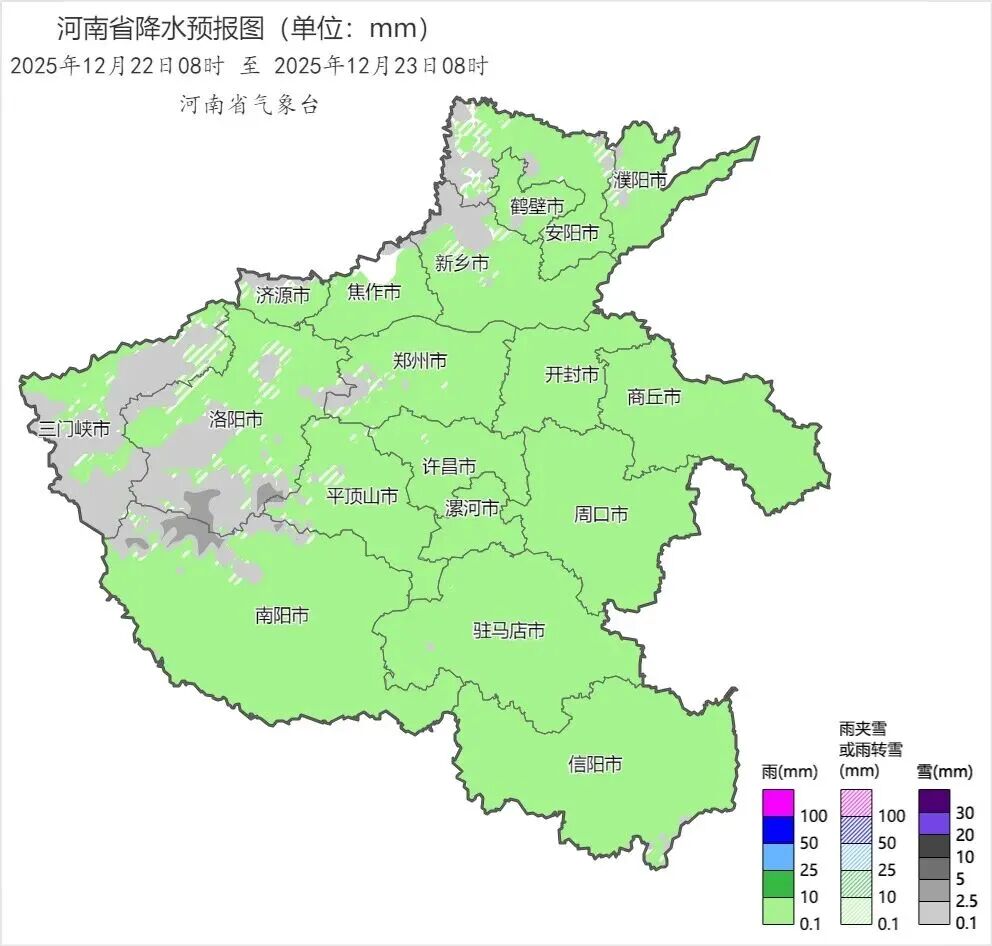
本文转自【河南日报】; 刚度过1961年以来历史同期第二暖的大雪节气,河南在今日(12月22日)迎来了气温的低点。受冷空气和暖湿气流共同影响,全省大部分地区最高气温将 不足5℃,体感从前期的偏暖转为寒冷。 今天的降水分布呈现西雪东雨的态势。中西部、西北部部分县市有雨夹雪或小雪,其他县市则以小雨为主。这场雨雪对改善空气质量有直接作用。此前受 偏东风输送影响,驻马店等地出现的重污染霾天气,以及南阳、光山等地的强浓雾,将随着今日的降水自北向南逐渐消散。 本周的寒冷将主要体现在最低气温上。除南部地区外,全省大部最低气温将持续处于0℃以下。特别是本周三、周四(24日、25日),北部、中东部、西 部的最低气温将降至-5℃以下。从长期监测看,尽管冷空气活动频繁,但受高空脊区控制,今年"一九"期间我国大部气温仍将处于总体偏暖的状态。 "晚来天欲雪,能饮一杯无?"白居易诗中的意境与今日河南多地的景象颇为契合。虽然今年大雪节气期间河南平均气温异常偏高,但"一九"第二天的这场 实打实的降温仍提醒大家及时增加衣物,防止寒气侵袭。 接下来的天气趋势节奏极快。明天(23日,周二),全省大部降水结束,仅东南部有零星小雨并逐渐停止。气温将出 ...