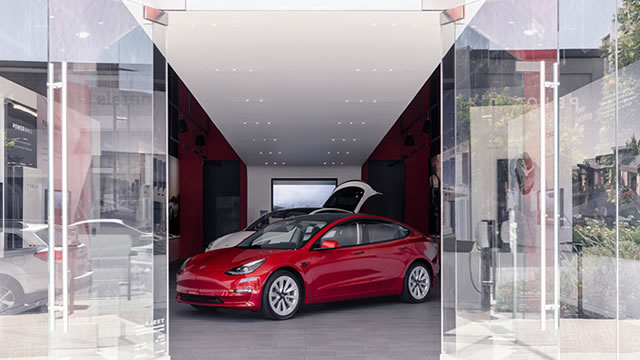
Autonomous Driving

Search documents
Rivian’s Autonomy & AI Day Failed to Move the Needle for RIVN Stock. How Should You Play It Here?
Yahoo Finance· 2025-12-11 20:47
Once positioned to be a “killer” in the electric vehicle industry, Rivian (RIVN), has been lagging the likes of Tesla (TSLA) and Google’s (GOOG) (GOOGL) Waymo both in terms of adoption and sales. Moreover, the company’s stock is down more than 80% from its IPO levels in 2021. For context, Tesla’s stock has more than doubled in this period. But Tesla has its hands full in other domains like artificial intelligence, and it seems like Rivian is making a strategic bet to drive future growth from AI as well. ...

Rivian CEO RJ Scaringe on new AI tech, autonomous driving and more
CNBC Television· 2025-12-11 19:17
Autonomous Driving Technology & Strategy - Rivian is developing its own chip for autonomous driving (AV) and artificial intelligence, a multi-year process requiring significant capital and a capable team [2][3][4] - The decision to vertically control hardware at the chip level aims to build a more efficient system and achieve higher performance at an affordable cost [4] - Rivian is focusing R&D spending on self-driving/autonomy, considering it the biggest spend category [7] - Rivian is demonstrating point-to-point full self-driving capability as a first step, with plans for future growth [8] - Rivian is aiming for level four autonomy, which would allow vehicles to drive empty without a driver [11][13] - Rivian is initially focused on personal level four vehicles, given that 99% of miles driven in the United States are in personally owned vehicles, but is open to exploring ride-sharing applications [11][12] Vehicle Development & Market Positioning - Rivian is launching the R2, a lower-priced vehicle starting at $45,000 [8] - Rivian emphasizes the importance of leading technology in lower-priced vehicles like R2 and R3 [9] - The R1S is the most popular premium electric vehicle in the United States due to its technology, brand positioning, and product features [9] Market Perception & Financial Considerations - Morgan Stanley questions Rivian's ability to keep up with the hype cycle regarding autonomous vehicles and whether it has sufficient capital for continued investments [5] - Rivian focuses on the long-term horizon, building technology for high levels of self-driving, including the hardware platform, data architecture, and data flywheel [6][7]

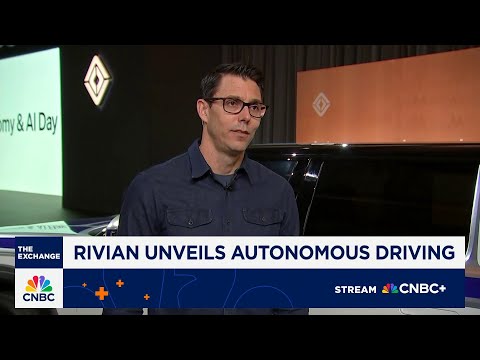
Rivian CEO RJ Scaringe on new AI tech, autonomous driving and more
Youtube· 2025-12-11 19:17
Core Insights - Rivian is unveiling its autonomous driving system and launching its own chip during its AI day in Palo Alto, indicating a strategic shift towards vertical integration in technology development [1][4][10] Company Strategy - The decision to design its own chip for autonomous vehicles (AV) and artificial intelligence (AI) is driven by the need for efficiency and performance, allowing Rivian to control hardware at the compute level [3][4] - Rivian emphasizes long-term investment in self-driving technology, with a significant portion of its R&D budget allocated to autonomy, showcasing confidence in its technological advancements [6][7] Product Development - The new R2 vehicle, starting at $45,000, represents Rivian's focus on lower-priced vehicles while maintaining a commitment to leading technology [8][9] - Rivian's current technology demonstrates point-to-point full self-driving capabilities, with plans for further advancements over time [7][8] Market Positioning - Rivian acknowledges skepticism regarding its ability to keep pace with the autonomous vehicle hype cycle, but maintains a long-term perspective on market movements [5][6] - The company is currently focused on personal level four autonomy, which could eventually extend to ride-sharing opportunities, although initial efforts will prioritize personal vehicle technology [11][12]
Morgan Stanley Just Broke Up with Tesla: Should You Buy or Sell TSLA Stock Here?
Yahoo Finance· 2025-12-11 19:04
Core Viewpoint - Morgan Stanley has downgraded Tesla's stock from "Overweight" to "Equal-Weight" while raising its target price to $425 from $410, marking the first downgrade in two years [1][2] Group 1: Downgrade Context - The downgrade was made by Andrew Percoco, who has taken over coverage from Adam Jonas, a long-time Tesla bull [2] - The decision reflects concerns about Tesla's automotive business, with expected cumulative volume growth projected to be 18.5% lower through 2040 due to slower adoption in the U.S. and increased competition globally [4] Group 2: Competitive Landscape - The competition from Chinese EV manufacturers is intensifying, with potential to significantly impact Tesla's U.S. sales if tariffs on imports from China were not in place [4] - The U.S. EV industry is anticipated to experience a more prolonged slump than previously suggested by Elon Musk [4] Group 3: Non-Automotive Business Concerns - Percoco believes that Tesla's non-automotive initiatives, such as autonomous driving and the Optimus humanoid robot, are already priced into the stock [5] - Execution risks are highlighted, as Tesla has not achieved significant success since the Model Y, and the Cybertruck has not gained market traction [5] Group 4: Self-Driving Technology Challenges - Tesla's camera-only approach to self-driving offers cost advantages over competitors like Waymo, but the company must demonstrate a high level of safety to gain regulatory trust, especially in adverse weather conditions [6] - Tesla's full self-driving (FSD) software has faced challenges in extreme weather, raising concerns about its reliability [6]


Rivian Automotive (NasdaqGS:RIVN) Investor Day Transcript
2025-12-11 18:02
Rivian Automotive Investor Day Summary Company Overview - **Company**: Rivian Automotive (NasdaqGS:RIVN) - **Event**: Investor Day held on December 11, 2025 Key Industry Insights - **Technology Inflection Point**: The automotive industry is experiencing a significant shift due to advancements in artificial intelligence (AI) and autonomy, making AI as essential as utilities like water and electricity [2][3] - **Autonomous Driving**: The focus on autonomous driving is highlighted as a transformative aspect of vehicle ownership, changing how consumers interact with their vehicles [4][9] Core Technological Developments - **AI Integration**: Rivian is leveraging AI across its vehicles and business operations, enhancing customer experiences and operational efficiency [11][21] - **Gen 2 and Gen 3 Platforms**: The introduction of Gen 2 vehicles with a 10x improvement in inference capabilities over Gen 1, and the upcoming Gen 3 platform featuring 65 megapixels of cameras and advanced sensors [14][16] - **Data Flywheel**: Rivian's approach to autonomy is built on a data flywheel model, where data collected from vehicles continuously improves the AI models, enhancing driving capabilities [15][46] Autonomy Features - **Hands-Free Driving**: An over-the-air update will expand hands-free driving capabilities from 150,000 miles to over 3.5 million miles of roads in North America [18][63] - **Future Capabilities**: Plans for point-to-point driving and "Eyes-off" features, allowing users to disengage from actively driving [20][63] Hardware Innovations - **Vertical Integration**: Rivian emphasizes vertical integration in its hardware development, including in-house silicon and autonomy systems [23][31] - **RAP1 Chip**: The Rivian Autonomy Processor (RAP1) is designed for high performance in AI applications, achieving 800 TOPS (trillion operations per second) [34][44] - **Sensor Suite**: The R2 platform will feature a multi-modal sensor strategy, including cameras, radars, and lidar, to enhance perception and safety [25][26] Software and AI Enhancements - **Rivian Unified Intelligence**: A comprehensive AI platform that integrates various systems within Rivian's operations, enhancing diagnostics, service, and customer interactions [65][67] - **Rivian Assistant**: An AI-driven assistant that integrates with user calendars and vehicle systems, improving user experience and operational efficiency [68][70] Market Position and Future Outlook - **Competitive Edge**: Rivian's focus on in-house development and AI integration positions it as a leader in the electric vehicle market, particularly in autonomy [12][21] - **Growth Potential**: The expansion of the vehicle fleet and adoption of new features are expected to enhance Rivian's data capabilities, driving further improvements in autonomy and customer experience [64][63] Conclusion Rivian Automotive is at the forefront of integrating AI and autonomy into its vehicles, with significant advancements in hardware and software that promise to reshape the driving experience. The company's commitment to vertical integration and a robust data-driven approach positions it well for future growth in the electric vehicle market.
Rivian Unveils Plans For Autonomous Driving
Bloomberg Television· 2025-12-11 17:32
RJ Rivian finally has an AI story. I actually would like to stop asking why now. You're ready to talk a bit more about where Rivian feels its A.I. competencies are. Yes.So Rivian launched the first vehicles and end of 2021, and almost immediately following that, we began the process of designing the clean sheet approach to how we were to integrate across the business sets on the autonomy platform, and that's the background level of the vehicle and of course, with the enterprise. And in doing that, we redefi ...

Rivian Unveils Plans For Autonomous Driving
Youtube· 2025-12-11 17:32
Core Insights - Rivian is advancing its autonomous vehicle technology with a focus on in-house developed hardware and software, aiming for significant improvements in vehicle autonomy capabilities [2][4][36] Group 1: Vehicle Development and Technology - Rivian launched its first vehicles at the end of 2021 and has since been designing an autonomy platform that integrates across business sets [2] - The Gen two fleet represents a tenfold improvement in compute capabilities, enhancing the camera platform and establishing a data flywheel for training [2][3] - The upcoming Gen three architecture will feature an in-house processor, improved camera systems, and LiDAR integration, significantly enhancing compute capabilities [4][10] Group 2: Autonomous Features and Updates - Rivian plans to expand hands-free driving capabilities from 150,000 miles to over 3.5 million miles in North America through an over-the-air update [8] - By 2026, Rivian aims to introduce point-to-point navigation, allowing vehicles to drive autonomously to specified addresses with supervision [9] - Future developments include "Eyes Off" driving capabilities on highways by 2027, leading to personal level four autonomy where vehicles can operate without anyone in the driver's seat [12][13] Group 3: Cost Management and Economic Strategy - The cost of LiDAR sensors has significantly decreased, making them a smaller percentage of vehicle production costs, while in-house custom silicon is expected to provide cost savings and performance improvements [21][22] - Rivian's strategy involves vertically integrating its software and electronics to enhance product differentiation and reduce costs, which is essential for scaling production beyond 50,000 vehicles annually [34][36] - The company has established a strong relationship with TSMC to support its semiconductor needs, which is crucial for its high-volume product strategy [30][22] Group 4: Market Position and Future Outlook - Rivian's self-driving technology is distinct from its joint ventures, focusing on proprietary capabilities that may eventually be licensed to other OEMs [37][39] - The pricing strategy for Rivian's autonomy features is competitive, with options for subscription or upfront payment, reflecting the company's commitment to R&D in self-driving technology [40][43] - Rivian's focus on self-driving technology is central to its business model, with significant investments aimed at building a robust infrastructure for future growth [44][45]
Here are 4 ways Rivian just stepped deeper into Tesla's turf
Business Insider· 2025-12-11 17:20
Core Insights - Rivian is intensifying its focus on autonomous driving, unveiling a roadmap for developing self-driving capabilities for its upcoming R2 vehicle, Rivian's most affordable model to date [1][4] Group 1: Autonomous Driving Development - Rivian plans to introduce a new in-house silicon chip to power its next-generation autonomous driving hardware, expected to ship with the R2 by the end of 2026 [2][5] - The company aims to achieve Level 4 autonomy, similar to Alphabet's Waymo, where driver supervision is not required [8][10] - Rivian's "Gen 3 Autonomy" hardware is currently under validation and is set to be integrated into the R2 vehicle [7] Group 2: Competitive Landscape - Rivian's announcement heightens competition with Tesla, as both companies aim for fully autonomous driving and software licensing opportunities [4] - Rivian's partnership with Volkswagen is a strategic move towards its licensing ambitions, contrasting with Tesla's reluctance to license its Full Self-Driving (FSD) technology [4] Group 3: Technology and Features - Rivian plans to incorporate lidar technology into the R2 vehicle, which is positioned above the windshield, enhancing safety and redundancy in self-driving capabilities [10] - The company will update its advanced driver assistance system (ADAS) to include hands-free assisted driving, operational on over 3.5 million miles of roads in the USA and Canada [11] Group 4: Subscription Model and AI Integration - Rivian is adopting a subscription model for its autonomous driving software, named "Autonomy+," priced at $49.99 per month or $2,500 for a one-time purchase, launching in early 2026 [12][13] - An AI voice assistant, "Rivian Assistant," will be introduced, allowing drivers to control vehicle features through voice commands and integrate with third-party apps like Google Calendar [14][15]
Rivian goes big on autonomy, with custom silicon, lidar, and a hint at robotaxis
TechCrunch· 2025-12-11 17:20
Core Insights - Rivian is advancing its electric vehicles towards greater autonomy, incorporating new hardware such as lidar and custom silicon, with aspirations to enter the self-driving ride-hail market [1][2] Technology Development - The company's first "Autonomy & AI Day" event revealed its technology advancements, aiming to produce the more affordable R2 SUV by the first half of 2026 [2] - Rivian plans to expand its hands-free driver-assistance software to over 3.5 million miles of roads in the USA and Canada, with a feature called "Universal Hands-Free" launching in early 2026 [3] Driver Assistance Features - The point-to-point navigation feature allows users to input a destination, enabling the vehicle to drive autonomously [4] - Future enhancements will allow drivers to take their eyes off the road, with plans to achieve "personal L4" autonomy, meaning no human intervention is required in specific areas [4] Market Competition - Rivian aims to compete with companies like Waymo, initially focusing on personally owned vehicles while also exploring opportunities in the rideshare market [5] Hardware Innovations - The company is developing a "large driving model" and a custom 5nm processor in collaboration with Arm and TSMC, moving away from Tesla's rules-based framework for autonomous vehicle development [7] - The new "autonomy computer" (ACM3) can process 5 billion pixels per second and will be featured in the upcoming R2 SUV [8][9] - The ACM3 will be paired with a lidar sensor to enhance real-time detection and spatial data processing, contributing to the vehicle's autonomy capabilities [9]
3 Things That Need to Happen for Tesla To Double From Here
247Wallst· 2025-12-11 16:37
Core Perspective - Tesla is viewed as a polarizing growth stock, with strong opinions on both sides regarding its future potential and valuation [1][2] Growth in Core Business - Tesla's electric vehicle (EV) sales are the primary source of revenue, and profitability is significantly driven by selling tax credits associated with this core business [3] - For Tesla to double its valuation, it must improve core fundamentals, which includes selling more EVs at higher margins to a wider consumer base [4][5] Interest Rates and Cost Factors - Lower interest rates would be beneficial for Tesla, as they would lead to lower auto loan rates, enhancing vehicle sales [4] - A reduction in input costs and a shift in insurance rates would also support profitability [4] Robotaxi Monetization - The rollout of Tesla's robotaxi fleet is crucial for generating high-margin revenue, especially as growth in the core EV business may slow [6][9] - If Tesla can outperform competitors in autonomous driving, it could capture significant market share, positively impacting stock performance [7] Other Core Businesses - Tesla's energy business has shown strong momentum, with storage deployments increasing over 80% year-over-year, and analysts expect revenue to double next year [11] - The success of Tesla's AI and robotics initiatives, particularly the Optimus project, could drive sentiment and growth, although it may take time to become a profitable venture [12]