Inflation

Search documents
Vanguard's $64.6 Billion Bet on Short Term TIPS Faces a Goldilocks Inflation Problem
247Wallst· 2026-02-09 15:05
Group 1 - The Vanguard Short-Term Inflation-Protected Securities Index Fund ETF (VTIP) has grown to $64.6 billion, making it one of the largest TIPS funds, providing a 5.4% return over the past year amid persistent inflation concerns and a shift towards Fed accommodation [1] - VTIP's value is closely tied to inflation expectations, with the CPI showing a year-over-year increase of 1.96% as of December 2025, aligning with the Fed's 2% target, creating a stable environment for TIPS [2][3] - The recent easing cycle by the Fed has reduced the federal funds rate to 3.75%, compressing nominal Treasury yields and enhancing TIPS valuations by making their inflation protection feature more attractive [3] Group 2 - The key factor to monitor is whether inflation reaccelerates or continues to moderate, as higher CPI trends would increase the value of VTIP's principal adjustments [4] - VTIP's focus on TIPS maturing within five years limits interest rate risk, making it less sensitive to rate swings compared to longer-dated TIPS funds, with a competitive 1.45% dividend yield [5] - The tradeoff for VTIP's short duration is lower potential for capital appreciation during inflation surges, but it also mitigates losses if rates rise unexpectedly [6] Group 3 - The most significant macro factor affecting VTIP is inflation trends relative to the Fed's 2% target, while the short duration of VTIP limits both risk and reward in a stabilizing rate environment [7]


Key Events This Week: Payrolls, CPI And Retail Sales
ZeroHedge· 2026-02-09 14:55
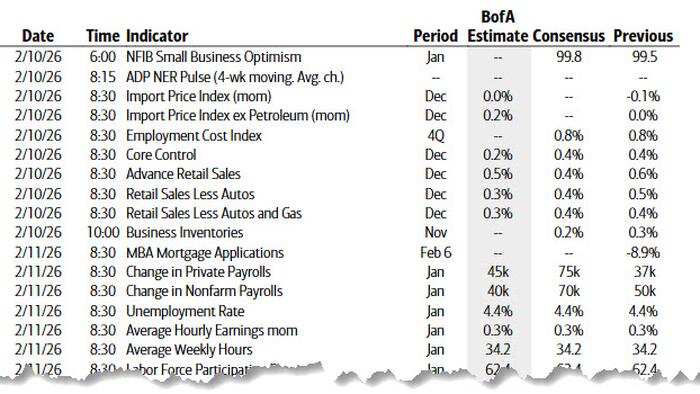
Economic Data Releases - The upcoming week will feature significant US economic data releases, including the January employment report and the January CPI report, which are typically not released in the same week [1] - December retail sales and the Q4 employment cost index will also be released, alongside global inflation updates from China and several European economies [1] Employment Report Expectations - DB economists project a rise in headline and private payrolls by 75k, with the unemployment rate expected to remain at 4.4% [2] - Average hourly earnings are anticipated to increase by 0.3%, with hours worked remaining unchanged at 34.2, leading to a year-over-year growth rate of payroll-based nominal compensation rising to 4.5% from 4.3% [2] Inflation Report Expectations - The headline CPI is expected to increase by 0.26%, influenced by a projected 2.4% drop in motor fuel prices, while core CPI is anticipated to rise by 0.35% [4] - This would result in a year-over-year headline CPI slowing to 2.46% from 2.68%, and core CPI to approximately 2.55% [4] Corporate Earnings - Corporate earnings reports are ongoing, with six of the Magnificent Seven having reported, which may reduce volatility until Nvidia's report on February 25th [1] - The week will also see earnings from major tech companies and consumer firms, including Cisco, Coca-Cola, and McDonald's [8] Fed Communications - Fed officials will be actively communicating throughout the week, discussing regulatory topics and the balance sheet outlook, particularly in light of the nomination of Kevin Warsh for Fed Chair [6] - Discussions will include perspectives on the labor market and inflation, with various Fed governors scheduled to speak [6][20] Global Economic Indicators - In Europe, key indicators include the UK's Q4 GDP and CPI reports from Denmark, Norway, and Switzerland [7] - In Asia, China's January inflation report is due, with forecasts indicating a slowdown in CPI inflation to 0.4% year-over-year [8]
US stocks open in the red: Dow down over 100 points, Nasdaq slips 0.4%
Invezz· 2026-02-09 14:48
The recovery on Friday came after a sharp sell-off driven largely by weakness in technology shares, particularly software stocks. During that period, risk appetite had deteriorated, with Bitcoin also plunging before recovering some of its losses as markets stabilised. US equities traded lower on Monday as investors turned cautious ahead of a series of closely watched economic releases and another round of corporate earnings, following a volatile week that ended with the Dow Jones Industrial Average reaching ...



What Markets Expect From Takaichi: Amova's Fink
Youtube· 2026-02-09 14:22
Group 1 - The Japanese yen is experiencing some downside, but the situation is not catastrophic at this moment, especially concerning the Takaichi trade [1] - Takaichi's electoral victory provides her with political capital to engage with markets, including stock, bond, and foreign exchange markets [2] - There is a need for long-term fiscal responsibility in Japan, as the government aims to avoid issuing new bonds while suspending food taxes for two years [3] Group 2 - Japan is facing cost of living pressures, and while reducing taxes may seem straightforward, inflation complicates the situation, making it the central bank's responsibility to address it [4] - The independence of the Bank of Japan (BoJ) from political influence is questioned, especially given its past alignment with government policies [5] - The BoJ's mandate focuses on price stability, and its past actions under the Abe administration were appropriate for a deflationary economy, but the current inflationary context requires a different policy approach [6][7]

Suze Orman’s Exact Roadmap for a Financially Successful 2026
Yahoo Finance· 2026-02-09 13:55
Core Insights - Suze Orman provides a financial roadmap for 2026, emphasizing the importance of staying invested in the stock market despite potential short-term fluctuations [2] Market Expectations - The stock market is expected to continue its upward trend, with occasional downward spikes lasting from a week to a month [2] - Interest rates are anticipated to decline slowly as the Federal Reserve aims to stimulate borrowing, spending, and hiring, which may also lead to a gradual decrease in mortgage rates [3] - Inflation is expected to increase costs across the board, primarily due to tariffs, while Bitcoin is projected to rise significantly over the long term despite its volatility [4] Recommended Actions - Regular investment is advised to leverage dollar-cost averaging, which helps mitigate market volatility [6] - Cutting expenses is crucial to prevent inflation from eroding savings, and maintaining an emergency fund of 8 to 12 months of expenses is recommended due to potential layoffs [8] - Downsizing may be beneficial to reduce expenses and free up cash [8] - Investors should remain in the market if they have at least five years before needing the funds and diversify their portfolios with high-quality mutual funds, ETFs, or stocks [8] Retirement Planning - Investing in Roth retirement accounts is recommended, with a focus on converting pre-tax accounts to Roths over time to minimize tax burdens [9] - Delaying Social Security benefits until age 70 is advised, or at least until reaching full retirement age [9] - Maximizing contributions to retirement accounts is essential, particularly to take full advantage of company matches [10] - Older individuals should consider long-term insurance to protect savings in case of nursing home needs [10] - Essential legal documents such as wills and trusts should be created to ensure wishes are honored [10]
Suze Orman Says $2M Is 'Pennies' Today and That You'll Likely Need $10M to Retire Without Touching Principal Or 'Burn Up Alive'
Yahoo Finance· 2026-02-09 13:31
Core Viewpoint - Personal finance expert Suze Orman asserts that $2 million is insufficient for financial security in today's economic climate, emphasizing the need for a significantly larger safety net, potentially up to $10 million [1][2][3]. Financial Security Perspective - Orman argues that merely accumulating $2 million does not guarantee financial safety, especially in the event of unforeseen circumstances such as health crises or economic downturns [2][3]. - She highlights the importance of considering various expenses, including healthcare, taxes, and inflation, which are often overlooked in retirement planning [3][4]. Required Wealth for Stability - According to Orman, individuals should aim for at least $5 million to $10 million to ensure a livable income without depleting principal, particularly to cover high costs like full-time care [4]. - She provides a specific example, stating that to maintain an after-tax yield of $300,000 per year, a portfolio of $2 million would not suffice unless high-risk investments are pursued, which she does not recommend [4]. Inflation Impact - The purchasing power of $2 million has significantly decreased since 2018 due to inflation, indicating that approximately $2.6 million would be needed today to achieve the same financial security [5].
Silver price prediction futures: Could silver price surge to $200 in 2026? Here’s what would have to happen
The Economic Times· 2026-02-09 13:29
Core Insights - Silver prices surged to an all-time high of $121 per ounce in early January 2026, driven by macroeconomic anxiety, Federal Reserve uncertainty, and strong retail investor participation [1] - A dramatic crash occurred on January 30, 2026, with silver prices plummeting over 30% in a single day, marking one of the worst declines in modern market history [2][25] - Despite the crash, silver remains one of the top-performing major assets of 2026, up more than 12% year-to-date compared to a 2% gain in the S&P 500 [3][27] Price Dynamics - For silver to reach $200 per ounce in 2026, it would need to more than double from its February valuation of $88, which is historically rare but not unprecedented [4][15] - The immediate trigger for the price collapse was political and monetary, specifically the announcement of Kevin Warsh as the next Federal Reserve chair, which led to a stronger U.S. dollar and reduced demand for safe-haven assets [5][7][25] - The crash was sentiment-driven rather than a collapse in physical market demand, as industrial demand indicators remained stable [11][12] Investment Landscape - Silver's unique position as both a safe-haven asset and an industrial metal supports its long-term pricing, with over 50% of global silver demand coming from industrial applications [13] - Retail investor interest surged, with increased trading activity in silver ETFs and mining stocks, indicating ongoing speculation [14] - The iShares Silver Trust (SLV) has outperformed most major asset classes in 2026, highlighting silver's diversification value, but it also reflects the downside risk associated with silver price volatility [20][21] Market Sentiment and Future Outlook - Silver's volatility reflects broader market dynamics characterized by fragile confidence and rapid narrative shifts, acting as a barometer of investor psychology [23][24] - Future silver price movements will depend less on mining output and more on confidence in economic leadership, inflation control, and institutional credibility [24] - Current fundamentals do not support sustained prices at the $200 level, and reaching such a price would likely require severe inflation fears or financial instability [26][30]

ICAEW sees slow path to further BoE rate cuts
Yahoo Finance· 2026-02-09 12:17
The Institute of Chartered Accountants in England and Wales (ICAEW) has said the Bank of England’s (BoE) decision to hold rates at 3.75% points to a slow route to lower borrowing costs, despite a more dovish inflation outlook. The central bank kept the rate unchanged after inflation rose to 3.4% in December. The Monetary Policy Committee backed the decision by a 5–4 margin. Four members supported a 0.25 percentage-point reduction, which would have taken the rate to 3.5%. The decision comes after the B ...
What Does Barbara Corcoran Predict for the Housing Market in 2026?
Yahoo Finance· 2026-02-09 12:01
Though 2026 has economists predicting more of a reset than a rebound for the housing market, real estate mogul, money expert and “Shark Tank” star Barbara Corcoran doesn’t think that should be a deterrent for those looking to buy a home. If you’re thinking about purchasing property right now, the current interest rates may have given you pause, but they are expected to take a modest dip in the new year. The average rate on a 30-year fixed mortgage is about 6.11% as of Feb. 5. That’s down more than a per ...
Gold News: Inflation and Jobs Data Could Decide Gold Market Direction This Week
FX Empire· 2026-02-09 11:30
Last week, XAUUSD settled at $4964.62, up $69.18 or +1.41%Technical Setup: Support TighteningThis week, the wide support zone comes in at $4744.34 to $4427.82, just like last week. However, the uptrend line from the $3886.46 main bottom, moving at a rate of $43.06 per week, comes in at $4532.39. This creates a relatively tight support cluster at $4532.39 to $4427.82. Relatively tight that is, given the current elevated volatility.Pattern, Price, and Time Still IntactMarkets follow three elements, in my opin ...