National Security

Search documents
Trump Won’t Seek Equity in Chipmakers Investing in US
Bloomberg Television· 2025-08-22 13:29
An official telling Bloomberg that the Trump administration will not seek equity stakes in chipmakers such as Micron and TSMC. If you were waiting for that because those chip makers are boosting their investments in the US, maybe Sheehy, a Bloomberg government, joins us now from Washington. To me it would seem like and I mnst write because this administration is going to want to invest in take equity stakes in American companies. Yeah, the administration has been very clear that they want to take on equity ...

Mike Pence urges #Trump to rethink Nvidia deal, equity stake in Intel #shorts #trump #nvidia #intel
Bloomberg Television· 2025-08-21 22:31
National Security Concerns - US government taking a position with a golden share in Nippon Steel or a percentage of Intel raises concerns [1] - Nvidia agreement is problematic due to existing export controls designed to protect national security [1] - Taking 15% of Nvidia's sales to China does not serve US national interest or security [2] Economic Philosophy - State-owned enterprise is not the American way; free enterprise is [2] - A free private sector with less taxes and less regulation has created the most prosperous economy [3] - Encourages a step back and a reevaluation of government involvement in private companies [2]


Trump admin’s ‘cruelty only matched by its incompetence’: Ex-CIA officer
MSNBC· 2025-08-21 15:20
Personnel Changes and Security Clearances - The Director of National Intelligence is cutting her office's staff by 40%, citing bloat and inefficiency [1] - Dozens of current and former national security officials had their security clearances revoked [1] - Critics allege the revocations are political retaliation from the President [2] Allegations and Rebuttals - The Director of National Intelligence claims those who had clearances revoked manipulated or leaked classified intelligence [3] - A former CIA officer denies the allegations, stating he had no access to classified information when he criticized the President [4][5] - The former CIA officer describes the revocations as an "indiscriminate drive by shooting" [2][5] Impact on Intelligence Community - The revocations send a chilling signal to those who might speak out against the administration [10] - There are concerns that these actions will discourage intelligence officials from speaking truth to power [11] - The administration is accused of weaponizing the federal government against those who speak up [14] National Security Implications - The government needs smart and dedicated people serving in a nonpartisan way [12] - The administration's actions are seen as dangerous for national security [14]

Sen. Chris Coons on China chip sales, U.S. government stake in Intel and Fed Gov. Lisa Cook
CNBC Television· 2025-08-21 13:14
group of Senate Democrats writing a letter to President Trump asking him to walk back his deal to sell chips to China, saying the following. The willingness displayed in this arrangement to negotiate away America's competitive edge that is key to our national security in exchange for what is in effect a commission on a sale of AI enabling technology to our main global competitor is cause for serious alarm. Joining us right now uh to sound that alarm, Delaware Senator Chris Coons, who signed that letter.Good ...
Will Widening Metal Tariffs Lead to Inflation?
Bloomberg Television· 2025-08-19 23:52
Economic Impact of Tariffs - Tariffs contribute to inflation, increasing costs for businesses and consumers [1] - Tariffs may reduce company profits and margins if costs are not fully passed on to consumers [2] - The U S government's tariff policies create governance problems domestically and internationally due to the use of emergency powers [2][3] Global Trade and U S Role - The U S government's approach shifts from being a global business insurer to an extractor, increasing premiums and reducing coverage [8][9][10] - Countries may seek alternative insurance or self-insure, leading to a weaker dollar and higher interest rates on U S treasuries [11][12] - U S allies may be more negatively affected by the U S government's policies than China [14] Policy Recommendations - The U S government should adopt an assumption, not sanction approach with China, attracting ideas, people, and investment away from China [15] - The U S government should avoid day-to-day pronouncements on specific stocks [4]
US Eyes Non-Governance Role in Intel
Bloomberg Technology· 2025-08-19 21:10
Government Intervention & National Security - The U S government is renegotiating its deal with Intel, moving towards an equity stake due to national security concerns [1][2] - The Department of Defense's involvement necessitates domestic manufacturing of chips for critical weapons systems like the F-35, making Intel's role crucial [2][3] - Government involvement extends to potentially influencing investment decisions and governance within Intel, even without explicit mandates [13] - The U S government is already involved with Nvidia by limiting their chip sales to China [12] Intel's Strategic Position - The renegotiated deal is considered a potential "life saver" for Intel, providing clarity after an uncertain period [1] - Intel previously lacked customers for its 14 architecture, but the Department of Defense is now a likely customer [4][5] - SoftBank may invest in Intel and line up ARM demand for those 14 chips [3] Market Dynamics & Competition - Nvidia has committed 500 billion dollars of investment in the US [6] - Nvidia holds a lead in AI chips, but there's a push for diversification, potentially involving Intel's help [7][8][9] - SoftBank's Masa has relationships with both Nvidia's CEO and aims to build a competing architecture, potentially collaborating with Intel [7]
Intel shareholders are popping the champagne, says Dan Ives
Bloomberg Television· 2025-08-19 19:15
Intel's Strategic Outlook - Strategic breakup of Intel was considered a likely outcome if the current intervention hadn't occurred [1] - The U S government's involvement is seen as an effort to revive Intel, driven by national security concerns [1] - A turnaround at Intel is considered a significant challenge, described as an "Everest like uphill climb" [5] - The company needs to change its operational approach, currently described as being run "like a motor vehicle" [6][15] - Despite potential government and SoftBank involvement, Intel has missed the artificial intelligence boom [13][14] Government Intervention & Investment - The U S government's direct equity investment in Intel is viewed as unorthodox and raises questions about potential unintended consequences [2][3][4] - The structure of the government's investment, including board representation, requires further clarification [9][10] - Bringing chip manufacturing back to the U S from Asia faces significant cost and intellectual property challenges, making it "almost an impossibility" in the short term [7] - The impact of government investment and supply chain shifts may take 4 to 5 years to materialize [7][8] Competitive Landscape - Intel has missed the window of opportunity in artificial intelligence and is unlikely to catch up to companies like Taiwan Semiconductor Manufacturing (TSMC) and Nvidia in chip design and contract chip making [13][14] - The recent earnings season validated the importance of artificial intelligence for tech companies [12] - Strong demand, potentially by a factor of 10 to 12, is expected to fuel a tech stock rally into the year end, despite potential geopolitical and Federal Reserve related risks [12][13]
X @The Economist
The Economist· 2025-08-19 17:50
An app that Congress considers to be a national-security risk helps to recruit soldiers https://t.co/oGnKCemmIN ...
Watch CNBC's full interview with U.S. Commerce Secretary Howard Lutnick
CNBC Television· 2025-08-19 14:15
Government Stake in Semiconductor Industry - The US government is considering taking an equity stake in Intel in exchange for CHIPS Act funding, moving away from grants [1][2][8] - The proposed equity stake is viewed as a way for American taxpayers to benefit from the investment in semiconductor manufacturing [2][8] - The potential stake could be around 10% of the company [2][3][4] - The government is considering non-voting rights with the equity stake [3] National Security and Semiconductor Manufacturing - National security concerns are driving the initiative to bring semiconductor manufacturing back to the US, reducing reliance on Taiwan [1] - The US aims to create its own domestic chip production capacity, including leading-edge chips [1] - The initiative involves deals with Japan and Korea to build semiconductor infrastructure and economic capacity in America [1][10][11] Trade and Investment - Japan has offered to reduce tariffs from 25% to 15% and provide a $550 billion investment fund [10][11] - Korea has offered an additional $350 billion investment [10][11] - The combined $900 billion from Japan and Korea will be used to improve infrastructure [10][11]
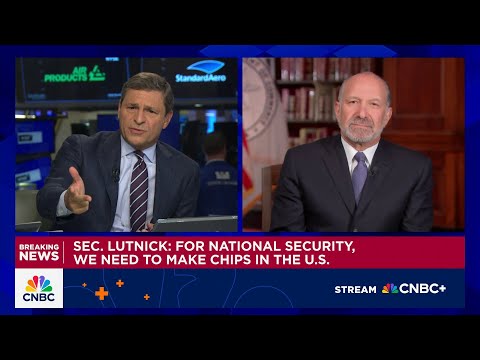
U.S. Commerce Secretary Howard Lutnick: Intel has to give gov. equity in return for CHIPS funding
CNBC Television· 2025-08-19 14:00
Government Stake & Investment - The government is considering taking an equity stake in Intel in exchange for chips act funding, a shift from the Biden administration's grant-based approach [1][2] - The proposed equity stake is viewed as a way for the American taxpayer to benefit from the investment in semiconductor manufacturing [1][8] - The potential equity stake under discussion is around 10% of the company [1] - The government aims to secure a good return for the American taxpayer by converting grants into equity [1] Semiconductor Industry & National Security - National security concerns necessitate domestic chip manufacturing to reduce reliance on Taiwan, located 9,500 miles away from the US and only 80 miles from China [1] - The initiative aims to build infrastructure and economic capacity in America for chip manufacturing, similar to deals with Japan and Korea [1] - The government desires to have an American company capable of manufacturing US transistors [1] Chips Act & Subsidies - The Chips Act is criticized as a giveaway to wealthy companies like TSMC, which has a trillion-dollar valuation [1] - The previous administration's approach of providing grants to companies is viewed as less beneficial to the American taxpayer compared to securing equity [8] - The government asserts that converting grants into equity is a smarter and more important approach for the American taxpayer [8] Governance & Control - The government clarifies that the equity stake would be non-voting, implying no direct governance control [3] - The golden share concept used with US Steel, involving 12 promises, is mentioned as a mechanism to ensure companies fulfill their commitments [4][5] - The golden share for US Steel ensures the company lives up to its 12 promises [4][5]