
零售转型

Search documents
锚定区域谋发展,郑州银行(002936.SZ/6196.HK)2025Q3以“稳”破局、以“优”提质
Ge Long Hui· 2025-11-06 01:05
Core Viewpoint - Zhengzhou Bank demonstrates robust operational performance amidst a moderately loose monetary policy and intensified industry competition, showcasing a dual focus on scale and quality in its development strategy [1] Group 1: Scale Growth and Risk Management - As of the end of Q3 2025, Zhengzhou Bank's total assets reached 743.55 billion yuan, a year-on-year increase of 9.93%, with an asset increment of 67.19 billion yuan, which is 1.87 times that of the same period last year [2] - The bank's total deposits reached 459.52 billion yuan, a year-on-year growth of 13.59%, with an increment of nearly 55 billion yuan [2] - The total amount of loans and advances reached 406.72 billion yuan, a year-on-year increase of 4.91%, with a focus on key economic sectors [2] - The bank's non-performing loan ratio decreased by 0.1 percentage points to 1.76%, while the provision coverage ratio increased by 19.94 percentage points to 186.17%, indicating improved asset quality [4] Group 2: Revenue Structure Optimization and Retail Transformation - The bank achieved an operating income of 9.395 billion yuan and a net profit attributable to shareholders of 2.279 billion yuan, representing year-on-year growth of 3.91% and 1.56%, respectively [5] - Net interest income increased by 5.83% to 7.816 billion yuan, while non-interest income reached 1.579 billion yuan, reflecting a shift towards a more diversified revenue model [5] - Personal loan balances reached 96.31 billion yuan, a year-on-year increase of 5.88%, while personal deposits surged by 22.44% to 267.14 billion yuan, indicating growing trust from local residents [5] Group 3: Ecosystem Development and Future Outlook - The bank's "Four Major Steward" ecosystem enhances customer engagement through various services, aligning with the industry's trend towards customer-centric development [6] - The bank's strategy of "stabilizing scale, optimizing structure, and strengthening risk control" forms a clear development trajectory, contributing to high-quality growth [7] - With the upcoming "14th Five-Year Plan," the bank aims to leverage regional economic growth and enhance its digital service capabilities to inject stronger financial momentum into local economic development [7]
锚定区域谋发展,郑州银行2025Q3以“稳”破局、以“优”提质
Ge Long Hui· 2025-11-06 01:02
Core Viewpoint - Zhengzhou Bank demonstrates robust operational performance amidst a moderately loose monetary policy and intensified industry competition, showcasing a dual focus on scale and quality in its development strategy [1] Group 1: Asset Growth and Risk Control - As of the end of Q3 2025, Zhengzhou Bank's total assets reached 743.55 billion yuan, a year-on-year increase of 9.93%, with an asset increment of 67.19 billion yuan, which is 1.87 times that of the same period last year [1] - The bank's total deposits reached 459.52 billion yuan, reflecting a year-on-year growth of 13.59%, with an increment of nearly 55 billion yuan [1] - The total loans and advances amounted to 406.72 billion yuan, a growth of 4.91% compared to the end of the previous year, indicating a targeted allocation of credit resources to key economic sectors [1] Group 2: Structural Optimization and Retail Transformation - In the first three quarters, Zhengzhou Bank achieved an operating income of 9.395 billion yuan and a net profit attributable to shareholders of 2.279 billion yuan, representing year-on-year growth of 3.91% and 1.56% respectively [5] - Net interest income increased by 5.83% to 7.816 billion yuan, while non-interest income reached 1.579 billion yuan, indicating a diversification of income sources [5] - Personal loan balances grew by 5.88% to 96.306 billion yuan, and personal deposits surged by 22.44% to 267.143 billion yuan, reflecting increased trust from local residents [5] Group 3: Ecosystem Development and Service Enhancement - The bank has established a "Four Major Steward" ecosystem, enhancing customer engagement through various services such as healthcare and social security integration, targeted support for small and micro enterprises, customized asset management, and financial services in rural areas [6] - This comprehensive service network aligns with the banking industry's trend towards customer-centric development, transforming retail operations from product sales to integrated service experiences [6] Group 4: Conclusion - Zhengzhou Bank's growth strategy is characterized by a clear trajectory of "stable scale, optimized structure, and strengthened risk control," forming a "iron triangle" for high-quality development [7] - The bank aims to leverage the economic development benefits of the Henan region while enhancing its digital service capabilities and financial operations to contribute to regional economic growth [7]
National Vision(EYE) - 2025 Q3 - Earnings Call Transcript
2025-11-05 14:30
Financial Data and Key Metrics Changes - Net revenue increased by 7.9%, driven by adjusted comparable store sales growth of 7.7% and growth from new store sales [17][22] - Adjusted operating income rose to $19.8 million from $14.3 million in the prior year, with adjusted operating margin increasing by 90 basis points to 4.1% [19][20] - Adjusted EPS increased to $0.13 per share from $0.12 a year ago [20] Business Line Data and Key Metrics Changes - The managed care business showed strong performance with low teens comp store sales growth, while cash pay traffic remained flat [5][24] - Average ticket increased by 7.1%, reflecting price increases and a refreshed merchandising mix [18] - Sales gains were noted in premium add-ons like superior progressive lenses and anti-reflective coatings [13] Market Data and Key Metrics Changes - Traffic from managed care customers offset a decline in cash pay traffic, with overall traffic remaining flat [24] - The company is seeing a shift in customer mix towards higher-value segments, which is expected to lead to healthier business overall [6][24] Company Strategy and Development Direction - The company is focused on transforming its merchandising and pricing strategies, with plans to modernize pricing architecture and evolve product assortment [9][10] - A new marketing campaign, "Every Eye Deserves Better," has been launched, resulting in a significant increase in unaided brand awareness [11][60] - The company aims to enhance its market position through strategic investments and cost optimization efforts [15][22] Management's Comments on Operating Environment and Future Outlook - Management expressed confidence in the multi-year growth opportunity ahead, citing strong performance and positive customer responses to recent initiatives [17][24] - The company anticipates continued operating margin expansion and is closely monitoring consumer response to pricing and merchandising changes [23][24] - Future pricing actions are expected to contribute similarly to 2026 as they did in 2025 [32] Other Important Information - The company ended the quarter with a cash balance of approximately $56 million and total liquidity of $349.6 million [21] - Capital expenditures guidance was reduced to $80-$85 million, primarily due to timing of investments [25][61] Q&A Session Summary Question: What signals are you looking for to know that you're not going too far with merchandising changes? - Management is monitoring NPS and conversion rates from exam to purchase, noting positive responses from cash pay consumers adopting higher price point items [28][30] Question: What would be the contribution from pricing as you look towards 2026? - Pricing actions in Q4 are expected to yield similar contributions in 2026 as in 2025, with a focus on modernizing price points [31][32] Question: Can you provide color on market share trends? - Management believes they are gaining share on both volume and dollar basis, outpacing category growth [44] Question: What is happening with the cash pay customer segment? - There is slight acceleration in the purchase cycle for cash pay consumers, with an increase in their adoption of premium products [46][47] Question: Can you elaborate on the lens pricing actions? - The company is taking surgical increases on lens pricing, focusing on coatings and materials, while being mindful of market positioning [64] Question: What are the trends observed throughout the quarter? - Sales trends were consistent throughout Q3, with no significant variations noted [84]

成都银行2025年三季报:资产质量领跑行业,战略发力激活高质量增长新动能
Jin Rong Jie· 2025-11-04 07:53
Core Insights - Chengdu Bank's Q3 2025 report highlights its robust asset quality and strategic positioning as a key financial support for the construction of the Western Financial Center and the Chengdu-Chongqing Economic Circle [1][2]. Asset Quality and Risk Management - Chengdu Bank maintains a low non-performing loan (NPL) ratio of 0.68% and a provision coverage ratio of 433.08%, placing it in the top tier of the banking industry [2]. - The bank's NPL ratio has remained at a historical low of 0.66% for six consecutive quarters, with a provision coverage ratio of 452.65%, significantly exceeding industry averages [2]. - The bank employs a refined risk control system, utilizing a comprehensive industry research framework and intelligent risk control technologies to predict and manage credit risks effectively [2]. - As of September, the bank's capital adequacy ratios are well above regulatory requirements, with a core Tier 1 capital ratio of 8.77%, Tier 1 capital ratio of 10.52%, and total capital ratio of 14.39% [2]. Credit Investment and Regional Development - Chengdu Bank's credit issuance aligns with the national policy to enhance financial support for the real economy, with total assets reaching 1.385 trillion yuan, a 10.81% increase year-on-year [3]. - The bank's loan and advance total reached 847.48 billion yuan, growing 14.13% from the previous year, thus contributing significantly to regional credit growth [3]. - The bank's deposits totaled 986.43 billion yuan, with an increase of 100.57 billion yuan, reflecting a growth rate of 11.35% [3]. Strategic Development and Growth - Chengdu Bank's strategic layout is closely aligned with the Chengdu-Chongqing financial collaboration policies, focusing on expanding its core business areas while developing new growth avenues [4]. - The bank has seen explosive growth in its cross-regional business, with over 30% of new deposits and loans coming from this segment, including personal deposits surpassing 100 billion yuan [4]. - The retail banking sector has shown significant progress, with over 5 million mobile banking users and a notable increase in personal consumption loans, reflecting a strong alignment with macroeconomic policies [4]. National Strategy and Financial Services - Chengdu Bank integrates its development with national strategies, focusing on technology finance, green finance, inclusive finance, pension finance, and digital finance [5][6]. - The bank has provided substantial funding for major projects, including over 45 billion yuan in special bonds and more than 16 billion yuan for local infrastructure [6]. - The bank's focus on key industries and innovative financial products has led to significant loan issuance to strategic emerging industries, with over 80% coverage for specialized enterprises [6]. Future Outlook - Chengdu Bank aims to leverage opportunities from the Western Financial Center and the Chengdu-Chongqing Economic Circle, focusing on high-quality development and expanding its business footprint [7].
江苏银行(600919):营收表现持续亮眼,存贷扩张积极
Ping An Securities· 2025-11-03 11:09
Investment Rating - The report maintains a "Strong Buy" rating for Jiangsu Bank, expecting the stock to outperform the market by over 20% within the next six months [13]. Core Insights - Jiangsu Bank reported a revenue of 67.2 billion yuan for the first three quarters of 2025, representing a year-on-year growth of 7.8%, and a net profit attributable to shareholders of 30.6 billion yuan, up 8.3% year-on-year [4][7]. - The bank's total asset scale grew by 27.8% year-on-year, with loans increasing by 17.9% and deposits by 22.5% [4][7]. - The bank's net interest income rose by 19.6% year-on-year, indicating a recovery in interest margin, while non-interest income saw a decline of 16.0% due to bond market volatility [7]. - The bank's non-performing loan (NPL) ratio remained stable at 0.84%, reflecting solid asset quality [7]. Summary by Sections Financial Performance - For 2025, the projected operating income is 85.5 billion yuan, with a year-on-year growth of 6.1%, and net profit is expected to reach 35.1 billion yuan, growing at 10.2% [6][11]. - The bank's return on equity (ROE) is projected to be 14.5% in 2025, with earnings per share (EPS) expected to be 1.91 yuan [6][11]. Asset Quality - The NPL ratio is forecasted to decrease slightly to 0.88% by 2025, with a provision coverage ratio of 321% [10][11]. - The bank's credit cost is expected to decline to 0.80% by 2025, indicating improved asset quality management [11]. Growth Prospects - The bank is expected to benefit from regional advantages and ongoing retail transformation, which will enhance profitability and quality [9]. - The projected growth rates for loans and deposits are 11.4% and 15.0% respectively for 2025 [11].

郑州银行三季度营收净利逆势“双增”
Zhong Guo Jing Ying Bao· 2025-11-03 10:54
Core Viewpoint - Zhengzhou Bank has demonstrated significant growth in its third-quarter performance, with total assets exceeding 740 billion yuan and a notable increase in retail loans and personal deposits, reflecting a successful strategy in serving the regional economy [1][2]. Group 1: Financial Performance - As of the end of Q3 2025, Zhengzhou Bank's total assets reached 743.55 billion yuan, marking a 9.93% increase from the end of the previous year, the highest growth rate for the same period in history [2]. - The bank's total liabilities grew by 10.62% to 685.94 billion yuan, indicating robust financial health [2]. - The bank's operating income for the first three quarters was 9.395 billion yuan, a 3.91% increase year-on-year, while net profit attributable to shareholders was 2.279 billion yuan, up 1.56% from the previous year [3][4]. Group 2: Strategic Focus - Zhengzhou Bank is focusing on key industrial chains and projects, providing financing support to advanced manufacturing and urban renewal, while also enhancing services for small and micro enterprises [3]. - The bank has implemented a "one enterprise, one policy" approach to assist businesses in overcoming financial difficulties, demonstrating its commitment to local economic development [3]. Group 3: Retail Transformation - The bank's retail loan balance reached 96.306 billion yuan, reflecting a 5.88% increase from the end of the previous year, despite broader industry challenges [5][6]. - Zhengzhou Bank has developed a comprehensive retail financial ecosystem centered around four key service areas: citizen services, financing, wealth management, and rural services, enhancing customer engagement and service quality [6][7]. - Total deposits reached 459.518 billion yuan, a 13.59% increase, with personal deposits growing by 22.44% to 267.143 billion yuan, showcasing the bank's strong brand loyalty and effective customer retention strategies [7].
面对城商行突袭,华夏银行打起业绩「防御战」
Hua Er Jie Jian Wen· 2025-11-02 10:45
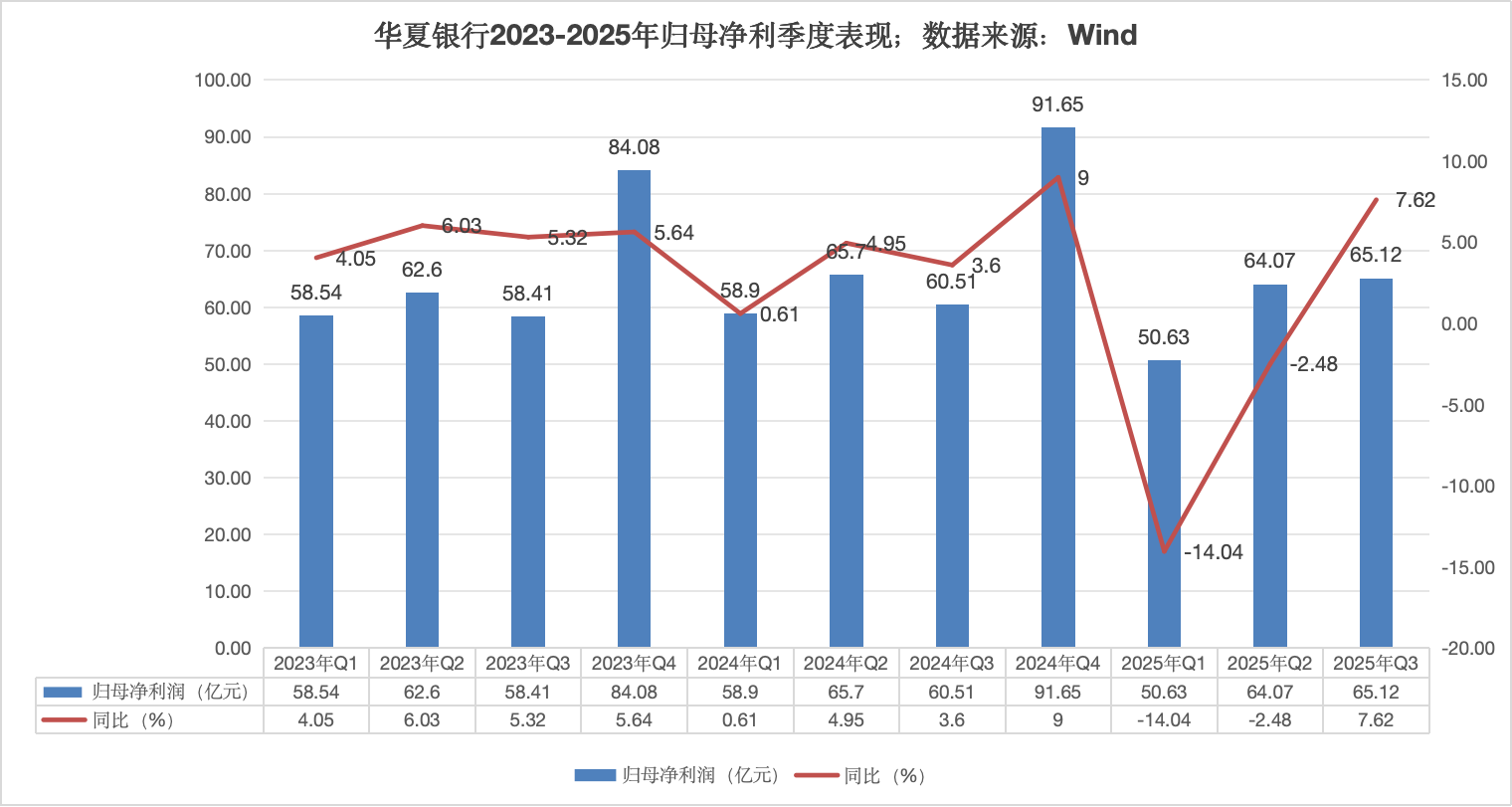
Core Viewpoint - Under the reshuffling of commercial banks, city commercial banks are gaining momentum, increasing growth anxiety for lagging joint-stock banks like Huaxia Bank [1][2]. Group 1: Financial Performance - Huaxia Bank reported a revenue of 64.881 billion and a net profit of 17.982 billion for the first three quarters, representing declines of 8.79% and 2.86% year-on-year, respectively [1][6]. - Among 42 listed banks in A-shares, Huaxia Bank ranked 40th and 37th in revenue and net profit growth rates, indicating a significant lag behind most banks [2]. - In the third quarter, Huaxia Bank experienced a revenue decline of 15.02% but a net profit increase of 7.62%, marking a V-shaped reversal in profit growth [7][9]. Group 2: Asset Quality and Risk Management - As of the end of the third quarter, Huaxia Bank's non-performing loan ratio stood at 1.58%, the worst among A-share joint-stock banks [4][14]. - The bank faces a dilemma between sacrificing risk control for growth or tightening risk management and potentially losing market share to aggressive city commercial banks [5][16]. - The bank's management has undergone significant changes, including the appointment of a new chairman and several key executives, aimed at addressing long-standing governance and risk management issues [18][19]. Group 3: Strategic Adjustments - Huaxia Bank is implementing a "cutting inward" strategy to optimize its organizational structure and improve operational efficiency [20][21]. - The bank's focus is shifting towards retail transformation and digital risk control, with an emphasis on supporting technological innovation and green finance [29]. - The bank's capital adequacy ratio is at 12.63%, which, while above the regulatory requirement, is still at the lower end compared to peers, indicating a weak capacity to absorb risks [14][23]. Group 4: Competitive Landscape - Huaxia Bank's profits have been surpassed by five city commercial banks, which are experiencing higher growth rates, intensifying competitive pressure [25][26]. - The bank's main markets, the Beijing-Tianjin-Hebei and Yangtze River Delta regions, are also the battlegrounds for these aggressive city commercial banks [28].


森马服饰(002563):三季报实现收入业绩增长
Tianfeng Securities· 2025-11-02 08:12
Investment Rating - The report maintains a "Buy" rating for the company, indicating an expected relative return of over 20% within the next six months [6][16]. Core Insights - The company reported a revenue of 3.7 billion yuan in Q3 2025, representing a year-on-year growth of 7%. The net profit attributable to the parent company was 200 million yuan, up 5% year-on-year, while the net profit after deducting non-recurring items also reached 200 million yuan, reflecting a 13% increase [1]. - The company is focusing on a retail transformation centered around consumers and stores, aiming to enhance its retail management system, product operation capabilities, and supply chain efficiency. This includes the introduction of brand health assessments to monitor store profitability and operational effectiveness [2]. - In the content e-commerce sector, the company is innovating its business model by enhancing brand exposure through live streaming and focusing on creating standout products driven by AI technology [3]. Financial Projections - The report maintains profit forecasts for 2025-2027, expecting net profits of 920.25 million yuan, 1.08819 billion yuan, and 1.26641 billion yuan respectively, with EPS projected at 0.34, 0.40, and 0.47 yuan per share [4]. - Financial data indicates a steady increase in revenue from 13.66 billion yuan in 2023 to an estimated 17.31 billion yuan in 2027, with a compound annual growth rate of approximately 6.23% [5]. - The company's EBITDA is projected to fluctuate, with estimates of 1.87 billion yuan in 2025 and 2.34 billion yuan in 2027, reflecting a focus on improving operational efficiency [5]. Valuation Metrics - The report provides various valuation metrics, including a P/E ratio of 15.84 for 2025 and a P/B ratio of 1.21 for the same year, indicating a reasonable valuation relative to earnings and book value [5]. - The EV/EBITDA ratio is projected to be 1.97 in 2025, suggesting a favorable valuation compared to earnings before interest, taxes, depreciation, and amortization [5].

规模、效益、质量三提升,郑州银行前三季度资产突破7400亿元
Zheng Quan Shi Bao Wang· 2025-11-01 02:29
Core Insights - Zhengzhou Bank has demonstrated solid progress in strategic transformation, achieving growth in scale, optimizing structure, and enhancing risk management despite a complex external environment [1] Group 1: Scale and Growth - As of September 30, 2025, Zhengzhou Bank's total assets reached 743.55 billion yuan, a year-on-year increase of 9.93%, marking the highest growth rate for the same period in history [2] - Total liabilities increased to 685.94 billion yuan, up 10.62% from the end of the previous year, with an asset scale increment of 67.19 billion yuan, equivalent to 1.87 times the increase from the same period last year [2] - The efficient growth of asset scale has strengthened the bank's comprehensive strength and market influence, providing a solid financial foundation for serving the regional real economy and expanding business [2] Group 2: Profitability and Revenue Structure - For the first three quarters of 2025, Zhengzhou Bank achieved an operating income of 9.395 billion yuan, a year-on-year increase of 3.91%, and a net profit attributable to shareholders of 2.279 billion yuan, up 1.56% [3] - Net interest income reached 7.816 billion yuan, growing by 5.83%, while non-interest income also increased, leading to a more diversified and reasonable income structure [3] - The growth in retail business, particularly personal loans, has been significant, with personal deposits reaching 26.714 billion yuan, a substantial increase of 22.44% from the end of the previous year [3] Group 3: Risk Management and Quality - The bank has implemented refined management practices, resulting in a 2.45% year-on-year decrease in business and management expenses, with a cost-to-income ratio of 23.99%, down 1.57 percentage points [4] - As of September 30, the non-performing loan ratio stood at 1.76%, a decrease of 0.1 percentage points year-on-year, while the provision coverage ratio improved to 186.17%, an increase of 19.94 percentage points [4] - Zhengzhou Bank aims to maintain internal capital accumulation while reasonably conducting external capital supplementation, considering market conditions and capital needs [4]
森马服饰(002563):25Q3业绩回暖 费用控制良好
Xin Lang Cai Jing· 2025-10-31 06:39
Core Insights - The company reported a year-on-year revenue increase of 7.31% and a net profit increase of 4.55% in Q3 2025, indicating a recovery in quarterly profits [1] - The gross margin has shown a steady increase, while the control of expenses has led to a significant reduction in the growth rate of expenses compared to previous quarters [2] - The company is focusing on retail transformation, brand management, overseas expansion, and enhancing channel capabilities [2] Financial Performance - For the first three quarters of 2025, the company's revenue, net profit, and net profit excluding non-recurring items were 9.84 billion, 537 million, and 515 million respectively, with year-on-year changes of +4.74%, -28.90%, and -29.83% [1] - In Q3 2025, the company's revenue, net profit, and net profit excluding non-recurring items were 3.695 billion, 212 million, and 219 million respectively, with year-on-year changes of +7.31%, +4.55%, and +13.11% [1] Margin and Expense Analysis - The gross margin and net margin for Q1-Q3 2025 were 45.12% and 5.38%, showing year-on-year changes of +0.36% and -2.62 percentage points [2] - In Q3 2025, the gross margin and net margin were 42.50% and 5.69%, with year-on-year changes of +0.06% and -0.17 percentage points [2] - The total expense ratio increased by 1.24 percentage points year-on-year, but the growth rate compared to the previous quarter significantly decreased [2] Cash Flow and Inventory Management - The net cash flow from operating activities in Q3 2025 was -208 million, indicating short-term cash flow challenges [2] - As of the end of Q3 2025, inventory turnover days were 191 days, an increase of 11 days year-on-year, while accounts receivable turnover days were 42 days, an increase of 4 days year-on-year [2] Revenue and Profit Forecast - The company forecasts revenues of 15.355 billion, 16.393 billion, and 17.542 billion for 2025-2027, with year-on-year growth rates of 5%, 7%, and 7% respectively [3] - The projected net profits for the same period are 944 million, 1.07 billion, and 1.2 billion, with year-on-year changes of -17%, +13%, and +12% respectively [3] - The current market capitalization corresponds to a PE ratio of 15X for 2025 and 13X for 2026, maintaining a strong buy recommendation [3]