
RAG

Search documents
X @Avi Chawla
Avi Chawla· 2025-11-08 06:31
AI Agent Workflow Platforms - Sim AI is a user-friendly, open-source platform for building AI agent workflows, supporting major LLMs, MCP servers, and vectorDBs [1] - Transformer Lab offers tools like RAGFlow for deep document understanding and AutoAgent, a zero-code framework for building and deploying Agents [2] - Anything LLM is an all-in-one AI app for chatting with documents and using AI Agents, designed for multi-user environments and local operation [6] Open-Source LLM Tools - Llama Factory allows training and fine-tuning of open-source LLMs and VLMs without coding, supporting over 100 models [6] - RAGFlow is a RAG engine for building enterprise-grade RAG workflows on complex documents with citations, supporting multimodal data [2][4] - AutoAgent is a zero-code framework for building and deploying Agents using natural language, with universal LLM support and a native Vector DB [2][5] Key Features & Technologies - Sim AI's Finance Agent uses Firecrawl for web searches and Alpha Vantage's API for stock data via MCP servers [1] - RAGFlow supports multimodal data and deep research capabilities [2] - AutoAgent features function-calling and ReAct interaction modes [5] Community & Popularity - Sim AI is 100% open-source with 18 thousand stars [1] - Transformer Lab is 100% open-source with over 68 thousand stars [2] - LLaMA-Factory is 100% open-source with 62 thousand stars [6] - Anything LLM is 100% open-source with 48 thousand stars [6] - One project is 100% open-source with 8 thousand stars [3]
X @Avi Chawla
Avi Chawla· 2025-11-08 06:31
6 no-code LLM/RAG/Agent builder tools for AI engineers.Production-grade and 100% open-source!(find the GitHub repos in the replies) https://t.co/It07fQRBL7 ...
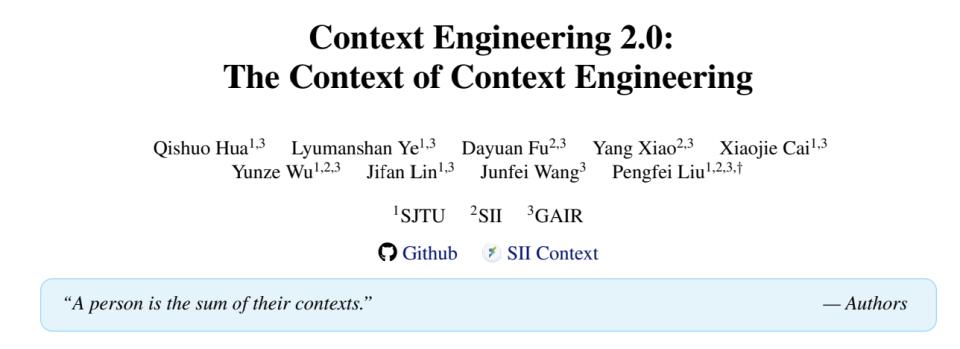
一篇论文,读懂上下文工程的前世今生
3 6 Ke· 2025-11-07 07:11
Core Concept - The article discusses the emerging field of "context engineering," defined as the art and science of providing the right information to prepare for subsequent reasoning, as proposed by Shopify CEO Tobi Lütke and AI expert Andrej Karpathy [1][3]. Summary by Sections What is Context Engineering? - Context engineering addresses the cognitive gap between humans and machines, where human communication is high-entropy and often ambiguous, while machines require low-entropy, clear instructions [3][14]. - The essence of context engineering is to reduce entropy through richer and more effective context, enabling better machine understanding of human intent [3][4]. Evolution of Context Engineering - Context engineering has evolved from a focus on translation (1.0 era, 1990s-2020) to a focus on instruction (2.0 era, 2020-present), with the introduction of large language models allowing for more natural interactions [5][11]. - The transition from context engineering 1.0 to 2.0 reflects a shift in how users interact with machines, moving from structured programming languages to natural language prompts [12][13]. AI Communication Gaps - The article identifies four main deficiencies in AI that contribute to the communication gap: limited sensory perception, restricted understanding capabilities, lack of memory, and scattered attention [14][15]. - These deficiencies necessitate the development of context engineering to facilitate better communication and understanding between humans and AI [15][16]. Framework of Context Engineering - A comprehensive context engineering framework consists of three components: context collection, context management, and context usage [16][24]. - Context collection involves multi-modal and distributed methods to gather information beyond simple text inputs, addressing AI's sensory and memory limitations [18][20]. - Context management focuses on abstracting and structuring high-entropy information into low-entropy formats that AI can understand, enhancing its learning capabilities [23][24]. - Context usage aims to improve AI's attention mechanisms, ensuring relevant information is prioritized during interactions [25][26]. Future of Context Engineering - The article anticipates the evolution of context engineering into 3.0 and 4.0 stages, where AI will achieve human-level and eventually superhuman intelligence, leading to seamless communication without the need for explicit context [30][34]. - Ultimately, the goal of context engineering is to become an invisible infrastructure that enhances AI usability without being a focal point of discussion [35].

X @Avi Chawla
Avi Chawla· 2025-11-06 20:53
AI Agent Infrastructure - The industry is focused on building a real-time context layer for AI Agents across numerous data sources [2] - Airweave offers an open-source context retrieval layer as a solution [2] Technical Challenges & Solutions - Companies face the challenge of querying data spread across multiple sources like Gmail and Drive [2] - A common but potentially insufficient solution is embedding everything in a vector database and using RAG (Retrieval-Augmented Generation) [2]


X @Avi Chawla
Avi Chawla· 2025-11-06 06:30
You are in an AI engineer interview at Google.The interviewer asks:"Our data is spread across several sources (Gmail, Drive, etc.)How would you build a unified query engine over it?"You: "I'll embed everything in a vector DB and do RAG."Interview over!Here's what you missed:Devs treat context retrieval like a weekend project.Their mental model is simple: "Just embed the data, store them in vector DB, and call it a day."This works beautifully for static sources.But the problem is that no real-world workflow ...
X @Avi Chawla
Avi Chawla· 2025-11-04 19:17
RT Avi Chawla (@_avichawla)You can now deploy any ML model, RAG, or Agent as an MCP server.And it takes just 10 lines of code.Here's a breakdown, with code (100% private): ...
X @Avi Chawla
Avi Chawla· 2025-11-04 06:31
Connecting AI models to different apps usually means writing custom code for each one.For instance, if you want to use a model in a Slack bot or in a dashboard, you'd typically need to write separate integration code for each app.Let's learn how to simplify this via MCPs.We’ll use @LightningAI's LitServe, a popular open-source serving engine for AI models built on FastAPI.It integrates MCP via a dedicated /mcp endpoint.This means that any AI model, RAG, or agent can be deployed as an MCP server, accessible ...
X @Avi Chawla
Avi Chawla· 2025-11-04 06:31
You can now deploy any ML model, RAG, or Agent as an MCP server.And it takes just 10 lines of code.Here's a breakdown, with code (100% private): ...
X @Avi Chawla
Avi Chawla· 2025-10-26 18:41
AI Engineering Projects - The industry highlights 9 real-world MCP (presumably Machine Comprehension and Planning) projects for AI engineers [1] - These projects are accessible via a GitHub repository [1] Project Types - The projects cover areas like RAG (Retrieval-Augmented Generation), Memory, MCP client, Voice Agent, and Agentic RAG [1] - The "and much more!" suggests the repository contains additional project types beyond those explicitly listed [1]
X @Avi Chawla
Avi Chawla· 2025-10-26 06:31
9 real-world MCP projects for AI engineers covering:- RAG- Memory- MCP client- Voice Agent- Agentic RAG- and much more!Find them in the GitHub repo below. https://t.co/oXp4PmxvYB ...