
Stock valuation

Search documents
Why MP Materials Stock Just Crashed
The Motley Fool· 2026-01-29 18:30
Core Viewpoint - MP Materials has received a $400 million investment from the U.S. Department of Defense, along with a 10-year supply agreement for rare-earth metals, but concerns about the sustainability of price guarantees are affecting its stock price [1][2][3]. Group 1: Government Support - The U.S. Department of Defense is investing $400 million in MP Materials through preferred convertible stock [1]. - A 10-year supply agreement guarantees the purchase of neodymium-praseodymium at a minimum price of $110 per kilogram [2]. - Recent reports suggest that the Trump administration may not extend similar price guarantees to new projects, but existing contracts, including those with MP Materials, should remain binding [3]. Group 2: Stock Performance and Valuation - MP Materials' stock price has decreased by 9.4%, currently trading at $60.41, with a market cap of $12 billion [2][4]. - The stock has a P/E ratio of nearly 200, based on expected earnings of $0.31 per share in 2026, indicating that the stock may be overpriced [4]. - The company has reported losses for both 2024 and 2025, raising concerns about its ability to justify its current valuation [4].



This Energy Stock Is Up 700%, But I Wouldn’t Touch It with a 10-Foot Pole
Yahoo Finance· 2026-01-29 17:05
Core Viewpoint - Babcock & Wilcox (BW) has experienced significant stock price appreciation, but analysts express concerns about its financial health and valuation despite strong technical indicators [6][8]. Company Overview - Babcock & Wilcox is valued at $1.16 billion and provides energy technology and services primarily for nuclear, fossil, and renewable power markets [1]. Stock Performance - BW shares have surged nearly 700% over the past year, reaching a new 5-year high of $10.97 [6]. - The stock has gained 684.68% over the past 52 weeks and is currently trading at $9.89, with a 50-day moving average of $6.79 [7]. - Since the Trend Seeker issued a new "Buy" signal on January 8, shares are up 27.52% [2]. Technical Indicators - Babcock & Wilcox has a 100% "Buy" opinion from Barchart and a Weighted Alpha of +384.64 [7]. - The stock has made 15 new highs and is up 75.63% over the past month [7]. - The Relative Strength Index (RSI) is at 70.34, indicating strong momentum [7]. - There is a technical support level around $10.05 [7]. Financial Projections - Revenue is projected to decrease by 13.07% this year but is expected to increase by 6.69% next year [7]. - Earnings are estimated to decrease by 64.60% this year, with a projected increase of 103.81% next year [7]. Analyst Ratings - Analysts tracked by Barchart have given BW 3 "Strong Buy" and 2 "Hold" ratings, with price targets ranging from $6 to $10 [8]. - Morningstar rates the stock as 79% overvalued and highlights concerns regarding its financial health, suggesting potential bankruptcy risk under adverse economic conditions [6][8]. - 5,490 investors are following the stock on Seeking Alpha, which rates it a "Hold" [8]. - Short interest is high at 10.97% of the float [8].

Coinbase Crumbles: Is The Downgrade Justified?
Forbes· 2026-01-29 16:10
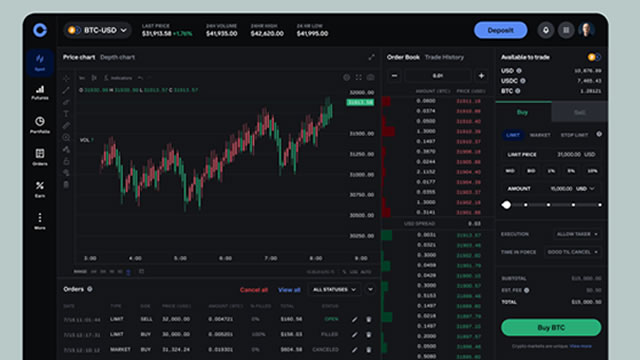
Core Viewpoint - Coinbase Global (COIN) has experienced a significant downturn, with a 7-day loss of 13% and a market capitalization decrease of approximately $8.5 billion, now at $56 billion [2]. Group 1: Stock Performance - The stock has a year-to-date (YTD) return of -7.4%, contrasting with a 1.9% return for the S&P 500, indicating a need for re-evaluation of its valuation [3]. - The ongoing losing streak of COIN stock raises concerns among investors, especially when compared to the Trefis High Quality (HQ) Portfolio, which has consistently outperformed its benchmarks [10]. Group 2: Causes of Decline - The decline is attributed to negative analyst adjustments and reduced institutional demand, with predictions of significant year-over-year decreases in earnings and revenue [4]. - A market-wide sell-off in cryptocurrencies and legislative issues, including the CEO's resistance to a proposed bill on stablecoin rewards, have contributed to negative sentiment in the crypto sector [9]. Group 3: Market Context - Since mid-January, U.S. spot Bitcoin ETFs have seen over $1.7 billion in outflows, reflecting broader market challenges [4]. - There are currently 55 S&P constituents with three or more consecutive days of gains, while 80 constituents have faced three or more consecutive days of losses, indicating a mixed market environment [9]. Group 4: Valuation Perspective - Despite the downturn, COIN stock is viewed as fairly priced due to its strong operating performance and financial stability, suggesting that it may not be a cause for concern [6]. - Historical analysis is necessary to determine if previous declines have served as buying opportunities or traps for investors [8].

Up More Than 210% in 5 Years, Can American Express Stock Still Rise Higher?
The Motley Fool· 2026-01-29 09:37
Core Viewpoint - American Express (AXP) has shown strong performance in recent years, but concerns about potential caps on interest rates may limit future gains [1][7]. Company Performance - American Express has been one of the best-performing financial stocks, with a stock price increase of over 210% in the past five years, significantly outperforming the S&P 500's 81% gain during the same period [2]. - The company's growth rate has been declining but remains positive, with current growth around double digits, indicating resilience amid economic challenges [4]. Valuation Metrics - The stock is currently trading at a price-to-earnings (P/E) multiple of 24, which is lower than the S&P 500 average of 27, suggesting that the stock may still have room for growth [6]. - The market capitalization of American Express is $246 billion, with a gross margin of 61.04% and a dividend yield of 0.92% [8][9]. Legislative Concerns - Year-to-date, American Express's stock has fallen by 2% due to concerns over proposed legislation that would impose a 10% cap on credit card interest rates, which could impact growth prospects [7]. - If the legislation passes, it may require American Express to be more cautious in extending credit, potentially affecting its financial performance [9]. Investment Outlook - Despite potential short-term challenges due to legislative uncertainty, American Express is viewed as a solid long-term investment due to its strong brand, consistent growth, and attractive valuation [10].


Automatic Data Processing, Inc. (NASDAQ:ADP) Stock Analysis
Financial Modeling Prep· 2026-01-28 23:05
Core Viewpoint - Automatic Data Processing, Inc. (ADP) is facing challenges in its growth potential due to high valuation and slowing employment trends, despite reporting a revenue increase in its recent financial results [2][3][6]. Financial Performance - For the quarter ending December 2025, ADP reported a revenue of $5.36 billion, reflecting a 6.2% increase from the previous year, but it fell short of the Zacks Consensus Estimate of $5.38 billion, resulting in a negative surprise of 0.47% [4]. - ADP's earnings per share (EPS) for the same quarter was $2.62, surpassing the consensus estimate of $2.58, indicating a positive surprise of 1.62% and growth from the previous year's EPS of $2.35 [4]. Market Position - ADP's current stock price is $254.28, showing a slight decrease of 0.09% or $0.23, with a trading range between $248.30 and $255.73 today [5]. - The company's market capitalization is approximately $102.8 billion, with a trading volume of 1,945,350 shares on the NASDAQ exchange [5]. Analyst Sentiment - Jefferies has maintained an "Underperform" rating for ADP, citing concerns over its high valuation of 22 times earnings and mid single-digit growth potential [2][6]. - The skepticism regarding ADP's Q2 report suggests that analysts do not expect significant share price boosts in the near term [2].


Is Commvault Stock A Buy At $90?
Forbes· 2026-01-28 19:00
Core Viewpoint - Commvault Systems (CVLT) shares dropped by 31% to $89.13 following a disappointing forward guidance despite strong revenue and earnings beats, leading to lowered price targets by analysts and increased selling pressure [2]. Financial Performance - Commvault reported a revenue increase of 22% over the last 12 months, rising from $898 million to $1.1 billion, with quarterly revenues up by 18.4% to $276 million [7]. - The company achieved an operating income of $86 million, resulting in an operating margin of 7.8%, and generated nearly $216 million in operating cash flow with a cash flow margin of 19.7% [8]. - Net income for the last 12 months was approximately $80 million, indicating a net margin of about 7.3% [8]. Valuation and Market Position - Commvault has a market capitalization of $4.0 billion and a Debt-to-Equity Ratio of 22.9%, with total debt at $908 million [9]. - The company's cash and cash equivalents amount to $1.1 billion, representing a Cash-to-Assets Ratio of 55.5% [9]. - The stock is considered fairly priced due to its strong operational performance and financial health, despite a high valuation [3]. Growth and Profitability - The average top-line growth for Commvault over the past three years has been 11.7% [7]. - Profitability appears weak compared to the broader market, indicating potential concerns for investors [5]. Historical Stock Performance - CVLT stock has shown significant volatility, with a decline of 39.1% from its peak of $83.87 in September 2021 to $51.08 in September 2022, while the S&P 500 experienced a peak-to-trough decline of 25.4% during the same period [12]. - The stock has historically rebounded from declines, recovering to pre-crisis peaks after significant downturns [12].


Apple: I Love The Valuation, But Not The Product Technology Path
Seeking Alpha· 2026-01-27 14:40
Core Insights - Apple Inc. (AAPL) stock has returned 6.4% since the last report, aligning with overall market performance, which is not considered satisfactory for a buy-rated stock [1] Group 1: Analyst Background - The analyst, Dhierin-Perkash Bechai, specializes in aerospace, defense, and airline sectors, aiming to identify investment opportunities within these industries [1] - With a background in aerospace engineering, the analyst provides insights into a complex industry characterized by significant growth prospects [1] - The analysis is data-driven, offering context to industry developments and their potential impact on investment theses [1] Group 2: Investment Research Service - The Aerospace Forum is highlighted as a leading investment research service focused on aerospace, defense, and airline sectors, providing access to proprietary data analytics [1]


Wolfe Research Downgrades Cummins After Stock Fully Prices In Upside
Financial Modeling Prep· 2026-01-26 21:51
Core Viewpoint - Wolfe Research downgraded Cummins from Outperform to Peerperform due to limited remaining upside after strong share price performance [1] Group 1: Stock Performance - Cummins was the second-best performing stock in Wolfe's coverage universe last year, with a share price increase of 46% [1] - The stock had already outperformed in 2024 prior to the downgrade [1] Group 2: Market Conditions and Expectations - Power generation sales and margins have continued to exceed expectations, contributing to Wolfe's optimism about a Class 8 recovery [2] - Improving truckload spot rates and clarity around EPA 2027 regulations have further supported this positive outlook [2] Group 3: Earnings Estimates - Wolfe raised its 2027 earnings estimate for Cummins by 6% to $32 per share, surpassing consensus forecasts [3] - Despite this increase, applying a 20 times earnings multiple suggests only about 12% upside potential [3] Group 4: Risk-Reward Assessment - With shares trading above the previous upside target, Wolfe indicated that the risk-reward profile has become less compelling [4] - The decision to lower the rating to Peerperform reflects this assessment of reduced attractiveness in the stock [4]


Why Energy Fuels Stock Dropped Today
Yahoo Finance· 2026-01-26 17:43
Core Viewpoint - Energy Fuels stock has experienced a 7% decline, with no clear reason identified for the drop [1]. Group 1: Uranium Market Conditions - Uranium prices are on the rise, having increased by 12% over the last two months to $88.40 per pound, the highest since May 2024, and approaching the decade-high of $106 recorded in February 2024 [3]. - Significant news in the uranium sector includes South Korea's announcement to construct two new nuclear plants, which is expected to boost global uranium demand [4]. Group 2: Company Valuation and Analyst Insights - Analysts predict that Energy Fuels will more than double its revenues this year compared to 2025 and grow revenue sixfold over the next three years, transitioning from losses to profits by 2028. However, projected GAAP profits for 2028 are only $0.43 per share, leading to a valuation of 55 times the potential profit at the current stock price of nearly $24 [5]. - The current valuation is considered too high, leading to a recommendation to sell Energy Fuels stock [6].

Sandisk Stock Is Up 1,000% in 6 Months. Analysts Think It Can Gain Another 20% from Here.
Yahoo Finance· 2026-01-26 14:00
A stock that just doubled in a month is life-changing for existing investors, attractive for onlookers, and scary for those looking to get in at current prices. Sandisk (SNDK) is one such stock, up almost 100% in just a month and up roughly 1,000% in six months. The company is known for its various memory devices, and the reason for SNDK stock's surge is the ongoing demand for and shortage of memory products in the market. There are multiple ways to look at the question of buying SNDK stock now. But one ...