tariffs

Search documents
The Last Word With Lawrence O’Donnell - Aug. 22 | Audio Only
MSNBC· 2025-08-23 16:10
Legal & Political Analysis - The report highlights potential political retribution by the Trump administration, evidenced by the FBI search of John Bolton's home and office shortly before the release of Epstein files [1][13][14] - The report suggests an attempt to distract from the Epstein files release, with the Justice Department releasing audio transcripts of an interview with Ghislaine Maxwell [1][12][14] - The report raises concerns about the impartiality of Todd Blanch's interview with Ghislaine Maxwell, suggesting it was aimed at exonerating Donald Trump rather than seeking truth [11][12][17] - The report mentions a resolution opposing clemency for Ghislaine Maxwell, indicating a political stance against pardoning her [12] Epstein Case & Maxwell Interview - The report emphasizes Ghislaine Maxwell's conviction as a sex trafficker and her attempts to downplay her involvement and Donald Trump's relationship with Jeffrey Epstein [1][8][10] - The report questions the credibility of Ghislaine Maxwell's statements, highlighting contradictions and potential lies during her interview [2][12][15] - The report points out that Ghislaine Maxwell was transferred to a lower security prison camp after the interview, raising suspicions [11][19] Economic Analysis - The report discusses the Federal Reserve's potential interest rate cut in September, influenced by concerns about the softening labor market and the impact of tariffs [24][27][28] - The report notes that tariffs are causing prices to rise, with Goldman Sachs estimating that 70% of tariffs will be passed on to consumers by October or November [32][33] - The report suggests that the middle class's strained budgets may limit their ability to absorb higher prices, impacting the effectiveness of passing on tariff costs [33] Other - The report mentions the US government taking a 10% stake in chipmaker Intel, indicating government intervention in corporate America [24]

Collins Says Next Fed Decision Not a Done Deal
Bloomberg Television· 2025-08-23 14:30
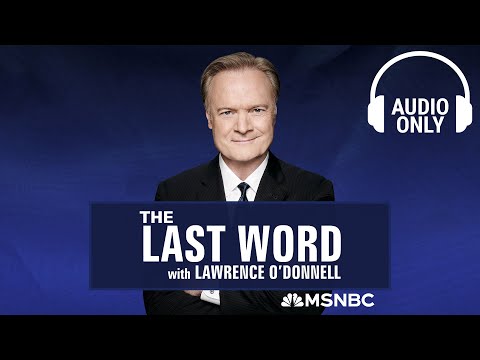
Economic Outlook & Monetary Policy - The industry acknowledges a complicated economic context with mixed indicators, requiring a balanced approach to the dual mandate of inflation versus labor [1][2] - The industry recognizes upside risks to inflation related to tariffs and downside risks on the labor market, necessitating a balancing act in monetary policy decisions [4] - The industry emphasizes the importance of real-time decision-making amidst uncertainty, balancing data analysis with insights from companies regarding employment and pricing plans [4][5] - The industry notes that while job growth has slowed, some labor market indicators remain healthy, suggesting a need for careful consideration of downside risks [7] - The industry observes that inflation has crept higher, moving in the wrong direction compared to previous expectations [8] - The industry anticipates inflation to remain elevated for the rest of the year into early next year, potentially with a larger and more persistent impact due to tariff impacts [12] - The industry views current monetary policy as modestly restrictive, appropriate for elevated inflation, but acknowledges the need to dial back restrictiveness if labor market risks worsen relative to inflation [17][18] Inflation & Tariffs - The industry is focused on the impact of tariffs on prices, considering not just direct imports but also the broader range of goods and services relying on imported intermediate goods [10][11] - The industry expresses concern about high price levels and the importance of restoring price stability [10] Labor Market - The industry is balancing the commitment to restoring price stability with the understanding that preserving healthy labor markets is crucial [14] - The industry sees risks on both sides, with the potential for a rapid rise in unemployment or a more long-term, steady rise in inflation [15]
Powell's made it clear he's ready for rate cuts in September, says Booth's Randy Kroszner
CNBC Television· 2025-08-22 20:13
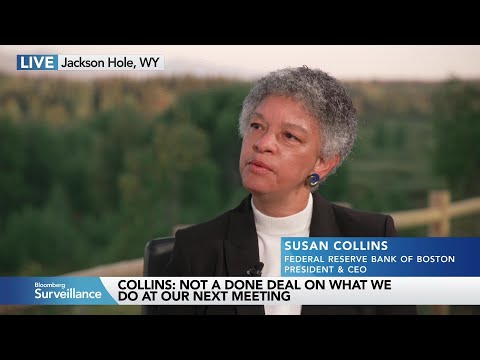
Monetary Policy Stance - The Federal Reserve (Fed) was in a wait-and-see mode regarding the impact of tariffs, but recent data suggests a muted impact, potentially leading to rate cuts [2] - The Fed perceives no signs of tariffs causing inflation expectations to become unanchored, viewing it as a one-off event rather than an ongoing inflationary cycle [3] - The speaker suggests Chair Powell is ready to start moving in September [3] - There was a debate within the committee about the luxury of waiting longer, possibly influenced by the August 1st payroll report [4] Inflation and Tariffs - Data suggests a more muted inflation impulse from tariffs, with some tariffs being negotiated down [5][6] - The initial tariff concerns from April, anticipating widespread increases of 20-30%, have subsided [6] - The slower impact of tariffs over time makes the Fed more comfortable that inflation expectations will remain anchored [7] Inflation Expectations - Inflation expectations are considered crucial in monetary policy, but the right measure is unclear, with options including Treasury Inflation Protected Securities (TIPS), consumer surveys, and business surveys [9] - The Fed has wiggle room in choosing which inflation measure to emphasize [10] - Despite past concerns about transitory inflation, people continue to believe the Fed regarding inflation expectations [10][11] Labor Market - Revised data suggests the labor market has been weakening [2][7] - Weakening labor market data supports the idea of bringing rates down [7]
Tariff and services inflation are coming, says RBC's Frances Donald
CNBC Television· 2025-08-22 18:40
Market Reaction & Rate Cut Probability - Market exuberance is noted, particularly in riskier, speculative market segments, following Powell's speech [4] - Market assigned approximately 80% probability of a rate cut in September prior to the speech, which increased to 85-86% during the conversation [4][5] - Market reactions should be considered, but the market is not always right [2][3] Inflation & Tariffs - Tariffs have begun to increase prices in some goods categories, with accumulating effects expected over the coming months [1] - Tariff inflation is likened to the "tariff Titanic" hitting the "inflation iceberg," suggesting significant impact [5] - Core inflation is projected to exceed 3% by year-end, influenced by both tariffs and service-side inflation [6] - The Federal Reserve acknowledges tariff inflation is coming through, as reflected in PPI (Producer Price Index) [11][12] Federal Reserve & Monetary Policy - Powell's speech emphasized balance, assessing both upside risks for inflation and downside risks for the labor market [2] - The Federal Reserve faces a dilemma balancing concerns about the labor market with rising inflation [7] - The Federal Reserve might not need to be as concerned about the labor market as expressed in the speech, given supply-side factors [7][8] - The Federal Reserve can choose to view inflation data differently and utilize various measures to justify a rate cut [12][13] Labor Market - The unemployment rate is at 42%, consistent with the rate a year prior [8]

WSJ Correspondent on Key Moments From Powell's Jackson Hole Speech | WSJ News
WSJ News· 2025-08-22 18:16
Economic Outlook - The Fed Chair Jerome Powell's speech addresses the shifting balance of risks, potentially warranting adjustments to the policy stance [1] - The labor market's unusual balance, resulting from slowing supply and demand for workers, suggests rising downside risks to employment [2] - Labor Department revisions in job growth figures for May and June altered the perception of the labor market's strength [3] Inflation and Tariffs - Tariffs are now feeding into goods prices, with the effects expected to be relatively short-lived, representing a one-time shift in the price level [4] - The impact of tariffs could take months or quarters to filter through the entire supply chain ecosystem [5] - Risks to inflation are tilted to the upside [6] Monetary Policy - A slowing labor market may lead the Fed to cut interest rates [6] - Intense pressure from President Trump and his senior economic advisors urging the Fed to cut interest rates [5]

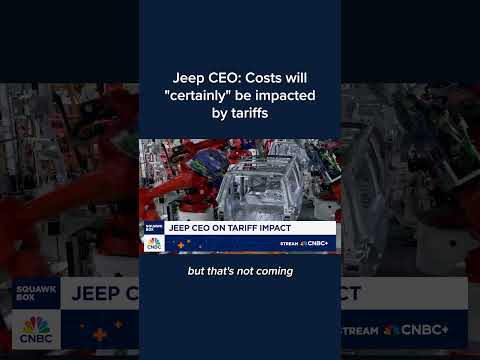
Jeep CEO: Costs will 'certainly' be impacted by tariffs
CNBC Television· 2025-08-22 14:06
Jeep CEO Bob Broderdorf told CNBC on Friday that "costs are certainly going to be impacted by tariffs" in manufacturing its newly announced Cherokee model. Amid a six-year sales decline for Jeep, Stellantis is also facing headwinds from President Donald Trump’s tariffs, estimating its full-year impact for the company will reach 1.5 billion euros, or $1.74 billion. ...
Inside Texas Instruments' $60 billion U.S. megaproject, where Apple will make iPhone chips
CNBC· 2025-08-22 12:00
Core Viewpoint - Texas Instruments (TI) is making a significant investment of $60 billion in a manufacturing megaproject to produce foundational microchips in the U.S., with Apple also committing to increase its U.S. spending to $600 billion over the next four years, indicating a strong push for domestic semiconductor production [1][2]. Company Overview - TI is building seven new factories in the U.S., including four in Sherman, Texas, which will increase its production capacity fivefold [3][7]. - The company specializes in analog and embedded chips, which are essential components in various electronic devices, from smartphones to industrial applications [4][9]. - TI's chips are produced on legacy nodes of 45 to 130 nanometers, which are more cost-effective compared to the advanced chips made by competitors [10]. Market Dynamics - TI's market share in the analog segment has declined from 19.8% in 2020 to 14.7% in 2024, raising concerns about demand stability amid tariff uncertainties [6]. - The company is positioned as a potential "tariff winner," as its U.S. foundry could allow it to offer competitive pricing against Taiwan-made chips [6]. Investment and Economic Impact - The $60 billion project is expected to create 60,000 jobs in the U.S., with a significant portion of capital spending occurring domestically [23]. - TI received $1.6 billion in CHIPS Act funding and a 35% investment tax credit, alongside state-level incentives from Texas [18]. Infrastructure and Resources - The new fabs in Sherman will utilize approximately 1,700 gallons of water per minute, with plans to recycle at least 50% of that water [21]. - TI's manufacturing will run entirely on renewable energy, enhancing energy efficiency in chip production [21]. Talent Acquisition - TI is addressing the talent gap in semiconductor manufacturing by partnering with universities and community colleges to attract skilled engineers [23]. - The company anticipates that the influx of younger people to the area will facilitate talent acquisition compared to previous years [23].


X @BBC News (World)
BBC News (World)· 2025-08-22 05:30
Beijing opposes 'bully' US for 50% tariffs on India https://t.co/dGUivduzsc ...
X @The Economist
The Economist· 2025-08-22 02:00
In the second age of Donald Trump, rules are out and the boss’s whim is in. No country has been spared tariffs, even those that run trade balances in America’s favour. This arm-twisting era is ghastly for many governments—especially Singapore https://t.co/7g3C7CF2rd ...
Capital outflows starting to normalize after 'highly unusual' first half, says Exante Data's Nordvig
CNBC Television· 2025-08-21 21:52
Market Trends & Capital Flows - A significant asset allocation shift away from the US dollar in international portfolios was observed, particularly into European equities, leading to their outperformance [2] - This asset allocation shift was most aggressive from March to June, with Asia following later, peaking in June [3][6] - The US dollar has stabilized in the last six weeks [7] Monetary Policy & Economic Factors - The Federal Reserve's actions will define the next move for the US dollar [3] - The Fed faces a tricky balancing act between unemployment and inflation [4] - The market is closely watching the labor market to determine if the Fed will cut rates [7] - A hawkish rate cut is expected in September, but the Fed is unlikely to commit to a multi-cut path due to inflation concerns [9] - Tariffs are expected to increase again by October, potentially impacting inflation [8] US Dollar & Government Influence - The US Treasury Secretary has expressed a desire for a weaker US dollar [10] - The US influence on the dollar is primarily through verbal interventions rather than direct control like China [11][12] - The cyclical state of the US relative to the rest of the world will ultimately determine the dollar's value [12] - The tariff push is expected to be paid for mostly by consumers, potentially leading to a decrease in consumption towards the end of the year [13]