Automation

Search documents
X @Polyhedra
Polyhedra· 2025-10-30 12:00
5/AI payments are coming fast — but automation can’t scale without verification.zkML turns intelligent transactions into verifiable ones, with logic you can trust and outcomes you can prove.That’s what @PolyhedraZK is building: zkML for a world where every transaction carries its own proof. ...
Aptiv(APTV) - 2025 Q3 - Earnings Call Presentation
2025-10-30 12:00
Financial Performance - Record Q3 revenue of $5.2 billion, with adjusted growth of 6% year-over-year[4] - Record adjusted operating income of $654 million, up 10% year-over-year, driven by strong flow through on volume and manufacturing performance[4] - Record adjusted EPS of $2.17, up 19% year-over-year, driven by increased operating income and lower share count from repurchases[4] - Operating cash flow of $584 million, enabling ~$250 million of capital deployment in share repurchases and debt repayment[4] Business Highlights - Bookings of $8.4 billion, reflecting sequential acceleration in program award timing[4] - Strong performance outside of Automotive, with double-digit revenue growth attributable to markets outside of Automotive, including 20%+ growth in Wind River[3] - 30% growth in Software bookings year-to-date[10] - Approximately 85% of year-to-date bookings in China are with Local OEMs[10] Segment Performance - Advanced Safety & User Experience (AS&UX) revenue was $1.442 billion[34] - Engineered Components Group (ECG) revenue was $1.714 billion[35] - Electrical Distribution Systems (EDS) revenue was $2.286 billion[36] Outlook - Raising full-year revenue guidance to $20.15 billion - $20.45 billion, representing adjusted revenue growth of 2%[47] - Expecting revenue growth to accelerate into 2026[49]

Robotics Stocks To Keep An Eye On – October 28th
Defense World· 2025-10-30 08:06
Group 1: Robotics Stocks Overview - Teradyne, Richtech Robotics, and Serve Robotics are highlighted as key robotics stocks to monitor, reflecting significant trading volume recently [2] - Robotics stocks encompass companies involved in the design, manufacturing, and provision of software and components for robots and automation systems across various sectors [2] - Investment in robotics stocks offers exposure to automation and AI-driven efficiency, but also presents sector-specific risks such as cyclical capital spending and high R&D costs [2] Group 2: Teradyne, Inc. - Teradyne, Inc. specializes in automated test systems and robotics products, operating through four segments: Semiconductor Test, System Test, Robotics, and Wireless Test [3] - The Semiconductor Test segment focuses on testing semiconductor devices for various applications, including automotive, industrial, and consumer electronics [3] Group 3: Richtech Robotics, Inc. - Richtech Robotics develops and sells robotic solutions aimed at automation in the service industry, offering products like indoor transport and delivery robots [4] - The company’s product lineup includes various delivery robots and cleaning robots, along with accessories to enhance their functionality [4] Group 4: Serve Robotics, Inc. - Serve Robotics designs and operates low-emission robots for food delivery in public spaces within the United States [5] - The company transitioned from its former name, Patricia Acquisition Corp., to Serve Robotics Inc. in July 2023, indicating a focus on the robotics sector [5]



Jerome Powell Just Paved The Way For A Market Rally Higher
From The Desk Of Anthony Pompliano· 2025-10-29 21:31
Monetary Policy & Market Impact - The Federal Reserve cut interest rates by 25 basis points, as widely expected [3] - Quantitative tightening is set to end on December 1st [3] - The market generally expects stocks and Bitcoin to continue rising due to the rate cut [6][8] - Historically, stocks have performed well following rate cuts when the S&P 500 is near an all-time high [7] - Ryan Dietrich of Carson Group notes that the S&P 500 has historically shown an average return of 6% in the last two months of the year when it has been up for the preceding six months [7] Robotics & Automation - The rise of automation, robotics, and machines is becoming increasingly prevalent in society [10] - 1X is developing a humanoid robot, Neo, for home use, priced at $20,000 to purchase or $500 per month to rent [11] - Neuralink is enabling individuals with spinal cord injuries to control robotic arms using brain-computer interfaces [13][16] - Alex Connley is the first person to use a brain-computer interface to control a robotic arm, demonstrating potential for restoring lost functions [13] Autonomous Vehicles - Boston is considering banning fully autonomous vehicles, despite data suggesting they are safer than human drivers [23][24] - Waymo vehicles are involved in five times fewer injury-causing collisions than human drivers [24] - San Francisco's taxi and limo industry saw a 7% increase in employment, contrary to concerns about job losses due to self-driving cars [24]

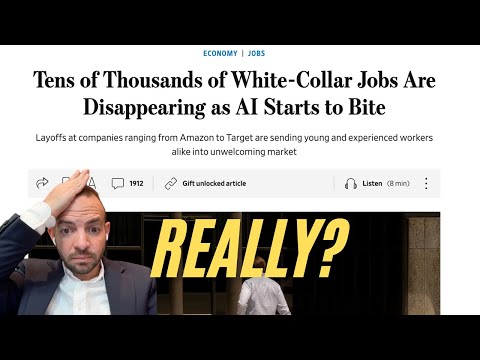
Is AI Really Replacing Thousands Of White Collar Jobs??
Alex Kantrowitz· 2025-10-29 18:45
Hey everyone, this article, tens of thousands of white collar jobs are disappearing as AI starts to bite. It's one of the most irresponsible pieces of journalism I've seen on artificial intelligence yet. It is an atrocious article.It suggests that AI is taking tens of thousands of white collar jobs. It's going to make so many people fear that their jobs are about to be automated by AI and it's just completely unsupported by anything in the body. This headline is unsupported.Uh, and I think frankly it was im ...
X @Cointelegraph
Cointelegraph· 2025-10-29 18:30
Can automation make DeFi safer?https://t.co/1NffpShE77 ...
NOV Q3 Earnings Miss, Revenues Beat Estimates, Both Decrease Y/Y
ZACKS· 2025-10-29 16:35
Core Insights - NOV Inc. reported third-quarter 2025 adjusted earnings of 11 cents per share, missing the Zacks Consensus Estimate of 24 cents, and down from 33 cents in the previous year due to underperformance in the Energy Products and Services segment [1][9] - Total revenues reached $2.2 billion, exceeding estimates by 1.9%, but declined 0.7% year-over-year due to a challenging macro environment and reduced oilfield activity [2][9] Financial Performance - The Energy Products and Services segment generated revenues of $971 million, missing estimates and down 3.2% from the prior year, attributed to decreased drilling operations and project delays [5] - The Energy Equipment segment saw revenues increase by 2.3% year-over-year to $1.247 billion, surpassing estimates by 4.8%, driven by strong demand and higher backlogs [6] - Adjusted EBITDA for the Energy Products and Services segment was $135 million, below estimates and down from $172 million in the previous year, while the Energy Equipment segment's adjusted EBITDA rose to $180 million, exceeding estimates [6][7] Shareholder Returns - In Q3 2025, NOV repurchased approximately 6.2 million shares for $80 million and paid a dividend of 7.5 cents per share, totaling $28 million in dividends, resulting in $108 million returned to shareholders [3] Strategic Developments - NOV secured multiple global contracts in automation and subsea systems, including a monoethylene glycol reclamation system for a Black Sea FPSO and several orders for projects in Guyana and Brazil [10] - The company achieved a 17% efficiency gain on a Guyana deepwater floater using its NOVOS™ and MMC technologies, and deployed its ATOM™ RTX robotic system on a U.S. land rig [11] Outlook - For Q4 2025, NOV anticipates a 5% to 7% decrease in consolidated revenues year-over-year, with adjusted EBITDA expected between $230 million and $260 million [12] - The company expects an 8-10% decline in revenues for the Energy Products and Services segment, while the Energy Equipment segment is projected to see a 2% to 4% revenue decrease [12] - NOV plans to exceed its minimum threshold of returning 50% of excess free cash flow to shareholders in 2025, despite facing tariff costs and inflation uncertainties [13]


PEP's Margins Under Pressure: Will Productivity Play Deliver Relief?
ZACKS· 2025-10-29 16:31
Core Insights - PepsiCo, Inc. is navigating a challenging cost landscape but has renewed confidence in its productivity initiatives, achieving nearly 3% reported net revenue growth in Q3 2025, driven by international market strength and marking its 18th consecutive quarter of mid-single-digit organic revenue growth [1][9] - Despite revenue growth, profitability is under strain due to higher supply chain costs, which created a three-percentage-point drag on margins, partially offsetting benefits from pricing actions and cost optimization [2][9] - The company is implementing aggressive cost-reduction and automation strategies, including reducing over 35% of SKUs since 2022 and cutting about 7% of full-time headcount in Frito-Lay, aimed at improving service levels and stabilizing margins [3][9] Financial Performance - PepsiCo's gross margin is under pressure from elevated supply chain costs, primarily from global inputs, ingredients, and tariffs, which have impacted overall profitability [2][9] - The company targets stronger margins, with PBNA aiming for mid-teens profitability and Foods North America focusing on cost discipline, expecting low-single-digit revenue growth and ongoing productivity gains to restore margins [4] Competitive Landscape - Coca-Cola and Keurig Dr Pepper are also managing margin pressures effectively, leveraging pricing power and productivity gains to sustain profitability amid a challenging cost environment [5] - Coca-Cola reported a 59% year-over-year surge in operating income to $3.98 billion, with its operating margin increasing to 32% from 21.2% a year ago, showcasing strong margin management capabilities [6] - Keurig Dr Pepper experienced a 7.9% year-over-year increase in adjusted gross profit to $2.35 billion, despite a decline in gross margin due to ongoing inflationary pressures [7] Stock Performance and Valuation - PepsiCo shares have gained 5.1% in the past three months, outperforming the industry’s rise of 2.7% [8] - The company trades at a forward price-to-earnings ratio of 17.70X, slightly below the industry average of 18.31X [10] - The Zacks Consensus Estimate for PepsiCo's 2025 earnings implies a year-over-year decline of 0.6%, while the 2026 earnings estimate indicates growth of 5.6% [11]


4 Metal Fabrication Stocks to Buy as Industry Trends Improve
ZACKS· 2025-10-29 15:21
Industry Overview - The Zacks Metal Products - Procurement and Fabrication industry is experiencing strong demand across various end markets, with improvements in order levels and strategic pricing expected to help maintain margins despite tariff impacts [1][2][4] - The industry primarily includes metal processing and fabrication service providers that transform metal into parts and components used in sectors such as construction, aerospace, automotive, and more [3] Current Trends - The Institute for Supply Management's manufacturing index showed a slight increase to 49.1% in September from 48.7% in August, indicating a potential recovery in the industry [4] - The Production Index registered 50.3%, reflecting growth in fabricated metal products, while new orders showed renewed demand momentum despite overall contraction in the New Orders Index [4] Strategic Initiatives - Companies are implementing strategic pricing adjustments, cost-reduction initiatives, and productivity enhancements to tackle rising labor, freight, and fuel costs [5] - Diversification of supplier bases and modifications to supply chains are also being pursued to mitigate tariff impacts [5] Growth Catalysts - Emphasis on automation and cost-effective technical solutions is positioning the industry for future growth, with expected demand increases in manufacturing, aerospace, and automotive sectors [6] - Rapid industrialization in developing economies presents additional long-term growth opportunities [6] Industry Performance - The Zacks Metal Products - Procurement and Fabrication industry ranks 19, placing it in the top 8% of 243 Zacks industries, indicating positive near-term prospects [7] - Over the past year, the industry has grown 15.4%, lagging behind the sector's 20.5% rise but outperforming the Zacks S&P 500 composite's 3.5% increase [10] Valuation Metrics - The industry is currently trading at a trailing 12-month EV/EBITDA ratio of 17.38X, compared to the S&P 500's 17.93X and the Industrial Products sector's 19.57X [13] Company Highlights - **Century Aluminum (CENX)**: Investing $50 million to restart over 50,000MT of idled production, expected to boost U.S. aluminum production by nearly 10% [19] - **Ardagh Metal Packaging (AMBP)**: Anticipating 3% growth in shipments and has raised its adjusted EBITDA guidance for 2025 to $720-$735 million [24] - **TriMas Corporation (TRS)**: Forecasting consolidated sales growth at the higher end of the 8-10% range for full-year 2025, driven by strong demand in its packaging segment [28] - **GrafTech International (EAF)**: Sales volume rose 9% year-over-year, with a strong focus on the U.S. market and an expected 8-10% increase in sales volume for 2025 [32]





Amazon fires staffers via early-morning text messages during round of 14K job cuts: report
New York Post· 2025-10-29 14:36
Core Points - Amazon has initiated a round of layoffs affecting approximately 14,000 corporate roles as part of its strategy to reduce bureaucracy within its workforce [3][4][7] - The company plans to cut a total of 30,000 corporate jobs, which represents about 9% of its global office-based workforce, over the coming weeks [7][10] - The layoffs were communicated to employees via text messages, urging them to check their emails before coming to the office to avoid discovering their job loss in person [1][2][5] Company Strategy - Amazon's HR executive, Beth Galetti, stated that the layoffs are part of a broader effort to operate more efficiently and leanly, focusing on fewer layers and more ownership within the company [3][13] - The company is also embracing automation and AI, which is expected to create new job opportunities while simultaneously reducing the need for certain roles [9][12] - Capital expenses related to AI data centers are projected to exceed $120 billion this year, marking a nearly 50% increase from the previous year [12] Future Outlook - Another round of layoffs is anticipated in January, following the holiday shopping season, as the company continues to adjust its workforce in response to changing market conditions [8] - Amazon's CEO, Andy Jassy, has emphasized the importance of adapting to new technologies and has encouraged employees to embrace automation as part of the company's evolution [9][12]