Share Repurchase

Search documents
How Hologic Leverages Its Financial Firepower to Drive Long-Term Value
ZACKS· 2025-06-25 14:16
Core Insights - Hologic's consistent profitability has resulted in strong annual cash flow generation of approximately $1 billion, which supports a robust balance sheet and capital deployment strategy focused on tuck-in acquisitions and share repurchases [1][8] - Recent acquisitions, including Biotheranostics, Endomagnetics, and Gynesonics, are expected to enhance revenue growth and improve operating margins, as these businesses are growing faster than Hologic's legacy units [2][3][4] - Hologic maintains a strong financial position with $1.6 billion in cash and investments and a leverage ratio below 1X, allowing for continued investments in acquisitions and share buybacks [2][8] Acquisition Strategy - Hologic has allocated approximately $3.6 billion for share repurchases and $2 billion for mergers and acquisitions, with a focus on high-growth adjacent markets [1] - The integration of Biotheranostics is expected to benefit from increased lab testing volumes, while Endomagnetics is positioned to capture significant market opportunities in wireless localization [3] - Gynesonics' Sonata System is anticipated to strengthen Hologic's International Surgical business by providing a minimally invasive treatment option for uterine fibroids [4] Competitive Landscape - Hologic's rivals, such as Becton, Dickinson and Company and Thermo Fisher Scientific, are also engaging in share repurchases and acquisitions, with BDX reporting $625 million in free cash flow and TMO returning $2.1 billion to shareholders [5][6] - Hologic's stock has performed relatively well, rising 5.3% over the past three months, while the industry has seen an 8.6% decline [7] Financial Performance and Estimates - Hologic's forward two-year earnings multiple stands at 14.66X, indicating a favorable position relative to the industry [9] - Consensus estimates for Hologic's fiscal 2025 and 2026 earnings remain stable, with projected earnings of $4.19 for the current year and $4.50 for the next year [10][11]



Citizens Financial Announces New Buyback Plan: Is it Worth Watching?
ZACKS· 2025-06-18 18:11
Core Viewpoint - Citizens Financial Group (CFG) is enhancing its shareholder-focused strategy, demonstrating confidence in its long-term performance through an increased share repurchase authorization of $1.5 billion, up from $300 million previously approved in June 2024 [1][8]. Financial Performance - CFG's quarterly dividend has been increased twice in the last five years, with a current payout ratio of 53% and a dividend yield of 4.15% based on a closing price of $40.45 [2]. - CFG's total revenues experienced a compound annual growth rate (CAGR) of 3% from 2020 to 2024, with net interest income (NII) growing at a CAGR of 5.3% during the same period [12]. - For 2025, management anticipates NII growth of 3-5% and non-interest income growth of 8-10% [14]. Capital Position - As of March 31, 2025, CFG reported total long-term borrowed funds of $12.3 billion and total available liquidity of $12.2 billion, indicating a strong balance sheet [5]. - The Common Equity Tier 1 ratio was 10.6%, and the total capital ratio was 13.9% as of the same date, reflecting a solid capital position [5]. Growth Strategy - CFG is pursuing growth through acquisitions, cost-cutting programs, and private banking expansion, with notable acquisitions including Investors Bancorp and HSBC's East Coast branches [9][8]. - The "Tapping Our Potential" (TOP) program has delivered consistent cost savings, with TOP 9 achieving $150 million in pre-tax run-rate benefits in 2024, and TOP 10 targeting an additional $100 million in savings by year-end 2025 [10]. Loan and Deposit Trends - CFG's loans and leases and total deposits recorded CAGRs of 3.1% and 4.4%, respectively, from 2020 to 2024, with expectations of continued growth through 2027 [11]. - Despite a dip in loan balances in early 2025, management remains optimistic about sustaining a healthy loan pipeline through a relationship-driven lending model [11]. Expense Management - Non-interest expenses have seen a CAGR of 18.4% from 2020 to 2024, with management projecting a 4% increase in adjusted non-interest expenses for 2025 [15]. - The company is facing elevated expense levels due to investments in private banking and digital infrastructure [15]. Market Performance - CFG shares have increased by 16.3% over the past year, outperforming the industry growth of 11.1% [17]. - CFG trades at a forward price-to-earnings (P/E) ratio of 10.76X, slightly above the industry average of 10.1X [20]. Investment Considerations - CFG's ongoing efficiency initiatives and strategic growth moves provide a solid foundation for future financial growth, despite near-term challenges related to elevated expenses and reliance on commercial lending [24].



GMS(GMS) - 2025 Q4 - Earnings Call Transcript
2025-06-18 13:32
Financial Data and Key Metrics Changes - For the full year, net sales were $5.5 billion, a marginal increase compared to the prior year, driven by contributions from recent acquisitions [6] - Organic sales for the year were $5.2 billion, down 5.4% on a same-day basis compared to the prior year [7] - Net income for the full year was $115.5 million, including a $42.5 million non-cash goodwill impairment charge [7] - Adjusted EBITDA was $500.9 million, and free cash flow for the year was $336.1 million, representing 67% of adjusted EBITDA [7] - In the fourth quarter, net sales were $1.3 billion, with organic sales declining 8.3% per day [8][15] - Net income for the fourth quarter was $26.1 million, and adjusted EBITDA was $109.8 million, at the high end of the outlook [8][29] - Free cash flow generated during the quarter was $183.4 million, or 167% of adjusted EBITDA, marking the highest level of quarterly free cash flow conversion in the company's history [8][29] Business Line Data and Key Metrics Changes - Ceilings saw volume improvement during the quarter, with sales up 6.4% compared to the prior year [8][22] - Wallboard sales for the quarter were $526.6 million, down 10.1% year-over-year, with a 12.1% decrease in volume partially offset by a 1% increase in price and mix [20][21] - Steel framing sales were $189.2 million, down 14.2% for the quarter, with volumes down 2.6% and price and mix down 10.2% [23] - Complementary product sales were nearly flat year-over-year, up 1.4% on a per-day basis, representing the twentieth consecutive quarter of per-day growth [24] Market Data and Key Metrics Changes - Wallboard industry volumes were down 10% in the first calendar quarter, with high interest rates and policy uncertainty as primary impediments to growth [10] - U.S. residential revenues declined 6% per day compared to the prior year, with single-family volumes down 1.9% per day [18][19] - Multifamily revenues fell 32.4% and commercial revenues fell 10.1% on a per-day basis [18] Company Strategy and Development Direction - The company is focused on four strategic pillars: expanding share in core products, growing complementary products, expanding the platform, and driving improved productivity and profitability [13] - A significant cost savings program has been executed, achieving $25 million in annualized cost savings in the fourth quarter, totaling $55 million for the fiscal year [14] - The company aims to maintain a disciplined approach to capital allocation, balancing stock buybacks with debt reduction while pursuing attractive M&A opportunities [32] Management's Comments on Operating Environment and Future Outlook - Management expressed cautious optimism about nearing the bottom of the cycle, with expectations for demand recovery as economic conditions improve [10][12] - The company anticipates that the near term will remain challenging, but expects to capitalize on long-term growth opportunities [13][39] - Management highlighted the importance of servicing customers and executing strategic priorities despite macroeconomic difficulties [33] Other Important Information - The company reduced net debt by more than 10% during the quarter, maintaining a target debt leverage range of 1.5 to 2.5 times [14] - Cash on hand was $55.6 million, with $631.3 million of available liquidity under the revolving credit facility [30] Q&A Session Summary Question: Sequential organic trends and expectations - Management noted improvements in the single-family market and share gains with larger customers, contributing to expectations of better performance [41][42] Question: Technology and efficiency optimization efforts - Management confirmed ongoing investments in digital initiatives and automation, which have contributed to cost reductions and improved service delivery [44][45][47] Question: Single-family dynamics and share gains - Management discussed leveraging scale to support builder partners and highlighted regional strengths contributing to share gains [52][56] Question: Margin dynamics and market dependency - Management indicated that half of the expected margin improvement is volume-related, while the other half is due to operational efficiencies [58][60] Question: Visibility into the single-family market - Management provided insights on lead times for orders and expressed confidence in a potential uptick in starts moving into the next selling season [66][68] Question: Impact of large homebuilders on distribution - Management emphasized gaining share with large builders due to service quality and efficiency, which positions the company well for future growth [77][80] Question: Return to office trends - Management expressed cautious optimism about future opportunities in tenant improvement work and office-to-residential conversions [82][84] Question: Wallboard pricing and industry dynamics - Management discussed the ability to pass through limited price increases and the resilience of pricing in the current environment [87][89]

Fifth Third Rewards Shareholders With New Share Repurchase Program
ZACKS· 2025-06-17 18:26
Core Viewpoint - Fifth Third Bancorp (FITB) has approved a new share repurchase authorization of up to 100 million shares, replacing the previous authorization of 11.8 million shares, providing flexibility for stock buybacks without a set expiration or price limit [1][2][7] Group 1: Share Repurchase Program - The new repurchase authorization allows for buybacks through open-market transactions or privately negotiated transactions, including Rule 10b5-1 programs [2] - The repurchase program can be modified, suspended, or discontinued based on market conditions and legal requirements [2] Group 2: Dividend Actions - In September 2024, FITB announced a 5.7% increase in its quarterly dividend to 37 cents per share, marking the fourth increase in the last five years [3] - The company has a payout ratio of 44%, and with a closing price of $38.32, the annualized dividend yield stands at 3.86% [3] Group 3: Financial Position - As of March 31, 2025, FITB had cash and due from banks totaling $17.9 billion, with total debt at $19.9 billion and short-term borrowings of $5.5 billion [4] - The common equity tier (CET) 1 ratio was reported at 10.45%, indicating room for enhancing capital distribution plans [4][5] Group 4: Market Performance - Over the past year, FITB shares have gained 6.2%, while the industry has seen a growth of 17.8% [6] - Currently, FITB holds a Zacks Rank of 3 (Hold) [8]


Should You Buy FDX Stock Now After Recent Dividend Hike?
ZACKS· 2025-06-17 15:51
Core Insights - FedEx Corporation has announced a 5.1% increase in its quarterly dividend, raising it to $1.45 per share, marking the fifth consecutive year of dividend hikes [1][9] - The company has executed $2.52 billion in share repurchases in the first nine months of fiscal 2025, surpassing the total for the entire fiscal year 2024 [5][9] - FedEx's stock is currently trading at a low price/sales ratio of 0.6, indicating potential undervaluation compared to the sector average of 0.96 [7][8] Dividend and Shareholder Returns - The quarterly dividend will be paid on July 8, 2025, to shareholders of record as of June 23, 2025 [2] - Dividends have increased significantly from $793 million in 2022 to $1.26 billion in 2024, with $1.01 billion already distributed in the first three quarters of fiscal 2025 [3] Capital Allocation Strategy - FedEx's aggressive capital allocation strategy aims to enhance shareholder returns through both dividends and share repurchases [3][5] - The company’s buyback program suggests management views its stock as undervalued and aims to improve per-share metrics [5] Market Position and Performance - The recent multi-year delivery deal with Amazon is expected to provide a significant boost to FedEx's domestic market presence and operational efficiency [10][11] - Despite the positive impact of the Amazon deal, FedEx shares have faced declines, although they have outperformed rival UPS over the past year [12] Financial Outlook and Challenges - FedEx is experiencing weak EPS forecasts and rising costs due to macroeconomic pressures, which are affecting its Freight segment [9][15] - The company has issued a lackluster revenue forecast for fiscal 2025, projecting flat or slightly declining revenues year over year [16] - Operating expenses increased by 2% year-over-year in Q3 fiscal 2025, driven by a 57% rise in business optimization costs [17] Investor Sentiment - Analysts have revised earnings estimates downward due to ongoing challenges, leading to negative sentiment surrounding FedEx stock [19][20] - The combination of weak current performance and uncertain future prospects raises concerns for potential investors [20]


Johnson Controls Announces $9 Billion Increase to Share Repurchase Program
Prnewswire· 2025-06-13 20:15
Core Viewpoint - Johnson Controls International plc has approved a $9 billion share repurchase authorization, which adds to the existing $1.1 billion remaining from a previous authorization [1][2]. Company Overview - Johnson Controls is a global leader in smart, healthy, and sustainable buildings, focusing on transforming environments for living, working, learning, and playing [3][4]. - The company has a history of nearly 140 years of innovation and offers a comprehensive digital offering called OpenBlue, which serves various industries including healthcare, schools, data centers, and manufacturing [4]. Share Repurchase Details - The share repurchase may be executed through various methods such as open market purchases, Rule 10b5-1 plans, tender offers, or accelerated share repurchase programs [2]. - There is no obligation to repurchase a specific amount of shares within a set timeframe, and the timing and amount will depend on market conditions and share price evaluations [2]. - The share repurchase authorization does not have a set expiration date and can be amended or terminated at the company's discretion [2].


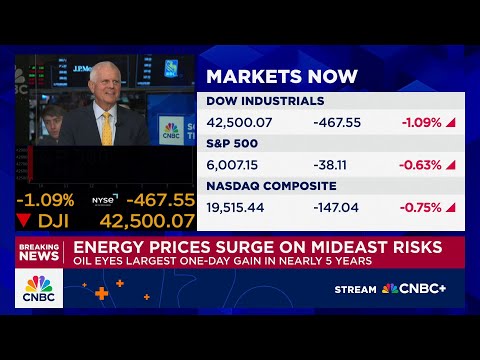
Ongoing volatility will impact equity markets for the year, says Citi's Scott Chronert
CNBC Television· 2025-06-13 14:18
Closer look at the markets here and reaction to the geopolitical news overnight. S&P's down 610 of 1%. Scott Croner joins us, Cityroup US equity strategist.He's here at Post 9. He raised his year-end S&P target to 6,300 this week from 5800. So kind of catching up with the market here, I guess, as we continue to make new highs, although a step back today.Does this how do you think that what happened overnight impacts the US equity market if at all. Yeah, Sarah. So, I I the way we've been talking about it is ...

ZKH Group Limited Announces New Share Repurchase Program
Prnewswire· 2025-06-13 10:00
Core Viewpoint - ZKH Group Limited has announced a new share repurchase program, allowing the company to buy back up to US$50 million worth of its shares over the next 12 months, reflecting confidence in its intrinsic value and long-term growth prospects [1][3]. Company Overview - ZKH Group Limited is a leading maintenance, repair, and operations (MRO) procurement service platform in China, leveraging robust supply chain capabilities and innovative technology to serve a global customer base [4]. - The company operates through multiple online platforms, including the ZKH platform, GBB platform, and Northsky platform, providing tailored MRO procurement solutions aimed at reducing costs and improving management efficiency [4]. Financial Strategy - The share repurchase program will be funded from the company's existing cash balance, indicating a strong financial position [2]. - The program is expected to be executed through various means, including open market purchases and privately negotiated transactions, depending on market conditions [2]. Management Commentary - The Chairman and CEO of ZKH expressed strong confidence in the company's business model and its ability to drive sustainable growth, supported by a healthy balance sheet and effective strategic execution [3].

Lear (LEA) 2025 Conference Transcript
2025-06-11 16:15
Lear (LEA) 2025 Conference Summary Company Overview - Lear Corporation is a leading supplier of seating and electronics in the automotive industry, recognized for its strong margin performance and operational efficiency [1][2]. Key Financial Highlights - **Q2 Financial Expectations**: - Projected revenues of $5.9 billion - Operating income between $260 million to $270 million, indicating an operating margin in the mid-4% range - Free cash flow expected between $50 million to $100 million - Plans to restart share repurchases targeting around $25 million in the quarter [3][4][5]. - **Guidance**: - The company plans to reinstate guidance during the Q2 earnings call, with visibility into the second half of the year [6][7]. Operational Performance - **Restructuring and Automation**: - Continued progress on restructuring efforts and automation initiatives, contributing to strong operational performance [2][3]. - **Wire Business**: - Strong performance from the wire business in Mexico, which had previously struggled [2][3]. Market Dynamics - **Tariff Negotiations**: - Successful tariff negotiations with expectations of minimal leakage in Q2 [4]. - Gross tariff exposure for 2025 estimated at $200 million, with significant recoverability agreements in place [17][19]. - **Production Environment**: - Modest changes in customer production plans, with no significant disruptions noted [8][10]. Margin Insights - **Variable Margins**: - Seating variable margins range from 15% to 20%, influenced by vertical integration levels [11][12]. - E Systems margins typically range from 20% to 25%, with regional variations impacting performance [13][14]. Strategic Focus - **Capital Allocation**: - Prioritization of capital investments in business segments and returning excess cash to shareholders through share repurchases [38][39]. - **M&A Opportunities**: - Interest in tuck-in acquisitions, particularly in the wiring and seating components sectors, to enhance competitive positioning [40][41]. Innovation and Growth - **Product Innovation**: - Continued focus on product innovation, with significant awards and contracts in thermal comfort and zonal control technologies [66][68]. - **Market Share Growth**: - Confidence in increasing market share in seating due to superior competitive positioning and ongoing investments [47][50]. Risks and Opportunities - **Economic Resilience**: - Potential volume opportunities if the U.S. economy continues to show strength, despite risks from trade negotiations and material costs [52][54]. - **Material Costs**: - Increased pass-through protection for steel and copper, with current coverage at 90% for steel [62][63]. Regional Insights - **China Market**: - Progress in increasing revenue from Chinese domestic OEMs, with expectations to reach 40% by year-end [72][73]. - **U.S. Production Trends**: - Anticipation of increased U.S. production due to recent announcements from General Motors, which is expected to positively impact Lear [28][29]. Conclusion - Lear Corporation is positioned for continued growth through operational efficiencies, strategic capital allocation, and a focus on innovation, while navigating challenges related to tariffs and market dynamics. The company remains optimistic about its ability to capture new business opportunities and expand margins in the coming years [50][84].

CRA International (CRAI) Conference Transcript
2025-06-11 15:45
Summary of CRA International (CRAI) Conference Call - June 11, 2025 Company Overview - **Company Name**: Charles River Associates (CRAI) - **Industry**: Consulting, specifically in legal and regulatory consulting and management consulting - **Revenue Breakdown**: Legal and regulatory consulting accounts for approximately 80% of revenue, while management consulting makes up the remaining 20% [5][6] Key Points and Arguments - **Company History**: CRA is celebrating its 60th anniversary, founded by professors from MIT and Harvard, focusing on delivering academic-quality research to the business world [5] - **Employee Retention**: CRA has a strong retention rate, with less than 10% turnover among top revenue generators over the past five years, indicating a positive work environment [9] - **Client Base**: CRA has worked with 85 of the Fortune 100 companies in the past two years and 98 of the Amlaw 100 law firms, showcasing its strong market position [12][13] - **Financial Performance**: Over the past ten years, CRA has seen a sixfold increase in stock price and a 2.5 times growth in revenue, with consistent performance across various time frames [15] - **Capital Allocation**: CRA has a strategy of returning excess capital to shareholders primarily through share repurchases, with a significant reduction in shares outstanding over the past decade [29] - **Shareholder Yield**: The current shareholder yield is approximately 6%, reflecting a growing market value for CRA [30] Growth and Market Dynamics - **Headcount and Talent Acquisition**: CRA is adding headcount in both legal regulatory and management consulting areas, despite a temporary flattening due to excess capacity in life sciences [34][36] - **Growth Factors**: Economic uncertainty and M&A activity levels are potential limiting factors for growth. CRA has historically performed well across various macroeconomic environments [37][38] - **Promising Segments**: The antitrust and competition economics practice, forensic practice, and energy practice are highlighted as areas with significant growth potential [41][43] Capital Structure and Acquisition Strategy - **Willingness to Take on Debt**: CRA is open to taking on debt for the right acquisition opportunities, emphasizing that any debt would be based on the asset's value rather than for share repurchases [46][48] - **Active Acquisition Pipeline**: There is an active pipeline for acquisitions, with CRA positioned to benefit from industry disruptions and seeking to attract the right candidates for growth [49] Conclusion - **Future Outlook**: CRA's success is attributed to its collective talent and the ability to adapt to changing market conditions. The company is well-positioned for future growth and continues to celebrate its legacy while looking ahead [52]