Bubble

Search documents
X @Raoul Pal
Raoul Pal· 2025-11-20 01:50
Tough to argue its an AI bubble when everyones revenues keeps rising massively...the only bubble might be in VC funding, but thats Power Law for you. You have to have enough shots to hit goal and the AI model factors in many zeroes.Nothing to see yet, move on. ...
AI stocks soared in 2025, but are valuation and bubble concerns killing the rally?
Yahoo Finance· 2025-11-15 16:24
Is AI a bubble or a generational boom? Yahoo Finance convenes Wedbush Securities managing director and global head of technology research Dan Ives, EMJ Capital founder and president Eric Jackson, and BlackRock (BLK) Americas chief investment and portfolio strategist Gargi Chaudhuri to debate Nvidia (NVDA), Tesla (TSLA), OpenAI (OPAI.PVT), and how AI will reshape jobs, markets, and the next leg of the AI trade. Palantir (PLTR) co-founder and CEO, Alex Karp, sits down with Yahoo Finance anchor Josh Lipton to ...


Iuorio: A.I. in "First Third" of Bubble Creation, Market Due for 5% Pullback
Youtube· 2025-11-14 01:00
Market Performance - The market has shown a lack of positive reaction following the government reopening, indicating potential weakness despite being in a longer-term bull market [2][3][4] - The NASDAQ is currently 15% below its recent high, suggesting room for correction [4] AI Sector Insights - There is a belief that the AI sector may be in an early stage of a bubble, with signs of excessive enthusiasm reflected in stock price movements [5][6] - A potential 30% correction in AI stocks is anticipated within the next 18 months, raising questions about investor readiness for such a downturn [8][9] Federal Reserve Outlook - The Federal Reserve's upcoming decisions are seen as data-dependent, with expectations leaning towards a 25 basis point easing in December [22][23] - Concerns about the accuracy of economic data collection methods are highlighted, suggesting the Fed may be operating with limited visibility [21][22] Consumer Sentiment and Economic Disparity - Consumer sentiment is reported to be near all-time lows, despite high stock market performance, indicating a disconnect between asset holders and the broader population [24][25] - The economic landscape is described as K-shaped, where the top 30-40% benefit from rising asset prices while the lower 60% face challenges such as increased grocery costs [26][27]

'We're Not in the Bubble Camp,' Says BI's Dougherty
Youtube· 2025-11-13 21:17
Core Insights - The integration between private and public markets is a significant trend that warrants close observation [1] - Companies are broadening their relationships and creating structures that may lead to potential IPOs in the long term [2] - The scale of certain companies, referred to as "deca-corns," is substantial, with some having implied valuations over $100 billion [3] Company Dynamics - Partnerships formed by large companies are critical for future growth, and there is a belief that the current market is not in a bubble [4] - OpenAI's implied valuation has more than doubled over the past year, indicating strong growth potential in the ecosystem [5] - The demand elasticity in the market suggests that any efficiency gains will lead to increased demand, driving further innovation [7] Market Trends - There is a noted tension in the market, with investor sentiment fluctuating between optimism and risk aversion, particularly as 2026 approaches [8] - The volatility in the market is expected to persist, and investors should be prepared for this as they consider fundamentals [9] - A holistic approach to investing is recommended, focusing on benchmark indices rather than individual stock picking to navigate through market disruptions [10][11]

Is the AI Rally Over? 3 Defensive Dividend Stocks to Rotate Your Profits Into
247Wallst· 2025-11-11 15:06
Core Viewpoint - There is a noticeable shift in sentiment among analysts and retail investors regarding the market, with an increasing belief that the AI rally has evolved into a bubble [1] Group 1 - Analysts are expressing concerns about the sustainability of the AI rally, indicating a potential shift in market dynamics [1] - Retail investors are also beginning to align with this cautious perspective, suggesting a broader market sentiment change [1]


Is Now the Time to Go All-In on Tech Stocks?
A Wealth Of Common Sense· 2025-11-06 18:48
Core Insights - The discussion revolves around the implications of potential market bubbles and the strategies investors should adopt based on their age and investment horizon [4][5][6]. Investment Strategies - Young investors, particularly those around 35, are encouraged to remain invested even during market fluctuations, as they have a longer time horizon to recover from downturns [5][6]. - The importance of diversification increases with age, as older investors have less time to recover from market losses [5]. - Investors should consider building market manias into their investment plans rather than trying to time the market, which is often fraught with mistakes [6][7]. Market Trends - The Vanguard Information Technology ETF (VGT) has shown significant growth, with a $10,000 investment in 2010 growing to nearly $165,000, reflecting a total return of over 1500% [9]. - The top stocks in major indices like the S&P 500 and Nasdaq 100 are predominantly technology companies, indicating heavy tech exposure for most investors [9][10]. - The market capitalization of leading tech companies, referred to as the "Mag 7," is approximately $22 trillion, highlighting their dominance in the market [12]. Technological Growth - There is strong conviction in the potential for technological advancements, particularly in AI, quantum computing, and robotics, which are expected to drive significant profits over the next 10-15 years [7][13]. - Despite concerns about being late in the investment cycle, the ongoing innovation in technology suggests that substantial growth opportunities remain [14][15]. Volatility Considerations - Investors looking to increase their tech exposure should be prepared for higher volatility, as tech stocks can experience significant price swings [15][17]. - The sentiment around investing heavily in tech may feel greedy, but historical trends indicate that such investments can still yield positive returns even after periods of skepticism [15].
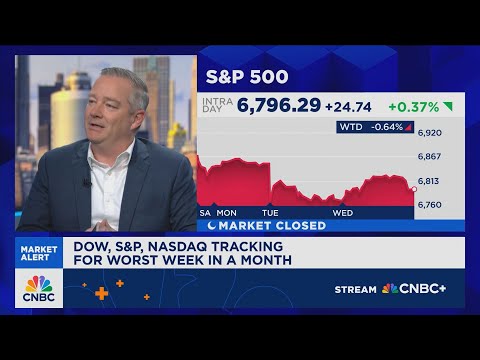
Hackett: The earnings trajectory is very strong and broadening beyond AI names
CNBC Television· 2025-11-06 12:10
Market Sentiment & Tariffs - The market initially reacted positively to a stronger-than-expected ADP report and skepticism surrounding the legality of tariffs, suggesting a hope for their repeal [1] - Investors exhibit a "buy the dip" mentality, potentially overemphasizing positive news regarding tariffs [3][4] - The market generally dislikes uncertainty, and the potential for tariff refunds outweighs the perceived risks [2][3] Bond Market & Treasury - The 10-year Treasury yield moved up by approximately 5-6 basis points due to the jobs report and the possibility of tariff repeal leading to increased bond issuances [5] - Potential tariff refunds for corporations, if mandated by the Supreme Court, would necessitate increased Treasury issuances [6] Earnings Season & Outlook - Earnings trajectory is strong, with convergence between AI-focused companies and other market sectors [10] - Resilient consumers and better-than-expected margins contribute to strong earnings, mitigating worst-case scenario concerns [11] - Dollar strengthening over the past three months has contributed to outsized earnings beats [9] Market Dynamics & Bubble Concerns - Smaller, less prominent companies are experiencing rallies following earnings beats, while previously strong performers face pullbacks [12] - Despite concerns from some analysts, the market may be moving past bubble fears, particularly in the AI space, due to fundamental differences compared to past bubbles [14][15] - There's a degree of froth and expectations have caught up with reality in the AI space, sideways movement is healthy [15]
Opinion: This Is the Biggest Bubble on Wall Street Right Now -- and I'm Not Talking About Artificial Intelligence (AI)
The Motley Fool· 2025-11-05 08:51
Core Insights - The rapid rise of quantum computing stocks is expected to be followed by a significant decline, indicating a potential bubble in the market [1][10][11] Market Performance - Quantum computing stocks have shown trailing-12-month returns of up to 3,170% as of October 31, with companies like IonQ, Rigetti Computing, D-Wave Quantum, and Quantum Computing Inc. leading the surge [2] - Current market capitalizations for these companies range from $3.7 billion for Quantum Computing Inc. to $21.7 billion for IonQ, despite a lack of supporting data for such high valuations [3] Technology and Use Cases - Quantum computing utilizes specialized computers based on quantum mechanics to solve complex problems beyond the capabilities of traditional computers [5] - Potential applications include enhancing AI algorithms, improving drug trial success rates, strengthening cybersecurity, refining weather forecasting, and optimizing investment portfolios [5] Investment Dynamics - The surge in quantum computing stocks has been fueled by potential partnerships and financing opportunities, including discussions of equity stakes by the Trump administration [7] - Major cloud computing services like Amazon's Braket and Microsoft's Azure Quantum are providing access to quantum computing resources, further legitimizing the technology [8] Market Sentiment - The phenomenon of "FOMO" (fear of missing out) is driving investor behavior, contributing to the rapid price increases of quantum computing stocks [9] - Historical trends suggest that every major technological advancement has experienced a bubble-bursting event, indicating that quantum computing may follow suit [12][15] Valuation Concerns - Current valuations of quantum computing stocks are unsustainable, with price-to-sales (P/S) ratios reminiscent of the dot-com bubble, where leading companies peaked at P/S ratios of 30 to 40 [16] - The S&P 500's Shiller P/E Ratio is currently at 41.20, suggesting that a market correction could disproportionately affect high-valuation stocks like those in quantum computing [19][20] Future Projections - Consensus sales projections for 2027 indicate that even with significant sales growth, existing valuations for quantum computing stocks cannot be justified [18]