
Trade War

Search documents
'Far cry from what we need': Farmer reacts to Trump's $12B aid package
MSNBC· 2025-12-08 20:43
Happening right now at the White House, President Trump is hosting a roundt discussion with farmers. He announced a new 12 billion aid package to help farmers who are struggling because of his trade war with China. Joining us, Arkansas soybean farmer Scott Brown.Scott, really good to have you. Thanks for being here. >> Thanks for having me, Katie.>> 12 billion. How's that sound to you. >> Well, I appreciate the help, but um it's it's it's a far cry from what we need.Just the loss in corn this year with a re ...

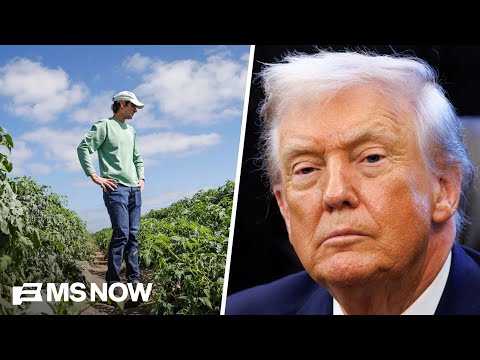
Trump to announce $12 billion aid package for farmers caught up in trade war
CNBC· 2025-12-08 17:47
Core Insights - The U.S. government is providing a $12 billion aid package to farmers affected by the trade war with China, with a significant portion allocated to support agricultural businesses [1][2]. Group 1: Aid Package Details - Up to $11 billion of the aid will be directed to the U.S. Agriculture Department's Farmer Bridge Assistance program, offering one-time payments to row crop farmers [2]. - The remaining $1 billion will be held by the USDA for evaluation of changing market conditions [2]. Group 2: Impact of Trade War - The agricultural industry is facing challenges due to the trade war, particularly from the halt of U.S. soybean purchases by China during critical harvest periods [4]. - Although China resumed some soybean purchases in late October, imports have not returned to previous levels, and stockpiles have reached recent highs [5]. Group 3: Future Projections - The U.S. administration maintains that China is expected to meet its projected purchase of 12 million metric tons of U.S. soybeans by the end of February, with a commitment to buy at least 25 million tons annually over the next three years [6].

X @Watcher.Guru
Watcher.Guru· 2025-12-08 04:24
JUST IN: 🇨🇳 China's annual trade surplus hits a record $1 trillion, despite trade war with the US. https://t.co/AVqs3TDAGZ ...
Nvidia (NASDAQ: NVDA) Bull, Base, & Bear Price Prediction and Forecast (Dec 5)
247Wallst· 2025-12-05 13:50
Core Insights - The trade war with China has negatively impacted Nvidia Corp. investors, leading to increased volatility and uncertainty in the stock performance [1] Company Impact - Nvidia Corp. has faced challenges due to tariffs and trade restrictions, which have affected its supply chain and market access in China [1] - The company's stock has experienced fluctuations as a result of the ongoing trade tensions, reflecting investor concerns about future growth prospects [1] Industry Context - The semiconductor industry, of which Nvidia is a part, is significantly influenced by geopolitical factors, particularly the relationship between the U.S. and China [1] - Trade policies and tariffs are reshaping competitive dynamics within the industry, potentially leading to shifts in market share among key players [1]


X @Bloomberg
Bloomberg· 2025-11-28 13:40
The Canadian economy rebounded sharply from the initial damage of the trade war as the country's growth drivers shifted to housing and government spending https://t.co/fhRjzYSm5X ...
X @The Economist
The Economist· 2025-11-28 13:40
To deal with the uncertainty of the trade war, Chinese companies’ best bet in the coming year will be to continue to diversify away from exporting to America and to focus on other markets, notably South-East Asia https://t.co/dUzNgkbqoN ...
X @Bloomberg
Bloomberg· 2025-11-28 12:00
On this episode of Everybody’s Business, the deputy editor of @Wirecutter and hosts @chafkin and @svaneksmith discuss how the trade war and recession fears may have delayed consumer discounts. Listen wherever you get your podcasts https://t.co/gd6NSP4oZn https://t.co/e0iU9XWJV2 ...
2026 年全球经济展望:有意识的再耦合-Global Economic Outlook 2026_ A conscious recoupling. Tue Nov 25 2025
2025-11-27 05:43
Summary of J.P. Morgan's Global Economic Outlook 2026: A Conscious Recoupling Industry Overview - The report focuses on the global economic outlook, particularly the impact of trade wars, labor markets, and fiscal policies on GDP growth and inflation trends. Key Points and Arguments Global Economic Growth - Global GDP growth is projected to be resilient, with an estimated increase of 2.3% in 2025, driven by strong capital expenditure (capex) in technology sectors despite a backdrop of trade war concerns [5][7][10] - A modest growth boost is expected from technology investments, particularly in AI, although productivity gains from these investments may take time to materialize [5][14][25] Labor Market Dynamics - Weak labor demand is eroding purchasing power, especially in the U.S., where private sector labor income growth is slowing amid rising inflation [5][19] - There is a projected 35% risk of the U.S. sliding into recession next year due to elevated downside risks interacting with depressed business sentiment [5][30] - The juxtaposition of strong business spending and weak hiring is unprecedented, indicating a potential shift in labor market dynamics [11][14] Inflation Trends - Global core inflation has remained sticky at around 3% for two years, influenced by tight labor markets and elevated wage inflation [5][24] - The expected rebound in labor demand amidst weak supply is likely to sustain inflationary pressures, with U.S. core inflation forecasted to remain above 3% in the first half of 2026 [5][58] Fiscal Policy and Economic Support - Front-loaded fiscal stimulus, particularly in the U.S. and China, is expected to boost global GDP growth in the first half of 2026 [5][21] - The fiscal easing implemented this year is projected to support growth but may lead to entrenched structural deficits, particularly in the U.S. [21][24] Trade War Impacts - The trade war has created imbalances, with tariff avoidance and new technologies contributing to capex strength, but business caution remains a significant drag on hiring [5][43] - The report notes a less disruptive trade war than initially anticipated, with tariff rates settling at levels significantly higher than earlier forecasts [46][54] Consumer Behavior and Spending - Consumer spending is expected to slow, particularly in the U.S., with a projected growth rate of around 1% in the fourth quarter of 2025 [20][19] - Households are in a strong position to smooth spending despite downward pressure on real labor income, but rising job security concerns could disrupt this [19][30] Future Scenarios - The report outlines various scenarios for the future, maintaining a 35% probability of recession, particularly in the U.S., while also highlighting the risks of sticky inflation and potential political influences on monetary policy [30][32] - The outlook suggests that the global economy has reached a critical juncture, with the potential for labor demand to recouple with GDP gains if supportive conditions persist [15][25] Other Important Insights - The report emphasizes the importance of business sentiment in navigating policy shocks and the unusual decoupling of capex growth from labor market performance [10][69] - It highlights the need for careful monitoring of consumer behavior and business sentiment as indicators of future economic resilience [19][30] This comprehensive analysis provides a detailed view of the current economic landscape and potential future developments, emphasizing the interconnectedness of global markets, labor dynamics, and fiscal policies.

X @The Economist
The Economist· 2025-11-26 04:00
Will retail sales in China suffer from a period of “payback”? Will the trade war with America throw the economy off course? And will the property market recover?These are the three big questions China will face in 2026 https://t.co/6Vm8pVioE6 ...
X @BBC News (World)
BBC News (World)· 2025-11-25 23:15
Can Canada wait out the trade war with the US? https://t.co/lGDP5dFdfK ...