Treasury Yields

Search documents
US Equity Indices Remain Stuck in the 'Tariff Scare' Range
Bloomberg Television· 2025-10-23 19:03
Earnings Season Performance - 86% of companies beat earnings expectations, which is in line with the average [3] - Strong results are seen across the board, but big upside moves are not necessarily observed, suggesting multiples may have reached a point where they can't push much higher [4] - Earnings have been a key reason for market resilience, with upward revisions of earnings estimates increasing profit estimates and providing an environment for multiple expansion [1] - Multiples tend to decrease when estimates are cut, indicating that valuations can remain high as long as numbers continue to be revised upwards [2] Bond Market and Economic Signals - Ten-year Treasury yields are below 4%, raising questions about whether the bond market is signaling concerns about equity and credit or reflecting expectations of quantitative easing or contained inflation [5][6] - The context of why the ten-year yield is falling is crucial; a falling yield due to a bad economic scenario implies lower earnings and valuations, while a falling yield due to an aggressive Fed or reduced Treasury issuance could still be beneficial for risk assets [8][9] - Fed GDP now is at 39% [5] Market Concentration and Potential Catalysts - The U S represents 30% of the global stock market, almost 50% now [10] - Concentration risk has been a topic for over a year, and past peaks of concentration (Nifty 50, tech bubble) were followed by lost decades of returns for equities [11][12] - A catalyst is needed for the concentration to unwind, and earnings growth of the "Magnificent Seven" is identified as a potential catalyst [12]


Stocks Hold Steady as Earnings Reports Pile In
Barrons· 2025-10-21 13:32
Core Insights - The stock market showed little movement despite a wave of strong earnings reports, with the Dow Jones Industrial Average increasing by 47 points, or 0.1% [1] - The S&P 500 remained flat, while the Nasdaq Composite experienced a slight decline [1] - Treasury yields decreased, with the 2-year note yield falling to 3.46% and the 10-year yield dropping to 3.96% [1]
Treasury Yields Snapshot: October 17, 2025
Etftrends· 2025-10-17 21:37
Group 1: Treasury Yields and Economic Indicators - The 10-year Treasury note yield fell below 4.00% for the first time in over a year, ending at 4.02%, while the 2-year note reached its lowest level since September 2022 at 3.46% [1] - An inverted yield curve, where longer-term Treasury yields are lower than shorter-term yields, is considered a reliable leading indicator for recessions, with the 10-2 spread turning negative before recessions [3][4] - The average lead time to a recession based on the first negative spread date is approximately 48 weeks, while using the last positive spread date yields an average lead time of 18.5 weeks [5][7] Group 2: Mortgage Rates and Federal Funds Rate - The Federal Funds Rate (FFR) influences borrowing costs for banks, which typically leads to higher mortgage rates when the FFR increases; however, recent trends show mortgage rates declining despite the Fed holding rates steady [8] - The latest Freddie Mac Weekly Primary Mortgage Market Survey reported the 30-year fixed mortgage rate at 6.27% [8] Group 3: Market Behavior and Federal Reserve Influence - Federal Reserve policy has significantly influenced market behavior, particularly in relation to Treasury yields and the S&P 500 [9]
Fed Signals Rate Cut, Credit Concerns Rattle Wall Street | Real Yield 10/17/2025
Bloomberg Television· 2025-10-17 21:19
Fed Policy and Labor Market - The Fed is focusing on the labor market and is expected to cut rates, potentially by 25 basis points in October, to achieve full employment [2][5] - Market participants anticipate the Fed will cut rates, with the two-year yield serving as an indicator of future Fed policy [3] - The market is pricing in a terminal funds rate of around 3%, aligning with estimates of a neutral rate, but there's downside risk if the economy softens [11][12] - The Fed's focus on the labor market weakness suggests a path towards lowering the federal funds rate, but cautiously, in increments of 25 basis points [6] - Tariffs are estimated to contribute about 10% to the current inflation rate, with the remaining impact expected over the next two to three quarters [50] Credit Market and Risk Assessment - Concerns about credit quality are emerging, with J P Morgan CEO Jamie Dimon warning of potential future credit problems, likening them to "cockroaches" [28][31] - Despite concerns, the investment-grade credit market shows resilience, supported by strong technicals and consistent inflows [33][34] - Investment-grade credit markets are experiencing 24 straight weeks of inflows, driven by attractive yields, while high-yield markets saw outflows [34][35] - Spreads between investment-grade banks and the rest of investment grade are relatively flat, indicating strong performance by big banks, but investors are advised to be cautious [38][39] Economic Outlook and Market Dynamics - The U S remains the best-performing country in terms of growth globally, despite trade war concerns with China [16][17] - The dollar's exposure has been somewhat hedged away, and foreign demand for U S assets, including corporate mortgage bonds, remains strong [16]

A proxy for jobless claims data: Here's what to know
CNBC Television· 2025-10-17 13:17
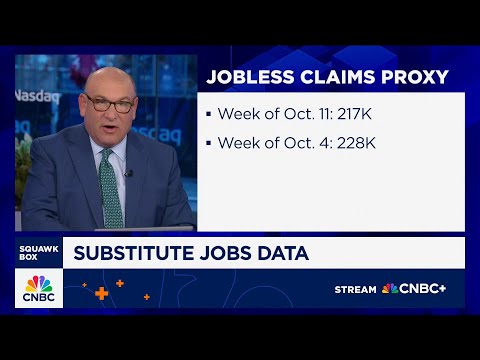
Labor Market Analysis - Haver Analytics estimates weekly jobless claims at 217,000 for the week of October 11th, compared to the government's 228,000 [1] - Continuing claims are estimated to be up at 1.942 million versus 1.92 million [2] - The economy is characterized as a relatively low fire, low hire environment, with no significant changes since the government stopped publishing data [4] - Goldman Sachs reports similar jobless claim numbers [5] Financial Market Conditions - Secured Overnight Funding Rate (SOFR) is at one-month highs, indicating a clamor for high-quality collateral and tightness in the financial market [11][12] - The rise in SOFR is reversing the effect of the Fed's rate cut on September 17th [13] - The fiscal year ended with 1.22 trillion to service the debt [16] Monetary Policy and Market Outlook - There's a divergence between jobless claims data and the Fed's concerns about the labor market [8] - The relationship between stocks and treasury yields is influenced by a "flight to good collateral" [9] - The current situation is not comparable to the great credit crisis [10] - Chairman Powell mentioned the possibility of ending quantitative tightening in the coming months due to some tightening in financial markets [17]
X @Bloomberg
Bloomberg· 2025-10-17 04:26
Five-year Treasury yields dropped to a one-year low as concerns surrounding US regional banks and lingering trade tensions fueled a flight to safety https://t.co/nO8ux2VXyU ...
Geopolitical risks that cause volatility are buying opportunities: Ayako Yoshioka
CNBC Television· 2025-10-14 20:22
Market Volatility & Earnings Season - Market volatility has returned as earnings season begins [1][2] - Initial bank earnings were positive, with Goldman Sachs and JP Morgan recovering from lows, and Wells Fargo performing strongly [2] - The start of earnings season is expected to be generally positive [3] - Treasury yields are down, boosting rate-sensitive sectors like home builders, which are up 3% [6] Market Trends & Sentiment - A broad reversal occurred, benefiting indexes and riskier assets like small caps and unprofitable companies [4] - A "mechanical dip buy" occurred in the morning, with retail investors supporting the market near Friday's low and the 50-day moving average [4] - The market is attempting to digest macro risks without overreacting, acknowledging that the backdrop is not perfect [6] - The market is expected to continue to experience choppiness [6] - Tech power and the AI theme are expected to continue driving markets higher [7] - Dips caused by social media posts and geopolitical risks are viewed as potential buying opportunities [7] Risk Factors - Social media posts from the president pose a risk to the market [1] - Trade headlines initially disrupted the low volatility upward trend [5] - The market has not fully cleared away risky, speculative assets [5]

Treasury Yields Snapshot: October 10, 2025
Etftrends· 2025-10-10 20:53
Group 1: Treasury Yields Overview - The yield on the 10-year Treasury note ended at 4.05% on October 10, 2025, while the 2-year note was at 3.53% and the 30-year note at 4.63% [1] - A long-term view of the 10-year yield shows significant historical context, starting from 1965, prior to the 1973 oil embargo [2] - The inverted yield curve, where longer-term yields are lower than shorter-term yields, is a reliable leading indicator for recessions, with the 10-2 spread turning negative before recessions [2][3] Group 2: Recession Indicators - The average lead time to a recession based on the first negative spread date is approximately 48 weeks, while using the last positive spread date yields an average of 18.5 weeks [4] - The 10-3 month spread also indicates a lead time to recessions ranging from 34 to 69 weeks, with similar patterns observed as in the 10-2 spread [5] - The most recent negative spread for the 10-3 month occurred from October 25, 2022, to December 12, 2024, with fluctuations between positive and negative since February 26 [5][6] Group 3: Mortgage Rates and Federal Funds Rate - The Federal Funds Rate (FFR) influences borrowing costs for banks, which in turn affects mortgage rates; however, recent trends show mortgage rates declining despite the Fed holding rates steady [7] - The latest Freddie Mac survey indicates the 30-year fixed mortgage rate at 6.30% [7] Group 4: Market Behavior and Federal Reserve Influence - Federal Reserve policy has been a significant factor in market behavior, particularly regarding Treasury yields and their relationship with the S&P 500 [8]
Treasury Yields Snapshot: October 3, 2025
Etftrends· 2025-10-03 20:50
Group 1: Treasury Yields Overview - The yield on the 10-year Treasury note ended at 4.13% on October 3, 2025, while the 2-year note was at 3.58% and the 30-year note at 4.71% [1] - A long-term view of the 10-year yield shows significant historical context, starting from 1965, highlighting the impact of events like the 1973 oil embargo [2] - The inverted yield curve, where longer-term yields are lower than shorter-term yields, is a reliable leading indicator for recessions, with the 10-2 spread turning negative before recessions [2][3] Group 2: Recession Indicators - The average lead time to a recession based on the first negative spread date is approximately 48 weeks, while using the last positive spread date yields an average lead time of 18.5 weeks [4][6] - The 10-3 month spread also indicates recession lead times ranging from 34 to 69 weeks, with similar patterns observed in past recessions [5] Group 3: Mortgage Rates and Federal Funds Rate - The Federal Funds Rate influences borrowing costs for banks, which in turn affects mortgage rates; however, recent trends show mortgage rates declining despite the Fed holding rates steady [7] - The latest Freddie Mac survey reported the 30-year fixed mortgage rate at 6.34% [7] Group 4: Market Behavior and Federal Reserve Influence - Federal Reserve policy has been a significant factor in market behavior, particularly in relation to Treasury yields and the S&P 500 [8]

Market Valuation, Inflation and Treasury Yields – September 2025
Etftrends· 2025-10-02 13:32
Core Insights - US stock indexes are significantly overvalued, indicating cautious expectations for investment returns [1] Market Valuation (P/E10) and Inflation - The P/E10 ratio is a key indicator of market valuation and its correlation with inflation shows crucial patterns across three distinct periods: January 1881 to December 2007, January 2008 to February 2020, and March 2020 to present [2] - The current P/E10 stands at 38.6, with a year-over-year inflation rate of 3.05%, placing it just outside the historical "sweet spot" of 1.4% to 3.0% inflation, which has supported higher market valuations [3] Market Valuation (P/E10) and the 10-Year Treasury Yield - The correlation between P/E10 and the 10-year Treasury yield has been examined since 1960, revealing that the post-financial crisis period saw P/E10 ratios above 20 with yields below 2.5%, deviating from historical patterns [4][5] - The current yield of 4.12% suggests a shift away from the unprecedented low yield environment towards a scenario reminiscent of the tech bubble [5] Historical Context - The historical average P/E10 is 17.6, providing a benchmark for current valuations, which are currently in extreme valuation territory [6] - The inflation "sweet spot" is highlighted as a range historically associated with higher valuations, while the current P/E10 and inflation rate are marked for comparative analysis [6][7]