
证券虚假陈述责任纠纷

Search documents
退市5年,龙力生物案判决出炉!1618名投资者获赔超2.7亿元
证券时报· 2025-08-27 03:13
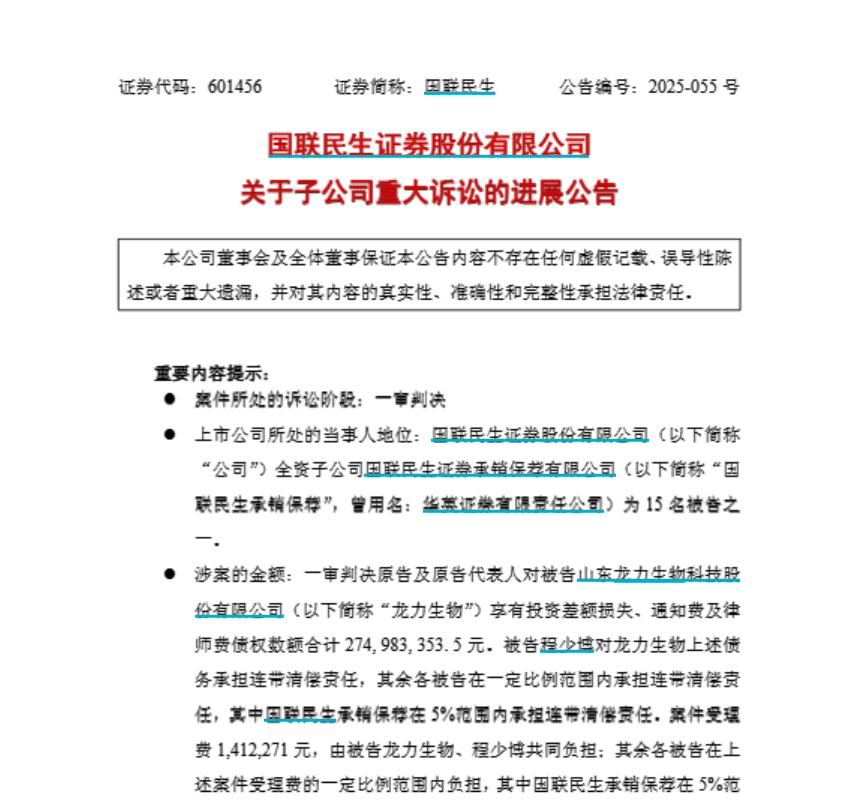
Core Viewpoint - The court ruling regarding the securities fraud liability dispute of Shandong Longli Biological Technology Co., Ltd. has been announced after five years of delisting, with 1,618 investors involved in the lawsuit claiming a total of 274 million yuan in investment loss and additional legal fees [2][5]. Summary by Sections Company Background - Longli Biological was listed on the Shenzhen Stock Exchange on July 28, 2011, under the stock code 002604, and was known as the "first stock of biofuels" [4]. - The company faced severe issues with systematic fraud, leading to its delisting from the stock exchange on July 1, 2020, after being labeled as "ST Longli" due to risk warnings [4]. Legal Proceedings - The lawsuit involved 1,628 investors who sought compensation for investment losses, commissions, and stamp duty losses from Longli Biological and associated parties, including its former chairman Cheng Shaobo and intermediary firms [5]. - The Jinan Intermediate People's Court ruled that the 1,618 plaintiffs are entitled to a total of 274 million yuan in investment loss claims and 809,000 yuan in legal fees, with additional notification fees for five representative plaintiffs [2][5]. Liability and Compensation - Cheng Shaobo is held jointly liable for the debts owed to the plaintiffs, while other defendants share liability within specified limits [2][5]. - The intermediary firm Guolian Minsheng Securities is responsible for 5% of the plaintiffs' losses, while Lixin Accounting Firm is liable for 30% [2][5]. Implications for Intermediaries - The ruling emphasizes the principle of holding primary offenders accountable while also ensuring that intermediaries are appropriately penalized based on their level of responsibility, thus maintaining a balance in liability [9].


退市5年,龙力生物案判决出炉!1618名投资者获赔超2.7亿元
Zheng Quan Shi Bao Wang· 2025-08-27 01:45
Core Viewpoint - The first-instance judgment regarding the securities false statement liability dispute of Shandong Longli Biological Technology Co., Ltd. has been issued after five years of delisting, with 1,618 investors participating in the lawsuit and claiming a total of 274 million yuan in investment loss [1][2][3]. Group 1: Legal Proceedings and Financial Implications - The Jinan Intermediate People's Court ruled that the 1,618 plaintiffs are entitled to a total investment loss claim of 274 million yuan and legal fees of 809,000 yuan, with five representative plaintiffs also entitled to notification fees of 80,600 yuan [1][3]. - Defendant Cheng Shaobo is jointly liable for the debts owed to the plaintiffs, while other defendants bear joint liability within a certain proportion [1][3]. - Guolian Minsheng Securities is liable for 5% of the plaintiffs' losses, while Lixin Accounting Firm is liable for 30% of the plaintiffs' losses [1][3]. Group 2: Company Background and Historical Context - Longli Biological was listed on the Shenzhen Stock Exchange on July 28, 2011, under the stock code 002604, and was known as the "first stock of biofuels" [2]. - The company was placed under risk warning on January 19, 2018, and was officially delisted on July 1, 2020, transitioning to the National Equities Exchange and Quotations [2]. - The China Securities Regulatory Commission previously identified Longli Biological for significant fraud, leading to penalties including a fine of 600,000 yuan for the company and 1.5 million yuan for Cheng Shaobo [2]. Group 3: Future Considerations and Company Status - Following the judgment, the parties involved may appeal to the Shandong High People's Court, indicating that the final outcome remains uncertain [4]. - Guolian Minsheng Securities stated that the lawsuit will not have a significant adverse impact on the company's current or future profits, as the financial status of the company remains stable and operations are normal [4].
龙力生物虚假陈述案1618名投资者获赔2.7亿,中介机构连带赔偿
Cai Jing Wang· 2025-08-26 08:55
Core Viewpoint - After five years of delisting, Shandong Longli Biological Technology Co., Ltd. has been ordered to compensate 1,618 investors a total of over 270 million yuan due to securities false statements [1] Group 1: Legal Proceedings - The Jinan Intermediate Court has ruled that the 1,618 plaintiffs collectively hold a claim for investment loss of 274 million yuan and legal fees of 809,000 yuan against Longli Biological [1] - Five representative plaintiffs also have a claim for notification fees amounting to 80,600 yuan [1] Group 2: Liability of Defendants - Defendants Cheng Shaobo and others are jointly liable for the debts of Longli Biological [1] - Guolian Minsheng Securities Co., Ltd. is responsible for 5% of the plaintiffs' total losses as part of the joint compensation [1] - Lixin Certified Public Accountants is liable for 30% of the plaintiffs' total losses in the joint compensation [1]

上海金融法院共受理证券虚假陈述案件1.8万件
Zheng Quan Ri Bao· 2025-08-20 23:16
Core Insights - The Shanghai Financial Court released a report on legal risk prevention regarding securities false statement liability disputes, coinciding with its seventh anniversary [1] - From 2018 to 2024, the court accepted 18,040 first-instance cases related to securities false statements, with a total amount in dispute of 7.646 billion and 26,956 investors involved, of which institutional investors represented only 0.26% [1] Group 1: Case Characteristics - The number of companies being sued has increased, covering multiple levels of the capital market, with a total of 77 companies involved [2] - The types of false statements are diverse, with financial fraud being particularly prominent, accounting for over one-third of the cases, including revenue, cost, cash flow fraud, and misuse of accounting estimates [2] - The court is balancing investor protection with the development of listed companies, recognizing some false statements as not significant or lacking causal relationship in certain cases [2] Group 2: Legal and Judicial Challenges - New types of disputes have emerged, focusing on compensation for investment differences, commissions, and stamp duty losses [3] - The report highlights the need for a more comprehensive accountability system and improved collaboration in fact-finding, especially in cases without administrative penalties [3] - The court is innovating in creating a resolution model for collective securities disputes and enhancing mechanisms for protecting small investors [3] Group 3: Recommendations for Market Participants - Recommendations for securities issuers include eliminating fraudulent issuance, improving corporate governance, and ensuring timely disclosure of significant events [4][5] - Controlling shareholders and actual controllers are advised to exercise their control rights in a regulated manner and ensure transparency in related transactions [5] - Directors and supervisors should fulfill their duties diligently, report issues promptly, and implement mechanisms for dissent and exemption [5] Group 4: Case Studies and Impact - The report includes ten selected cases, five related to judicial disputes over false statements and five concerning administrative enforcement of information disclosure violations [5] - These cases focus on common disputes and new legal issues, clarifying judicial principles and enforcement standards to enhance market rule expectations [5] - The release of these cases aims to protect investor rights, promote better corporate governance, and ensure compliance by intermediaries and executives [5]
上海金融法院共受理证券虚假陈述案件1.8万件 涉案标的总额为76.46亿元 涉及2.7万投资者
Zheng Quan Ri Bao· 2025-08-20 17:00
Core Viewpoint - The Shanghai Financial Court released a report on legal risk prevention related to securities false statements, highlighting the increase in related lawsuits and the need for improved governance and compliance among market participants [1][2][4]. Group 1: Case Statistics and Trends - From 2018 to 2024, the Shanghai Financial Court accepted 18,040 first-instance cases of securities false statement liability disputes, with a total amount in dispute of 7.646 billion yuan and 26,956 investors involved, of which institutional investors accounted for only 0.26% [1]. - The number of companies sued for false statements has risen, with a total of 77 companies involved, reflecting a broader range of capital market segments including the Shanghai and Shenzhen main boards, STAR Market, ChiNext, New Third Board, and interbank market [2]. - Financial fraud is a prominent issue, with over one-third of the false statements related to financial information, including revenue fraud, cost and expense fraud, cash flow fraud, and misuse of accounting estimates [2]. Group 2: Legal Framework and Recommendations - The report emphasizes the need for a balanced approach to protect investor rights while allowing for the development of listed companies, with a focus on holding primary offenders accountable and addressing complicity [2][3]. - Recommendations for market participants include improving corporate governance, enhancing financial regulations, and ensuring timely disclosure of significant events to mitigate risks associated with fraudulent activities [4][5]. - The report suggests that controlling shareholders and actual controllers should exercise their control rights responsibly, while directors and supervisors should fulfill their duties diligently and report issues promptly [5]. Group 3: Judicial and Regulatory Innovations - The report outlines the need for a comprehensive accountability system and improved collaboration in fact-finding among administrative, civil, and criminal proceedings related to securities false statements [3]. - The Shanghai Financial Court is innovating in creating a model for resolving collective disputes in the securities market and enhancing mechanisms for protecting the rights of small and medium investors [3]. - The release of ten selected cases aims to clarify common disputes and new legal issues in false statement cases, reinforcing market rules and expectations to purify the capital market ecosystem [5].
上海金融法院共受理证券虚假陈述案件1.8万件 涉案标的总额为76.46亿元,涉及2.7万投资者
Zheng Quan Ri Bao· 2025-08-20 16:26
Core Viewpoint - The Shanghai Financial Court released a report on legal risk prevention related to securities false statements, highlighting the increase in related lawsuits and the need for improved accountability mechanisms in the financial market [1][2]. Group 1: Case Statistics and Trends - From 2018 to 2024, the Shanghai Financial Court accepted 18,040 first-instance cases of securities false statement liability disputes, with a total amount in dispute of 7.646 billion yuan and 26,956 investors involved, of which institutional investors accounted for only 0.26% [1]. - The number of companies being sued has increased, covering various capital market segments, with a total of 77 companies involved in lawsuits since the introduction of regulations in 2022 [2]. - Financial fraud is a prominent issue, with over one-third of false statements related to financial information, including revenue, cost, cash flow manipulation, and misuse of accounting estimates [2]. Group 2: Legal Framework and Recommendations - The report emphasizes the need for a balanced approach to protect investor rights while allowing for the development of listed companies, with a focus on holding primary offenders accountable and addressing complicity [2]. - Recommendations for securities issuers include eliminating fraudulent issuance, improving corporate governance, and ensuring timely disclosure of significant events [4]. - Suggestions for controlling shareholders and actual controllers include exercising control rights responsibly and ensuring transparency in related transactions [4]. Group 3: Role of Intermediaries and Case Studies - Intermediaries are advised to strengthen due diligence obligations and ensure compliance and independence in their professional opinions [5]. - The report includes ten selected cases, five related to judicial disputes over false statements and five concerning administrative enforcement of information disclosure violations, aimed at clarifying judicial principles and enhancing market expectations [5]. - The publication of these cases is expected to protect investor rights further, promote better corporate governance, and ensure that intermediaries and executives fulfill their legal responsibilities [5].
事关证券虚假陈述责任纠纷案件 上海金融法院最新发布
Zheng Quan Shi Bao Wang· 2025-08-20 09:58
Core Insights - The Shanghai Financial Court has accepted over 23,000 cases of securities false statement liability disputes since its establishment, with a total claim amount of 7.646 billion yuan [1] - The report indicates that individual investors constitute 99.74% of the plaintiffs, highlighting a trend of small case amounts and dispersed claims [1] Group 1: Case Statistics - From 2018 to 2024, the court is expected to handle 18,040 securities false statement liability disputes, with a total claim amount of 7.646 billion yuan [1] - The average claim amount per investor is approximately 283,600 yuan, indicating a pattern of small individual claims [1] Group 2: Types of False Statements - Financial information-related false statements account for over one-third of the cases, including revenue fraud, cost manipulation, and cash flow misrepresentation [2] - Other significant types of false statements include concealing related party transactions and improper disclosure of predictive information [2] Group 3: Litigation Trends - Most investor claims focus on compensation for investment losses, commissions, and stamp duty losses [2] - There has been a notable increase in lawsuits against controlling shareholders, actual controllers, and intermediaries since 2022, indicating a developing accountability system for false statements [2] Group 4: Legal Risk Categories - The report categorizes legal risks into five main types, including disputes arising from false statements by listed companies, internal personnel, securities intermediaries, major asset restructuring counterparties, and recovery rights disputes [4][5][6][7] - Each category outlines specific behaviors leading to disputes and the associated legal responsibilities of the involved parties [4][5][6][7] Group 5: Recommendations - The report provides recommendations for various market participants, including securities issuers, controlling shareholders, board members, intermediaries, and related parties involved in major asset restructurings [7]
事关证券虚假陈述责任纠纷案件,上海金融法院最新发布
Zheng Quan Shi Bao Wang· 2025-08-20 09:32
8月20日,在建院七周年之际,上海金融法院召开新闻发布会。证券时报记者从发布会现场获悉,上海 金融法院建院以来共受理证券虚假陈述责任纠纷案件2.3万余件。 发布会现场,上海金融法院发布《证券虚假陈述责任纠纷法律风险防范报告》(以下简称《报告》), 对2018—2024年受理的证券虚假陈述责任纠纷案件进行统计分析。根据《报告》,截至2024年12月,上 海金融法院共受理证券虚假陈述责任纠纷18040件,标的总额为76.46亿元,原告以自然人为主。 从虚假陈述类型来看,被诉发行人往往多种虚假陈述行为交织,其中涉财务信息类虚假陈述行为数量占 比达1/3以上,具体包括收入造假、成本费用造假、现金流造假、滥用会计估计调节损益等。其次为隐 瞒关联交易,包括隐瞒关联方身份、关联担保、关联资金占用等。此外,不当披露预测性信息在被诉虚 假陈述行为中也占据一定比重。 从诉讼类型来看,多数投资者的诉请集中于赔偿投资差额、佣金及印花税损失等。与此同时,近年来, 司法实践中还出现若干新类型争点,包括多层次资本市场不同板块的法律适用和损失核算问题;预测性 信息的识别与"安全港"规则适用;帮助造假者的"明知"标准认定;上市公司董监高公开承 ...
600310,财务造假遭索赔
Di Yi Cai Jing Zi Xun· 2025-08-03 13:19
Core Viewpoint - Guangxi Energy (600310.SH) inflated its revenue by a total of 6.8 billion yuan over two years, leading to administrative penalties and a lawsuit from 10 investors who sought compensation of 142,300 yuan but lost in the first instance [2][4][5]. Group 1: Financial Misconduct - Guangxi Energy inflated its revenue by 3.542 billion yuan in 2019 and 3.286 billion yuan in 2020, violating information disclosure regulations [2][5]. - The inflated figures represented 13.39% and 14.07% of the reported revenue and costs for 2019, respectively [5]. - The 2020 semi-annual report also showed significant overstatements, with 3.286 billion yuan in inflated revenue and costs, accounting for 28.95% and 30.16% of the reported figures [6]. Group 2: Legal Proceedings - The court dismissed the lawsuit from the 10 investors, stating that the alleged false statements did not significantly impact stock prices or trading volumes [8][9]. - The investors purchased shares between April 15, 2020, and January 5, 2022, and claimed losses after selling or holding the stock [7][8]. - Other individual investors also attempted to claim damages through civil lawsuits but faced similar outcomes, with courts ruling that the false statements did not have a substantial effect on market performance [8][9]. Group 3: Regulatory Actions - The Guangxi Securities Regulatory Bureau issued a warning and imposed fines totaling 1.2 million yuan on Guangxi Energy and its executives for the violations [6]. - Key executives, including the chairman and financial director, received individual fines ranging from 600,000 to 800,000 yuan for their roles in the misconduct [6]. Group 4: Investor Sentiment - Legal experts suggest that the severity of the violations may justify investor claims, and they recommend considering appeals against the first-instance rulings [3][10]. - The negative outcomes of these lawsuits could undermine investor confidence in Guangxi Energy and raise concerns about the risks associated with similar legal actions in the future [10].


广西能源财务造假遭索赔,10名投资者一审败诉引争议
Di Yi Cai Jing· 2025-08-03 11:43
Core Viewpoint - Guangxi Energy (600310.SH) inflated its revenue by a total of 6.8 billion yuan over two years, leading to administrative penalties and a lawsuit from 10 investors seeking compensation of 142,300 yuan, which was dismissed in the first instance [1][3][4]. Group 1: Financial Misconduct - Guangxi Energy reported inflated revenues of 3.542 billion yuan in 2019 and 3.286 billion yuan in 2020, violating information disclosure regulations [1][4]. - The company was penalized by the China Securities Regulatory Commission (CSRC) for these violations, receiving a warning and a fine of 1.2 million yuan [6]. - The inflated figures represented 13.39% and 14.07% of the reported revenue and costs for 2019, and 28.95% and 30.16% for the first half of 2020 [4][6]. Group 2: Legal Proceedings - The court dismissed the lawsuit from the 10 investors, stating that the inflated revenue did not significantly impact stock prices or trading volumes [1][8]. - The investors purchased shares between April 15, 2020, and January 5, 2022, and claimed losses after selling or holding the stock [5][6]. - Other individual investors also attempted to claim damages through civil lawsuits but faced similar outcomes, with courts ruling that the false statements did not lead to significant market changes [7][8]. Group 3: Investor Reactions and Future Actions - Legal experts suggest that the nature of the violations warrants investor claims, and they may consider appealing the court's decision [2][9]. - The first-instance ruling has raised concerns about investor confidence, as it may deter future claims against similar misconduct [9].