
癌症早筛

Search documents
多癌早筛成果登上国际顶级期刊《自然医学》
Xin Hua Ri Bao· 2025-06-03 21:48
Core Insights - The DECIPHER-Omnia study, led by the company, has been published in the prestigious journal Nature Medicine, highlighting advancements in cancer early screening technology [1] - The company has developed a non-invasive blood test, MERCURY, which can screen for nine common cancers using a single blood sample, addressing significant limitations in current cancer screening methods [1] Group 1: Cancer Screening Technology - The current cancer screening methods are invasive, have low compliance, and poor accuracy, primarily covering a limited range of cancers such as lung, breast, and colorectal cancers [1] - The MERCURY technology utilizes ultra-low depth whole genome sequencing combined with AI models to analyze cfDNA fragments in blood, identifying unique tumor signals [1] Group 2: Research and Community Impact - The "Jinling Cohort" project, initiated by the company in collaboration with Nanjing Jiangbei New Area and Nanjing Medical University, has provided free comprehensive health checks to nearly 15,000 residents, totaling 25,000 tests [2] - The study shows a specificity (true negative rate) of 98.1% and a sensitivity (true positive rate) of 53.8%, with 91% of detected positive cases being in the early stages of cancer, significantly improving treatment opportunities [2] Group 3: Future Directions - The company plans to deepen collaboration with Nanjing Jiangbei New Area to promote the widespread application of cancer early screening technologies using genomics and big data analysis [2]
关注无痛肠癌早筛 诺辉健康(06606)常卫清守护家人的“肠”寿之道
智通财经网· 2025-05-28 03:40
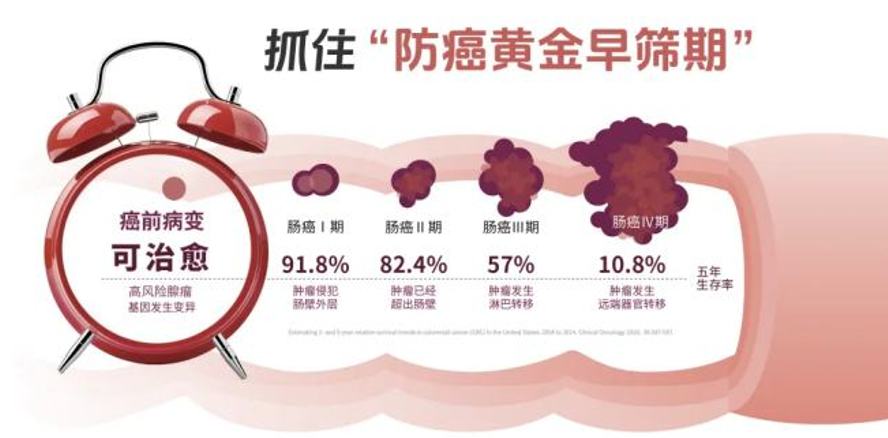
Group 1 - The cancer prevention and treatment situation in China remains severe, with 4.82 million new cancer cases and 2.57 million deaths reported in 2022, indicating a diagnosis every minute and a death every 15 seconds [1] - The top five cancers in terms of new cases are lung cancer, colorectal cancer, thyroid cancer, liver cancer, and stomach cancer, which together account for 57.42% of new cases, highlighting key areas for cancer prevention [1] - Early detection significantly improves cure rates for cancers, particularly colorectal cancer, where the five-year survival rate is 91.8% if detected early, but drops to 10.8% if treatment is delayed [1] Group 2 - Nohui Health's Changweiqing is a non-invasive colorectal cancer screening product that requires only a stool sample, utilizing triple detection technology with a negative predictive value of 99.6% [3] - All commercialized products from Nohui Health are supported by extensive clinical data, ensuring their professionalism, compliance, reliability, and high recognition [3] - Changweiqing is the only product included in all national colorectal cancer screening and treatment guidelines in China, underscoring its significance in the market [3]

“滴血验癌”成真?这家筛查胃癌的公司要上市了
凤凰网财经· 2025-05-21 13:36
Core Viewpoint - The article discusses the challenges faced by Mirxes Holding Company Limited (referred to as "Mirxes Group") in commercializing its blood-based cancer screening product GASTROClear, highlighting issues related to technology maturity, market education, and financial sustainability [3][4][24]. Group 1: Product Technology and Market Challenges - Mirxes Group's core technology is based on the detection of microRNA (miRNA), which plays a crucial role in gene regulation and is linked to various diseases, including cancer [5]. - GASTROClear, designed for early gastric cancer screening, claims a sensitivity of 87.5% for stage I gastric cancer, requiring only 5ml of blood for testing [5][6]. - Despite the promising technology, GASTROClear has not yet been commercialized in China, leading to a 16.14% decline in revenue to $2.028 million and a 32.55% increase in losses to $92.2147 million in 2024 [6][24]. Group 2: Pricing and Market Acceptance - GASTROClear is priced between $150 and $250, which is higher than traditional gastroscopy priced at $80 to $200, raising concerns about its competitiveness in the market [8]. - The specificity of GASTROClear is only 68.4%, meaning a significant number of false positives could lead to consumer skepticism and reluctance to adopt the product [9][10]. Group 3: Financial Needs and Investment Landscape - The company has relied heavily on external funding, with significant investments from various entities, including a $87 million C round financing in 2021 [15][16]. - As of March 31, 2025, Mirxes Group had only $2.6125 million in cash and cash equivalents, indicating a pressing need for capital to sustain operations [18]. - The company has not demonstrated the ability to generate revenue independently, with R&D expenses accounting for 94.19% of revenue in 2024, leading to a cumulative loss of $218 million since 2022 [20][23]. Group 4: Regulatory and Market Entry Barriers - Even if GASTROClear receives regulatory approval, the lack of a comprehensive cancer screening system in China poses significant challenges for market penetration [22]. - The Chinese healthcare system is primarily government-driven, and without support from public insurance, widespread adoption of cancer screening products like GASTROClear is unlikely [22].
三年亏十个亿,滴血认癌技术跑出一个新IPO
3 6 Ke· 2025-05-17 04:04
Company Overview - The company, founded by three medical doctors in Singapore, is preparing for an IPO on the Hong Kong Stock Exchange, planning to issue 46.62 million shares at a price of HKD 23.30 per share [1][2] - The founders have extensive backgrounds in biotechnology, with over 23 years of research experience in biochemistry and over a decade in the biopharmaceutical field [2][8] - The company specializes in developing and commercializing blood-based miRNA testing kits for cancer and other disease screenings [2][7] Financial Performance - The company has reported significant losses over the past three years, with losses of approximately USD 56.2 million, USD 69.6 million, and USD 92.2 million from 2022 to 2024, totaling nearly 1.4 billion RMB [3][12] - Despite multiple rounds of financing totaling USD 167 million, the company has faced cash flow challenges, with expenditures significantly exceeding revenues [12][14] Market Potential - The cancer screening market in regions such as China, Japan, Southeast Asia, and the United States has grown from USD 13 billion in 2019 to USD 15.2 billion in 2023, with projections to exceed USD 25 billion by 2033 [3][6] - The company operates in the liquid biopsy sector, with its flagship product, GASTROClear™, being the first molecular gastric cancer screening product to receive regulatory approval [7][14] Product Details - GASTROClear™ requires only 1 milliliter of blood for testing, offering a less invasive alternative to traditional endoscopic procedures [7][14] - The product has shown a sensitivity of 87.5% for stage I gastric cancer, but its specificity is only 68.4%, which may lead to a higher rate of false positives [14][15] Competitive Landscape - The company faces competition from other cancer screening firms, including Galleri, which offers a broader range of cancer detection through a single blood test [15][19] - The pricing of GASTROClear™ is positioned between USD 150 to USD 250, which may be less competitive compared to traditional endoscopic procedures that are often covered by insurance [15][16] Industry Challenges - The cancer early screening industry has seen significant investment but also faces scrutiny due to past failures and high-profile scandals, leading to a cautious investment environment [19][20] - The industry is characterized by high operational costs, with the company’s administrative expenses significantly outpacing its research and development spending [12][13][22]
诺奖级技术突围战,觅瑞撬动千亿癌症早筛市场
Sou Hu Cai Jing· 2025-05-09 06:55
Core Insights - The global cancer early screening market is experiencing rapid expansion, particularly in the gastric cancer screening sector, which has grown from $13 billion in 2019 to $15.2 billion in 2023, with projections to exceed $25 billion by 2033 [1][3] - Mirxes, a pioneer in miRNA technology, has developed GASTROClearTM, the world's first approved miRNA gastric cancer early screening kit, which offers a non-invasive, cost-effective, and convenient alternative to traditional screening methods [1][6] Market Growth - The gastric cancer screening market in China, Japan, Southeast Asia, and the U.S. is expected to see a compound annual growth rate (CAGR) of 4.1% from 2019 to 2023, accelerating to a projected CAGR of 6.8% from 2023 to 2028 [3][4] - The penetration rate of gastric cancer screening in high-risk populations in China has increased from 21.6% in 2019 to 27.8% in 2023, with expectations to rise to 67% by 2033 [4] Technological Advancements - Mirxes has successfully commercialized miRNA early screening products, overcoming significant challenges in the industry related to the detection of subtle differences between miRNAs [5][7] - GASTROClearTM has demonstrated a high sensitivity of 87% for overall gastric cancer detection, with specific sensitivities of 87.5% for stage I cancer and 75% for lesions smaller than 1 cm [9] Business Strategy - Mirxes plans to initially offer GASTROClearTM as a laboratory-developed test (LDT) to build brand awareness before transitioning to in vitro diagnostic (IVD) product sales [2] - The company has submitted an IPO application to the Hong Kong Stock Exchange, aiming to leverage its unique miRNA technology for rapid market expansion [1][10] Financial Performance - In 2024, GASTROClearTM generated $6.278 million in revenue, accounting for 30.9% of total revenue, with a gross profit of $1.9234 million and a gross margin of 70.6% [10][11] - The detection volume for GASTROClearTM doubled in 2024 compared to 2023, reaching 106,600 tests, indicating strong market demand and operational efficiency [10] Future Outlook - Mirxes is set to launch GASTROClearTM as an IVD product in China by mid-2025, following the completion of clinical trials and submission of registration applications [11] - The company has secured $40 million in strategic financing to support the commercialization of GASTROClearTM in the Asia-Pacific market and accelerate clinical validation of other product lines [11]