Affordability

Search documents
Polymarket Says There’s a 4% Chance Powell Gets Out of the Fed
Bankless· 2026-01-16 19:43
So the question is what's the probability that Powell [music] gets tossed out still on poly market the probability by the end of March is 4% and the probability by May 14th is 8%. This has not moved all that much. Maybe the market has already priced this in.Actually, David, the best take I read on some of the things happening with Trump, this Fed prosecution, also Venezuela came [music] from Noah Smith this week. You know, economist Noah Smith, he's got a great one. His whole thing was Trump is actually doi ...


Peabody's President and Chief Executive Officer Jim Grech Named Chair of National Coal Council
Prnewswire· 2026-01-15 15:42
Core Insights - Peabody's CEO Jim Grech has been appointed Chair of the National Coal Council, emphasizing the importance of coal in U.S. energy security and affordability [1][2] - U.S. coal-fueled generation increased by an estimated 13% in 2025, driven by extended coal plant lifespans and rising electricity demand from AI and data centers [2] - The National Coal Council advises the Secretary of Energy on coal-related policies, highlighting coal's affordability, reliability, and its role in steelmaking and critical minerals [3][4] Company Overview - Peabody is the largest coal producer in the U.S., operating eight thermal coal mines and one metallurgical coal mine domestically, along with five metallurgical coal mines and two seaborne thermal coal mines in Australia [6] - The North Antelope Rochelle Mine in Wyoming is the largest surface coal mine in the Western Hemisphere, producing 12% of U.S. coal [6] - Jim Grech, with over 35 years of experience in the coal and natural resources industry, has been with Peabody since 2021 and holds various board memberships [5]


Trump turns to progressives for ideas on affordability
NBC News· 2026-01-13 10:00
Core Viewpoint - President Trump is seeking to align with progressives to address affordability issues and position Republicans favorably for the midterm elections, despite his previous economic policies that have been criticized by the left [1][8]. Economic Policies - Trump has renewed his campaign promise to cap credit card interest rates at 10%, a proposal that has been stagnant in Congress since its introduction [2][14]. - He aims to ban large investors from purchasing single-family homes, a move intended to make housing more affordable for first-time buyers, echoing progressive initiatives [13]. - Trump has directed Fannie Mae and Freddie Mac to invest $200 billion in mortgage bonds to lower mortgage rates and monthly payments, although analysts predict minimal impact on the housing market [2][15]. Political Dynamics - Trump's economic agenda has raised concerns among traditional conservatives, as it deviates from limited-government, free-market principles [5][6]. - The shift towards cost-control policies is seen as a response to recent electoral successes for Democrats, indicating a strategic move to regain voter support [8][10]. - There is skepticism from progressive leaders like Sen. Bernie Sanders regarding Trump's commitment to these policies, given his past actions that favored deregulation [7][20]. Bipartisan Support and Opposition - Some of Trump's initiatives may garner bipartisan support, but significant opposition is expected from business-friendly Republicans and Democrats [10][21]. - The political landscape is complicated, as Trump's policies may force Republicans to support ideas they traditionally oppose, while some Democrats may struggle to vote against him [21][23]. Public Perception and Polling - Recent polling indicates that only 31% of voters approve of Trump's handling of the economy, a decline from 40% shortly after he returned to office [17]. - The gap between Trump's economic perspective and voter sentiment has prompted him to campaign in key states to promote his economic agenda [18][19].

Could This New Partnership Help DoorDash Stave Off Concerns About Affordability?
Yahoo Finance· 2026-01-12 14:36
Core Insights - DoorDash has partnered with Family Dollar to enhance its delivery offerings, targeting price-sensitive customers in "food deserts" where affordable food options are limited [1][2] - The partnership aims to counteract perceptions of DoorDash being unaffordable, especially among lower-income consumers [2][6] Group 1: Partnership and Market Position - Family Dollar will sell a range of products through DoorDash, including cleaning supplies and groceries, with delivery fees varying based on order and location [1] - DoorDash's collaboration with Family Dollar and Dollar General expands its network to over 35,000 stores accepting SNAP/EBT payments, making it more accessible to low-income customers [8][9] Group 2: Consumer Behavior and Trends - A McKinsey survey indicates a decline in food delivery intent, particularly among individuals with incomes below $50,000, highlighting potential challenges for DoorDash [3] - Despite economic pressures, DoorDash reported $10.7 billion in revenue for 2024, with food delivery spending in the U.S. reaching $100.5 billion, a 924% increase since 1997 [4][5] Group 3: Affordability and Customer Loyalty - DoorDash is actively addressing affordability concerns, with 33% of its customers earning below $50,000, aligning with broader U.S. income demographics [6][10] - The company has reduced fees for non-DashPass customers by 12% in 2024, indicating a commitment to making its services more affordable [12] Group 4: Financial Performance and Future Outlook - In Q3 2025, DoorDash reported 776 million orders, a 21% year-over-year growth, and a marketplace gross order value of $25 billion, up 25% year-over-year [13] - The company is well-positioned to retain customers, even in a weaker economy, with expectations of continued growth into 2026 and beyond [14]

Earnings season is here, and there's one big wild card
Business Insider· 2026-01-12 12:06
Group 1 - The earnings season is led by major banks, starting with JPMorgan, followed by Bank of America, Citi, Goldman Sachs, and Morgan Stanley [1][2] - Banks are crucial to the economy due to their lending and dealmaking capabilities, making their earnings reports significant for understanding broader economic trends [2] - The year-end earnings reports will reflect on a volatile first half of 2025, with stocks, including banks, reaching record highs despite concerns about an AI bubble [4] Group 2 - President Trump is focusing on affordability, which may impact various sectors, including the defense sector and institutional investors in residential housing [5][6] - The potential for Trump's affordability agenda could be beneficial for banks, as a healthy consumer environment typically supports their business [6] - Other industries should remain vigilant as they may become targets of Trump's affordability initiatives, regardless of their direct relevance to the issues he addresses [7]



2026 年能源展望:十大主题、40 张图表-2026 Energy Outlook_ 10 Themes, 40 Charts
2026-01-08 10:42
Summary of Key Points from the Energy Sector Conference Call Industry Overview - The conference call focuses on the energy sector, particularly oil and natural gas, with insights into market dynamics and future trends for 2026 and beyond [1][2][3]. Core Themes and Insights 1. **Affordability and Inflation**: The U.S. administration is prioritizing lower oil prices and inflation control, particularly in the lead-up to the 2026 midterms. Gasoline, diesel, and electricity prices are key focus areas [4][24][30]. 2. **Oil Market Outlook**: A bearish consensus on oil prices is expected to hold in the first half of 2026, driven by OPEC's production adjustments and modest U.S. shale growth. The market is characterized by rising inventories, indicating a well-supplied environment [4][37]. 3. **U.S. Shale Production**: U.S. shale is facing challenges in sustaining production levels due to maturing core acreage and the need for higher prices to support growth. Efficiency gains are being leveraged by larger operators to offset declines [5][38][42]. 4. **Natural Gas Volatility**: The natural gas market is expected to experience increased volatility as demand outpaces storage capacity. The projected rise in power demand for gas in 2026 is significant, with a forecasted increase of approximately 4% [5][53]. 5. **M&A Activity**: The energy sector is likely to see increased mergers and acquisitions, driven by the need for scale and efficiency. Integrated models combining upstream, midstream, and downstream operations are becoming more attractive [6][54][59]. 6. **LNG Market Dynamics**: The global LNG market is adjusting to oversupply concerns, with U.S. LNG capacity projected to reach approximately 264 million tons per annum by 2030. However, project delays and lower utilization rates may pressure margins [9][68]. 7. **Refining and Marketing Sector**: The refining sector is expected to face volatility in 2026, with lower crack spreads year-over-year. Underinvestment in the sector may support long-term stability, but short-term revisions are likely downward [10][12]. 8. **Offshore and Deepwater Growth**: Offshore capital expenditures are expected to remain flat in 2026, with a cautious outlook for deepwater growth. Investment in subsea technology is anticipated to improve utilization rates [11][12]. Key Companies Mentioned - **Top Picks**: OVV, SLB, EQT, CVX, XOM, COP, CRC, CVE CN, BKR, FLOC, GPOR, SOBO CN, SOC, WMB [3][15][17]. - **Specific Company Insights**: - **Chevron (CVX)**: Conservative growth outlook with potential upside from various projects [19]. - **ExxonMobil (XOM)**: Strong upstream and downstream assets, operational excellence driving growth [19]. - **ConocoPhillips (COP)**: High-quality assets with competitive returns [19]. - **EQT Corporation (EQT)**: Positioned well for long-term growth in the Appalachian basin [19]. - **Baker Hughes (BKR)**: Strong positioning in diverse end markets with a focus on long-term earnings [20]. Additional Important Insights - **Market Sensitivity**: The natural gas market's sensitivity to weather and LNG flows is increasing due to limited storage capacity, which could lead to price volatility [50][51]. - **Technological Advancements**: Companies are increasingly adopting AI and other technologies to enhance operational efficiency, with significant potential for further deployment across the sector [45]. - **Geopolitical Factors**: Ongoing international tensions, particularly in oil-producing regions, could impact market dynamics and pricing strategies [3][37][27]. This summary encapsulates the key themes and insights from the energy sector conference call, highlighting the challenges and opportunities facing the industry as it heads into 2026.


4 Auto Stocks Wall Street Analysts Are Bullish About for 2026
ZACKS· 2025-12-29 15:11
Industry Overview - The auto industry in 2025 is navigating policy uncertainty and shifting incentives, with U.S. new-vehicle sales expected to reach about 16.3 million units, the strongest level since 2019 [1] - Sales are projected to settle near 16 million units in 2026 as pricing, inventory, and dealer supply normalize, with growth driven by real consumer demand rather than short-term incentives [2] - Affordability remains a key theme, with higher-income buyers supporting demand for larger vehicles while cost-conscious shoppers lean towards used and off-lease options [3] Company Insights Garrett Motion - Garrett Motion develops advanced turbocharging and zero-emission technologies, securing new light-vehicle turbo programs and expecting over $40 million in lifetime revenues from turbochargers used in data-center backup power systems [6][7] - The company raised its 2025 profit outlook and approved a $250 million share repurchase program for 2026, with a Wall Street average price target of $20.75/share suggesting a nearly 19% upside [8] Standard Motor Products - Standard Motor Products specializes in premium automotive replacement parts, with demand driven by an aging vehicle fleet and long-term growth themes like electrification and affordability [9] - The acquisition of Nissens in November 2024 is expected to deliver $8-12 million in annualized cost savings, with a Wall Street average price target of $47/share suggesting a nearly 25% upside [11][12] Blue Bird Corporation - Blue Bird is a leader in low- and zero-emission school buses, with a record delivery of 901 electric buses in fiscal 2025 and an order backlog of 680 electric buses supporting its 2026 sales outlook [13][14] - The company targets $1.5 billion in revenues and $220 million in adjusted EBITDA for fiscal 2026, with a Wall Street average price target of $56.71/share suggesting a nearly 12% upside [15] WeRide Inc. - WeRide is a leader in the autonomous driving space with a fleet of over 1,600 AVs, including robotaxis and driverless licenses across eight countries, and is expanding its commercial operations [16][17] - The company has an attractive average broker recommendation of 1.42, with a Wall Street average price target of $15/share suggesting a nearly 72% upside [18]


X @Bloomberg
Bloomberg· 2025-12-23 00:00
Affordability Concerns - Affordability concerns are intensifying across the US [1] Political Conversation - Affordability issues are infusing the political conversation [1] Public Sentiment - Bloomberg reporters are seeking personal stories about individual financial situations [1]
Joe Lavorgna: Pres. Trump has put in place policies that benefit middle- and lower-income workers
CNBC Television· 2025-12-22 14:29
Economic Outlook - The economy is considered very healthy, with potential for a significant boom next year, contingent on lower interest rates to facilitate investment spending, particularly in infrastructure for factory construction [6][7] - Non-financial corporate productivity growth has risen by 35% in the last four quarters [6] - Tariffs have not had the anticipated negative effects, and lower rates are needed to strengthen interest-sensitive sectors, as inflation is a lagging indicator [7][8] - The market reflects confidence in current policies, indicated by tight credit spreads and strong performance in both bond and equity markets [17] Fiscal Policy & Investment - Full expensing for factories is permanent, which will spur a supply-side boom evident in GDP data, with further acceleration expected next year [5] - Capex grew nearly 15% in real terms in the first half of the year, the largest increase since 2011-2012, excluding the pandemic period, which typically precedes hiring cycles and manufacturing job growth [10] - The bill providing 100% expensing for factories, with a normal shelf life of nearly 40 years, allows full expensing in year one, effective until 2028 [11] Labor Market & Wages - Real wages fell, impacting consumer sentiment [13] - Blue-collar workers have seen a 16% annualized increase through November of this year, marking one of the largest increases in the last 60 years at the start of a new administration [15] - Rising participation in the job market and new highs in the stock market contradict claims of economic misery [18] Tax & Revenue - Revenue share of GDP is over 17%, with spending being the primary concern [20] - Maintaining low taxes on labor and capital is crucial for fostering growth, creating goods, services, industries, and jobs [24] - If the economy grows at 3%, approximately $4 trillion more in revenue could be generated compared to CBO predictions, benefiting the long-term budget outlook [24] Deficit & Debt - Deficit numbers have improved under the current administration [28] - The tax cuts and jobs act effectively paid for itself, considering CBO scoring and revenue outcomes [28]
How 'out-of-control costs' are hurting Americans & fueling the affordability crisis
MSNBC· 2025-12-21 19:07
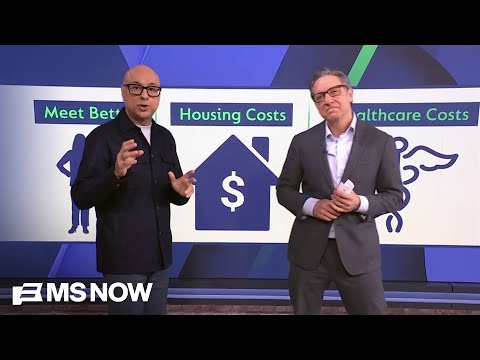
Affordability Crisis - Investopedia's most searched word of the year is "affordability," reflecting widespread concerns about the cost of living [1] - Housing, healthcare, and food costs are major contributors to the affordability crisis, disproportionately impacting working families [2][7][10] Housing Market - The median price for an existing home in America was $415,000 in October, significantly higher than $271,000 five years ago [2] - Housing costs now account for over 33% of the annual budget for many Americans, exceeding the previously recommended 30% threshold [3] - High mortgage rates and home prices make it difficult for first-time homebuyers to enter the market [2] Energy Costs - Electricity bills are rising due to increased demand from data centers supporting AI development and seasonal shifts [5] - In Massachusetts, energy bills have increased by an average of 10% since 2018 [5] Healthcare Costs - Failure to extend Affordable Care Act (ACA) subsidies could lead to a doubling or tripling of healthcare premiums for some families on January 1st [7][8] - Rising healthcare costs may exceed housing costs for some individuals, leading some families to forgo insurance [9][10] Food Costs - Overall food costs are approximately 18% higher than in January 2022, meaning a $100 grocery bill then would now cost $118 [10][11] - Prices for protein sources like beef and chicken have nearly doubled in the last two to three years [12] - Some prices have decreased, such as cocoa (down 43%) and sugar (down 30%), influenced by global markets and factors like GLP-1 medications [12] Economic Disparity - The economy is exhibiting a K-shaped recovery, with those invested in property and the stock market faring well, while others struggle [15][16] - The stock market is near record highs, and there is a record number of 401k millionaires, highlighting the benefits of asset ownership [16] Tariffs and Inflation - Tariffs may be contributing to higher prices in some areas, particularly produce [14] - Inflation is currently around 27%, with the Federal Reserve aiming for 2% [13] Consumer Spending - American consumers are projected to spend over $11 trillion during the holiday shopping season [14] - Many consumers began holiday shopping earlier than usual due to concerns about rising prices [15]