
Fed rate cuts

Search documents
X @Anthony Pompliano 🌪
Anthony Pompliano 🌪· 2025-12-11 00:48
I sat down with Jeff Park (@dgt10011) to discuss the Fed’s year-end shift toward rate cuts and easier liquidity, what it means for markets, and why bitcoin sentiment feels so negative despite strong performance.Jeff also digs into how AI investment is reshaping the macro landscape, what institutional players like BlackRock and Stripe signal for crypto, and why ProCap's mission centers on bitcoin and the coming age of abundance.YouTube: https://t.co/gAO7ETGKFHSpotify: https://t.co/DQqndf8oOtApple: https://t. ...
There's no guarantee the Fed's rate cuts will lower the rates that matter
Yahoo Finance· 2025-12-10 10:59
Core Insights - The article discusses the puzzling behavior of bond yields in the context of the Federal Reserve's rate cuts, highlighting a disconnect between expected outcomes and actual market reactions [2][4][5]. Group 1: Federal Reserve Actions - The Federal Reserve began easing rates last September, with a total reduction of 1.5 percentage points expected to continue through 2025 [4]. - A further quarter-point rate cut is anticipated, with traders pricing in additional cuts in 2026 [4]. Group 2: Bond Market Reactions - Despite the Fed's rate cuts, the 30-year Treasury yield is around 4.8% and the 10-year yield is approximately 4.17%, both of which have risen over the past month [6]. - Higher yields are impacting borrowing costs across the economy, contrary to the administration's goal of lowering mortgage rates and business loan costs [7]. Group 3: Investor Sentiment and Economic Factors - Investors are concerned about shifts in trade policy and increasing national debt, leading to a sell-off in government debt and rising yields [8]. - Historically, deficits have had minimal impact on Treasury yields due to the U.S.'s economic dominance, but current trade dynamics may be altering this relationship [9]. - Higher yields indicate that investors are demanding greater compensation for risks associated with rising deficits and policy uncertainties, reflecting skepticism about the Fed's continued rate cuts amid persistent inflation [11].
Tech earnings will be more important Fed rate cuts next year, says Truist's Keith Lerner
CNBC Television· 2025-12-09 21:17
All right, Keith Learner, set us up here. We got the Fed decision. We got some key earnings as we as we know.How you think. >> Yeah. Well, I think Mike summed it up well.I think I wouldn't be, you know, overly focused just on tomorrow, even though there could be a knee-jerk reaction. The important thing is historically when the Fed cuts rates and markets are near all-time highs, a year later, the market has been up about 93% of the time. Go back to the mid 90s, 97 98, the Fed stayed on hold at 550.for over ...

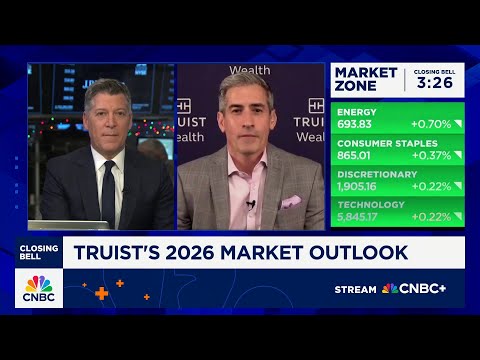
Tech earnings will be more important Fed rate cuts next year, says Truist's Keith Lerner
Youtube· 2025-12-09 21:17
All right, Keith Learner, set us up here. We got the Fed decision. We got some key earnings as we as we know.How you think. >> Yeah. Well, I think Mike summed it up well.I think I wouldn't be, you know, overly focused just on tomorrow, even though there could be a knee-jerk reaction. The important thing is historically when the Fed cuts rates and markets are near all-time highs, a year later, the market has been up about 93% of the time. Go back to the mid 90s, 97 98, the Fed stayed on hold at 550.for over ...

X @Ansem
Ansem 🧸💸· 2025-12-09 19:53
RT fejau (@fejau_inc)yeah the thesis has been- macro growth scare/shutdown impact/monetary liquidity concerns in Q4- same time as everyone selling cause 4 year cycle top- victory laps about 4 year cycle being right again- q4 dat unwind which has been ongoing, dont think they will be big sellers but market had to adapt to a fraction of DAT buys occurring. where in that churn rn- meanwhile 2026 fed rate cuts are underpriced + beginning to expand balance sheet again- big beautiful bill impact hits in 2026- pot ...
We are in a high-risk bull market, says Crossmark Global Investments CEO
Youtube· 2025-12-08 15:46
Market Outlook - The current market is characterized as a high-risk bull market, with a path of least resistance pointing higher due to the Federal Reserve's rate cuts and rising earnings estimates [1] - Speculation and valuation concerns contribute to the high-risk nature of the market, indicating potential volatility ahead [1] Federal Reserve Insights - There is uncertainty regarding the Federal Reserve's decisions, with expectations of rate cuts fluctuating from an 80% chance to a 90% chance [1] - The Fed's history shows that cutting rates significantly without a recession is unusual, raising questions about the sustainability of current economic conditions [1] - The Fed's target inflation rate of 2% may need to be reassessed, as current inflation is expected to remain stubbornly around 2.8% [1][1] Economic and Sector Performance - The economy is anticipated to remain stable, with few rate cuts expected next year [1] - The stock market is experiencing rotations between technology and non-technology sectors, with cyclical sectors gaining traction [1] - Volatility, as indicated by the VIX, is expected to continue, reflecting uncertainty in market direction [1]

美国经济-关税开始抑制实际支出-Tariffs start to cool real spending
2025-12-08 15:36
Summary of Key Points from the Conference Call Industry Overview - The conference call primarily discusses the **US Economics** sector, focusing on the impact of tariffs on real spending and inflation trends in North America [1] Core Insights and Arguments - **Core PCE Inflation**: Core PCE inflation rose by **0.20% month-over-month (m/m)** in September, slightly below expectations of **0.22%**. The annual pace was recorded at **2.83%**, which is above the target of **2%** [4][5] - **Goods Prices**: There has been a gradual passthrough of tariffs, with goods prices increasing, which has negatively impacted real goods spending. Real goods spending fell by **0.4% m/m** in September, while services spending rose by **0.2%** [4][21] - **Real Personal Spending**: Real personal spending was flat in September, with nominal spending increasing by **0.3%**. The overall consumption for Q3 is expected to rise by **2.7% quarter-over-quarter (q/q)** [21][22] - **Income Trends**: Real disposable personal income increased by **0.1%**, while nominal personal income rose by **0.4%**. Labor compensation also saw a rise of **0.4%** [26] Additional Important Insights - **Tariff Impact**: The total tariff push to PCE prices has been estimated at about **30 basis points (bp)** so far, with expectations of continued inflationary pressure from tariffs into Q4 and Q1 [7][27] - **Consumer Behavior**: Initial reports on Black Friday spending were better than anticipated, but these do not correlate well with overall spending data, indicating that prices likely influenced nominal sales [27] - **Sector Performance**: Within goods, real durable goods spending fell by **0.6% m/m**, with significant declines in auto spending and furniture. Nondurable goods spending also decreased by **0.3% m/m** [23][24] Conclusion - The overall economic outlook suggests a cooling in real spending due to higher prices driven by tariffs and slower income growth, with expectations of further deceleration in real consumption growth in Q4 [27]
美国经济-风险倾向更多美联储降息-US Economics_ The Daily Update – Risks balanced to more Fed cuts_ The Daily Update -- Risks balanced to more Fed cuts
2025-12-08 15:36
Vi e w p o i n t | 05 Dec 2025 08:32:39 ET │ 11 pages US Economics The Daily Update – Risks balanced to more Fed cuts CITI'S TAKE Following a very likely 25bp rate cut next week, interest rate markets are only pricing about two more 25bp cuts next year. 50bp of further cuts is a reasonable base case (and has been ours), but growing downside risks to employment and diminished upside risks to inflation imply a higher probability of more significant rate cuts than markets are pricing. Andrew Hollenhorst AC +1- ...

美国利率策略:迈向 8 万亿美元及更远-US Rates Strategy-To $8 Trillion and Beyond
2025-12-08 00:41
Summary of Key Points from the Conference Call Industry Overview - The conference call focused on the **US money market fund (MMF)** industry, highlighting its assets under management (AUM) which recently surpassed **$8 trillion** for the first time, reaching **$8.053 trillion** as of December 4, 2025 [9][6][32]. Core Insights and Arguments - **Defiance of Misconceptions**: Contrary to the belief that Federal Reserve (Fed) rate cuts would lead to mass outflows from MMFs, the industry has seen **$1.42 trillion** in inflows since the current easing cycle began on September 18, 2024 [9][6]. - **Forecast for Growth**: AUM is expected to exceed **$8.6 trillion** by the end of 2026, driven by an estimated **$500 billion** in inflows [32][6]. - **Investor Allocations**: Allocations to MMFs are not extreme and are likely to rise, especially when compared to other asset classes like stocks and corporate bonds [6][12]. - **Institutional vs. Retail Inflows**: Institutional funds have driven the recent AUM highs, accounting for **64%** of total inflows this year, while retail funds accounted for **34%** [12][19]. - **Yield Dynamics**: MMF yields are expected to remain attractive, with forecasts suggesting they will stay above **3.00%** in 2026, which is historically significant [23][28]. Additional Important Insights - **Income Generation**: The income generated by MMFs is projected to be **$275 billion** over the prior 12 months by the end of 2026, with a high reinvestment rate expected [33]. - **Relative Attractiveness**: MMFs have maintained a yield differential of approximately **175 basis points** over bank certificates of deposits (CDs), making them a preferred cash alternative [46]. - **Market Sensitivity**: MMF AUM is sensitive to yields on short-dated bills, with recent declines in 3-month T-bill yields coinciding with increases in MMF AUM [49]. - **Regulatory Environment**: The symposium discussed regulatory challenges affecting money market conditions, including the Fed's balance sheet management and its implications for market dynamics [74][94]. Conclusion - The US MMF industry is experiencing significant growth, driven by strong inflows and attractive yields, despite prevailing misconceptions about the impact of Fed rate cuts. The outlook for 2026 remains positive, with expectations of continued inflows and a stable yield environment.

JPMorgan is the most excited about these 3 areas of the stock market heading into 2026
Yahoo Finance· 2025-12-03 23:46
Market Outlook - JPMorgan strategists believe it is time for investors to strategically increase stock holdings, expecting a market rally into early 2026 [1][2] - The market is supported by several key catalysts that should drive stock prices higher [2] Investment Strategy - JPMorgan favors a barbell portfolio strategy, balancing high- and low-risk assets to capture high yields while maintaining downside protection [3][4] Sector Opportunities - The bank identifies opportunities in key sectors of the US market and emphasizes international stocks, particularly in banking, healthcare, and mining [4] Economic Indicators - The US economy is projected to grow by 3.9% year-over-year in Q3, with consumers in a healthy debt position, accounting for two-thirds of GDP [5] - 83% of S&P 500 companies reporting Q3 earnings have exceeded analysts' estimates, with the index on track for its highest revenue growth in three years [5] - The average effective tariff rate in the US has declined, alleviating concerns from earlier in the year, a trend expected to continue into 2026 [5] International Market Outlook - The outlook for international stocks is promising, with China's economy in an early recovery stage and increasing economic activity across Europe [5]
