GDP growth

Search documents
Economy will 'rev up' in the first half of next year, says JPMorgan's David Kelly
CNBC Television· 2025-12-16 16:48
Labor Market & Economic Growth - The labor market shows weakness with the highest unemployment rate and lowest year-over-year wage growth in four years [2] - Despite weak job growth, the economy is still moving forward, avoiding a recession, but is described as a "sickly tortoise" [3] - The economy is expected to experience weak fourth-quarter GDP growth, potentially around 1% [9] - The economy may grow at 3% in the first half of next year and 1% in the second half, resulting in approximately 15% growth for the year if a recession is avoided [8] - Labor supply is limited, with a shrinking native-born working-age population and near-zero net immigration, making it difficult for the economy to grow beyond 15% of trend rates [7][8] Consumer Spending & Fiscal Stimulus - Consumer spending is expected to increase in the first half of next year due to income tax refunds, with the average refund projected to be $4,000, up from $3,200 this year [4] - The boost in consumer spending from tax refunds is considered temporary ("sugar, not protein") and unsustainable in the second half of the year [6] Investment & Sector Performance - While there's a significant data center boom, other investment spending, such as heavy truck sales and home building, is weak [10][11] - Low oil prices are hindering drilling activity in the energy sector [11]

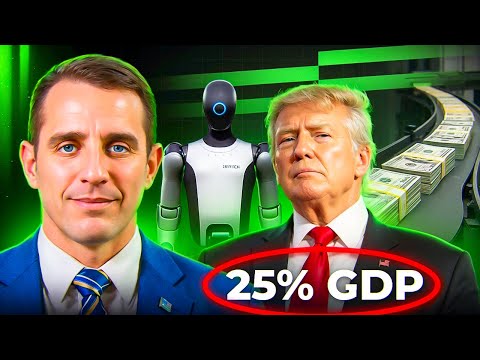
Why Trump’s 25% GDP Claim Is NOT As Absurd As It Sounds
From The Desk Of Anthony Pompliano· 2025-12-15 22:00
Hello everyone. The president wants GDP to grow 25% a year. AI job loss seems to be way overstated. We got a new way to think about the US economy transitioning. And LA public schools, they lost their minds and they proved the problem with big bureaucracies. We're live today from the desk of Anthony Pompiano. Before we get into today's episode, I need your help. My goal is to get to 1 million subscribers on YouTube. But today, today's a big day. We have 41,000 subs. Exactly. 41,000. That means that you you ...
Fed forced to buy BILLIONS in debt as market demand weakens
Youtube· 2025-12-15 21:30
Welcome to the Big Money Show. I'm Degan McDow along with my co-host Taylor Riggs, Brian Breberg, Jackie D'Angelus, and with us for this hour, Mr. . Sunshine, Rosecliffe, founder and managing partner Mike Murphy.And I actually mean that. I don't mean that in an Eddie Haskell sort of way. Investors are hoping for a Santa Claus rally to cap off what has been a big year, but keeping their eyes set firmly on 2026.Analysts from America's largest investment banks, banks galore, seeing at least an 11% gain on the ...

HAP: An Option To Consider If Inflation And Commodities Rise In 2026
Seeking Alpha· 2025-12-15 19:09
There are a wide range of predictions for what the US economy could look like next year. A recent article in Barron’s projected domestic GDP growth around 2% and rising inflation that peaks around 3.3% next summer. The “The One Big Beautiful Bill” that wasI have been involved in the financial world for over 20 years with experience as an advisor, teacher, and writer. I am a full believer in the free-market system and that financial markets are efficient with most stocks reflecting their real current value. ...

More Young Adults Are Living With Their Parents—and It Could Be Hurting the Economy
Investopedia· 2025-12-12 21:00
Core Insights - The percentage of young adults aged 25 to 34 living with their parents has increased from 11% in 2005 to 16% in 2023, indicating a shift in living arrangements among this demographic [1][6] - Financial reasons are speculated to be the primary factor keeping young adults at home, as the costs of renting and homeownership have risen significantly [2][6] Economic Impact - Young adults who remain living at home tend to spend less than their peers who have moved out, which can negatively affect overall consumer spending and, consequently, GDP growth [2][4] - A report from Oxford Economics estimates that the rising number of young adults living at home has depressed consumer spending by approximately $12 to $13 billion, equating to about 0.1% of total consumption [5] Employment Concerns - The unemployment rate for recent college graduates aged 22 to 27 stands at 4.8%, higher than the 4% rate for all workers, suggesting challenges in the job market for this age group [3]

Advisor to Treasury Secretary Bessent talks growing the economy & why the Fed should cut rates
Yahoo Finance· 2025-12-12 15:00
And for more on that, I want to welcome into the program Joe Leavia, counselor to Treasury Secretary Bessett. Joe, thanks so much for joining me. Always great to see you.>> Thank you. Thank you. >> The Fed yesterday increased their outlook for the economy next year.They now see GDP growth of 2.3%. Fed Chair Powell said that he thinks that any price increases from tariffs could peak in the first quarter. where they see inflation falling to 2.5% next year, but the unemployment rate is expected to hold at 4.4% ...

Advisor to Treasury Secretary Bessent talks growing the economy & why the Fed should cut rates
Youtube· 2025-12-12 15:00
Economic Outlook - The Federal Reserve has increased its GDP growth forecast for next year to 2.3% and expects inflation to fall to 2.5% while maintaining an unemployment rate of 4.4% [2][4] - The Atlanta Fed reports a growth rate of 3% for the current quarter, following a 3.8% growth in the second quarter [2][3] - The economy is performing better when excluding federal spending, with growth estimated at 4.5% in the second quarter [3] Productivity and Tax Policies - Current productivity trends and tax policies, referred to as "Trumpomics," are expected to drive faster economic growth than the Fed's forecast [4][5] - The administration anticipates tax refunds of $1,000 to $2,000 per household next year, which could stimulate demand [6] Interest Rates and Financial Markets - The Fed has cut rates three times since September, but the current yield on the 10-year Treasury is around 4.1%, indicating a restrictive policy environment [9][10] - The Treasury is implementing policies to restore fiscal sanity and reduce budget deficits, which is expected to lead to lower interest rates and mortgage rates [12][15] Financial Stability Oversight - Proposed changes to the Financial Stability Oversight Council aim to reduce regulatory burdens on the banking system, facilitating credit flow to small businesses [16][17] - The goal is to enhance economic growth and improve wage rates by ensuring that credit is accessible to the backbone of the economy, small businesses [17][18]

全球股市重回历史高位-Global equities back to all-time high
2025-12-12 02:19
Summary of Key Points from the Conference Call Industry Overview - **Global Equities**: Global equities reached all-time highs, with emerging markets rising by 1.4% and technology sectors outperforming with a 1.7% increase, while utilities lagged with a 3% decline [1][10][11]. Economic Data and Forecasts - **US Economic Indicators**: Upcoming reports include JOLTS job openings, employment cost index, ISM manufacturing and services indexes, and core PCE inflation [2]. - **European Economic Indicators**: Key data includes GDP reports from Germany, France, Spain, and the UK, along with German industrial production and Swiss policy rate decisions [2]. - **Japan's Economic Updates**: Japan will revise its GDP base year and release updated GDP statistics retroactively to 1994 [3]. Sector Performance - **Impact of China on Europe**: China's export-driven growth is pressuring Europe's high-tech sector, leading to a 0.2 percentage point downgrade in Germany's growth forecast over four years. Despite this, the DAX index has shown strong performance with double-digit gains year-to-date [5][6]. - **Sector Vulnerability**: Chemicals, autos, and basic resources are most exposed to China's pricing strategies, while sectors like financials, media, and utilities remain insulated. Some consumer and service industries are experiencing margin improvements due to lower prices from China [6]. Innovation and Investment Trends - **R&D Investment**: The innovation gap is widening as China and the US out-invest Europe in R&D and capital expenditures, particularly in chemicals and electronics. European firms are competitive in pharmaceuticals and tech hardware but lag in other sectors [7]. Market Performance Metrics - **Equity Indices Performance**: The S&P 500 is forecasted to reach 6870, with a potential upside of 4.8% to 7200 over the next 12 months. The STOXX Europe 600 is projected to reach 579, with a 2.8% upside [19]. - **Sector Returns**: Year-to-date returns for various sectors show technology leading with a 26.8% increase, while utilities have declined by 3% [13][34]. Risk Indicators - **Market Sentiment**: The GS Bull/Bear Market Indicator is at 67%, indicating a relatively high level of market sentiment, with various economic indicators showing mixed signals [28]. Conclusion - The global equity market is experiencing significant growth, driven by strong performances in technology and emerging markets. However, challenges from China's pricing strategies and the widening innovation gap with the US and China pose risks for European sectors. Investors should remain cautious and consider these dynamics in their investment strategies [5][7][19].
Fed’s Deepening Split Clouds the Path for 2026 Rate Cuts
Investopedia· 2025-12-12 01:09
Core Insights - The Federal Reserve is experiencing significant divisions among its officials regarding future interest rate cuts, with projections indicating only one cut in 2026, reflecting a wide range of individual forecasts from policymakers [1][10] - A notable minority of seven Fed officials oppose cutting rates in 2026, while eight anticipate at most two cuts next year, and four are considering more aggressive actions [2][10] - The upcoming economic data will be crucial in determining whether a consensus can be reached or if divisions will deepen [3] Economic Outlook - The Fed's median forecasts predict real GDP growth of 2.3% in 2026, an increase from the previous forecast of 1.8% in September, despite a slower anticipated growth of 1.7% for 2025 [7][10] - Fed officials expect the unemployment rate to rise to 4.5% by year-end but project it will decrease back to 4.4% by the end of 2026 [11] - Inflation is expected to decline towards the Fed's 2% target, with forecasts suggesting a deceleration to 2.5% in 2026, slightly better than the previous estimate of 2.6% [12][11] Policy Dynamics - The next Fed chair will face challenges in unifying a committee with a strong hawkish presence, as the current chair's term ends in May [4][6] - President Trump has expressed a desire for lower interest rates, which may influence the selection of the next Fed chair [5][6] - Analysts predict that while the Fed may pause rate cuts in January, further reductions are likely later in the year, with expectations of a 25-basis-point cut in March and June [16][17]

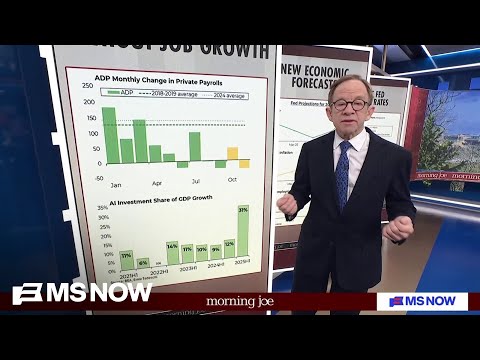
Steve Rattner: Fed signals further rate cuts next year likely to be modest
MSNBC· 2025-12-11 13:06
Our rate should be the lowest rates in the world because all these countries that you see, you know, with low rates, many of them are low because of us because they suck so much money out of us. But that's not happening anymore. We should have the lowest rates in the world.And without us, none of them really exist as an economy. >> It's President Trump speaking yesterday after the Federal Reserve reduced interest rates by a quarter of a percentage point, the Fed's third cut in a row. Joining us now with cha ...