
Quantitative Easing (QE)

Search documents
美银:The Flow Show-Krunchy Kredit
美银· 2025-10-09 02:00
Investment Rating - The report indicates a bullish sentiment with the BofA Bull & Bear Indicator rising to 6.5, reflecting strong inflows into stocks and a positive outlook for global equity markets [7][11]. Core Insights - There have been record inflows into global equity ETFs, totaling $152 billion over the past three weeks, marking the largest inflow on record [2][16]. - The report highlights a shift in investment themes from war to peace, and from US exceptionalism to global rebalancing, suggesting a favorable environment for gold and international equities in the second half of the 2020s [2][3]. - The report notes a significant outflow from Treasuries, amounting to $7.5 billion, which is the sixth-largest outflow ever recorded [10]. Summary by Sections Market Flows - Global equities saw inflows of $114 billion in the past three weeks, the third highest ever, with $26 billion inflows to stocks and $19.9 billion to bonds [16][41]. - Private clients have allocated 64.7% of their assets to stocks, the highest since March 2022, while bond allocations have decreased to 18.0%, the lowest since May 2022 [11][41]. Investment Themes - The report identifies entrenched trends favoring corporations over governments and passive over active management, with a notable shift towards national security and border control [2][3]. - The "Magnificent 7" companies are reallocating cash flow towards capital expenditures in the AI sector, indicating a significant trend in technology investment [17][38]. Sector Performance - The technology sector experienced the largest inflow of $9.3 billion, while healthcare saw a minor inflow of $33 million, contrasting with a record outflow of $17 billion for the sector [16][42]. - Financials and materials sectors also saw substantial inflows, with $3.3 billion and $5.9 billion respectively, indicating strong investor interest [16][42]. Economic Indicators - The report notes that 80% of global stock indices are trading above their 50-day and 200-day moving averages, suggesting a robust market breadth [11]. - The report emphasizes that no central bank has raised rates in the past two months, which may contribute to the current bullish sentiment in the markets [18].

Fed Balance Sheet QT: -$15 Billion in September, -$2.38 Trillion from Peak, to $6.59 Trillion
Wolfstreet· 2025-10-03 01:05
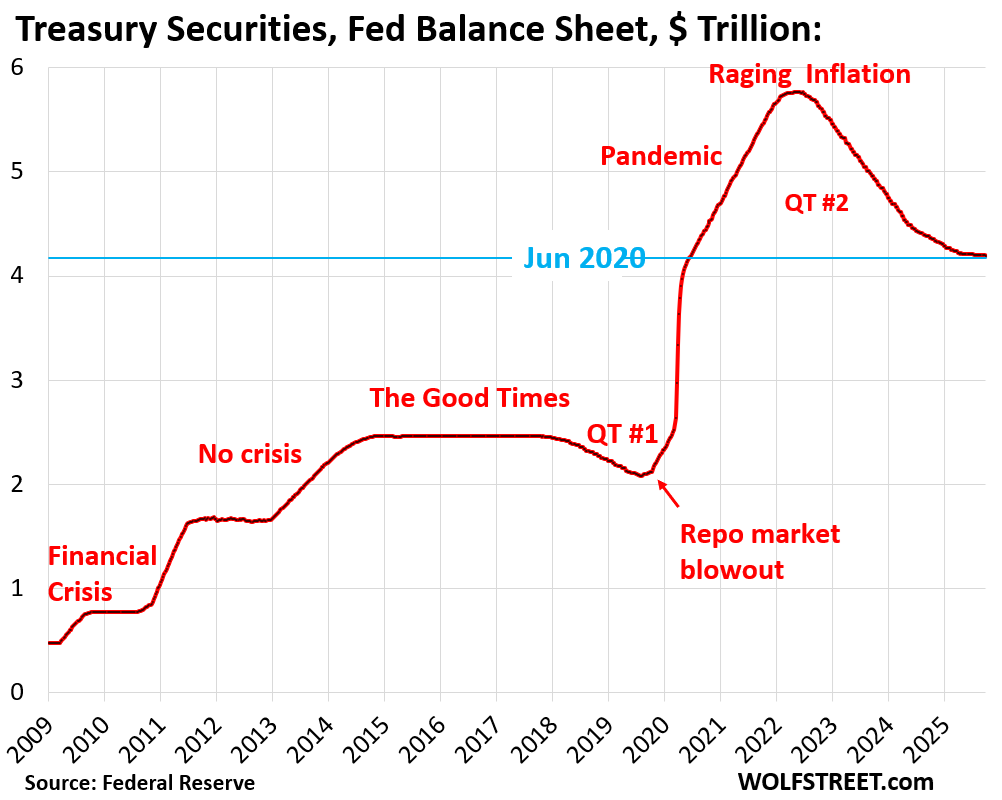
Core Insights - The Federal Reserve's balance sheet decreased by $15 billion in September, totaling $6.59 trillion, marking a 26.5% reduction since its peak in April 2022 [1][2] - The Fed has shed 49.5% of the $4.81 trillion accumulated during the pandemic-era quantitative easing (QE) [1] - The Standing Repo Facility (SRF) saw limited use, with $1.5 billion drawn on September 15, indicating minor liquidity strains in the repo market [1][15] Balance Sheet Changes - Total assets declined by $15 billion, consisting of $24 billion in declines and $9 billion in increases [1] - Treasury securities decreased by $4.4 billion in September, down 27.3% from the peak in June 2022, totaling $4.20 trillion [4] - Mortgage-Backed Securities (MBS) fell by $16.8 billion in September, down 24% from the peak, now at $2.08 trillion [7] Specific Asset Changes - The decline in MBS is attributed to reduced mortgage refinancing and home sales, leading to slower principal payments [8][9] - The Fed has shed 48% of the $1.37 trillion in MBS accumulated during pandemic QE [7] - Unamortized premiums decreased by $1.9 billion in September, reflecting the amortization of premiums paid for bonds during QE [22] Liquidity Facilities - The Discount Window saw an increase of $2.8 billion, reaching $7.2 billion, indicating some uptake by banks to manage liquidity needs [19] - The SRF has been improved to encourage banks to borrow and lend in the repo market, helping to stabilize overnight rates [14][15] Economic Context - The Fed's assets-to-GDP ratio fell to 21.6% in September, a level not seen since Q3 2013 [25] - The remaining pandemic-era Special Purpose Vehicles (SPVs) are declining, with only the MSLP remaining at $3.7 billion [23]

U.S. Treasury's Gold Stash Surpasses $1 Trillion
Yahoo Finance· 2025-09-30 19:00
Core Viewpoint - The value of the US Treasury's gold reserves has exceeded $1 trillion for the first time, driven by a 45% increase in gold prices this year, raising speculation about a potential revaluation of these assets by Treasury Secretary Bessent [1][2]. Group 1: Gold Reserves and Valuation - The current value of the US Treasury's gold is over 90 times the amount reported on the government's balance sheet, suggesting a significant discrepancy that could lead to a revaluation [2]. - Unlike many countries, the US government directly holds its gold reserves, while the Federal Reserve holds gold certificates that correspond to the value of these holdings [3]. - A revaluation of gold reserves could potentially inject approximately $990 billion into the Treasury, reducing the need for new Treasury bond issuance [4]. Group 2: Implications of Revaluation - A gold re-marking would have substantial implications for both the Treasury and the Federal Reserve's balance sheets, effectively functioning like a quantitative easing operation without actual market purchases [6][7]. - The re-marking would increase the assets and liabilities of both the Treasury and the Federal Reserve, with the Treasury's assets rising by the re-marked gold value and the Fed's assets increasing by the value of gold certificates [9]. - The market may view a gold re-marking as unconventional, as it has not occurred for decades, likely due to concerns over the independence of fiscal and monetary authorities [8].
The “Lock-in Effect” and Mortgage Rates: Update on Unwinding a Phenomenon that Wrecked the Housing Market
Wolfstreet· 2025-09-29 23:30
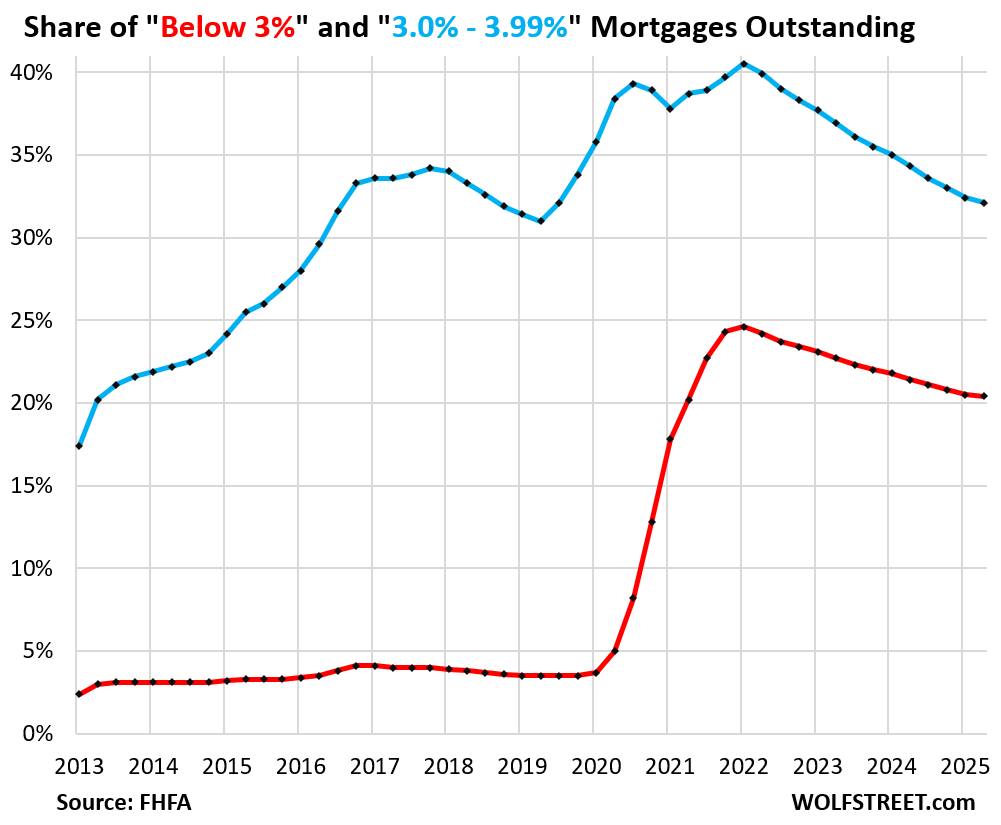
Core Insights - The share of below-3% mortgages has declined to 20.4% in Q2, the smallest since Q2 2021, indicating a slow exit from the "lock-in effect" for homeowners and investors [1][8] - The share of 3%-3.99% mortgages decreased by 30 basis points to 32.1%, the lowest since Q3 2019, reflecting a broader trend of rising mortgage rates [1][8] - The overall mortgage landscape is characterized by a significant decline in ultra-low-rate mortgages, with the share of 4.0%-4.99% mortgages dropping to 17.9%, the lowest since 2013 [8][11] Mortgage Rate Trends - The ultra-low mortgage rates that emerged in early 2020 led to a surge in refinancing, with 65% of all mortgages outstanding having rates of 3.99% or below by Q1 2022 [2][5] - The share of mortgages with rates of 6% or higher rose to 19.7% in Q2, the highest since Q4 2015, as home sales and refinancing activities have significantly declined [11][12] - The share of mortgages in the 5.0%-5.99% range has remained stable at around 9.9% in Q2, indicating a balance between new originations and payoffs [12][13] Economic Context - The ultra-low-rate mortgages were a result of the Federal Reserve's quantitative easing (QE) policies, which began in 2009 and intensified in 2020, leading to historically low mortgage rates [15][16] - The Fed has since initiated quantitative tightening (QT), shedding $2.36 trillion in assets to address the inflation and housing market distortions caused by previous policies [16][18] - The period of negative "real" mortgage rates, where mortgage rates were below inflation, peaked with rates below 3% and CPI inflation exceeding 7%, creating unsustainable conditions in the housing market [18]
Fed Cuts Only at Halfway Mark, Marathon's Richards Says
Bloomberg Television· 2025-09-23 08:37
A few things are happening here. So since September of last year, one year later, the Fed has now reduced rates by 125 basis points. Yep.And that brings us to 4 and a quarter 4 to 4 and a quarter. The Fed no doubt will go to a neutral rate, which is 3%. So they have 125 basis points to go.So only at the halfway mark. So that's the first thing. It's only eased one time this year.But they have a lot more to go because jobs are slowing. And more importantly, the neutral rate is much lower than the rate we have ...

Fed Cuts Only at Halfway Mark, Marathon's Richards Says
Youtube· 2025-09-23 08:37
Group 1 - The Federal Reserve has reduced rates by 125 basis points since September of last year, currently at 4.25% to 4% [1] - The neutral rate is estimated to be around 3%, indicating that there is still room for further rate cuts [1][5] - The current restrictive rate environment is negatively impacting economic growth, particularly in sectors like housing and construction [2][3] Group 2 - Job growth is slowing, which is prompting the Fed to initiate an easing cycle despite higher inflation [3][5] - The next Fed chair, expected to take office in May, is likely to adopt a more dovish stance, potentially lowering rates to the neutral level of 3% [6] - Historically, the Fed has lowered rates by 100 basis points or more in 8 out of the last 14 instances, often leading to subsequent increases in long-term rates [6] Group 3 - The average mortgage rate in the U.S. is currently 6.4%, while existing mortgages average 4.1%, creating a significant gap that discourages homeowners from moving [8][9] - This disparity in mortgage rates is contributing to a slowdown in housing and construction activity, placing additional pressure on the Fed to adjust rates [9]
Ongoing inflation is more important than a Fed rate cut, says Charles Schwab's Kathy Jones
Youtube· 2025-09-15 19:13
Core Viewpoint - The bond market's reaction to Federal Reserve actions is critical, with inflation trends being a more significant driver of bond yields than Fed rate cuts [3][4][6]. Group 1: Federal Reserve Actions - The Federal Reserve's potential rate cuts are largely anticipated by the market, but the actual impact on borrowing costs, such as mortgage rates, remains uncertain [2][4]. - The Fed's balance sheet management, including quantitative easing (QE) and quantitative tightening (QT), is crucial for influencing long-term bond yields [9][10]. Group 2: Inflation and Economic Conditions - Inflation remains a key concern, with current rates around 3% and showing signs of increasing, which complicates the economic landscape and poses risks of stagflation [3][7]. - The bond market is experiencing hesitancy in longer-term investments due to inflation expectations and significant fiscal deficits in various countries [6][7]. Group 3: Market Dynamics - There is a possibility of a bond market rally following Fed rate cuts, but it may not be sufficient to lower mortgage rates below 6% [8]. - The dynamics of supply and demand for bonds, particularly longer-term bonds, are influenced by investor confidence and the Fed's actions regarding its bond holdings [6][7].

Andrew Bailey under political attack on all fronts
Yahoo Finance· 2025-09-15 09:00
Core Viewpoint - The article discusses the growing criticism of the Bank of England's approach to managing interest on reserves and the implications of quantitative easing (QE) on public finances, highlighting the urgent need for reform in light of rising government borrowing costs and losses incurred by the Bank. Group 1: Criticism of Current Policies - Louise Haigh calls for a more strategic unwind of QE and criticizes the excessive cash given to commercial banks at taxpayers' expense [1] - Richard Tice highlights that the current approach is leading to tens of billions in losses and urges the Bank to stop selling bonds and reduce interest payments to banks [2][5] - The Bank of England's profits have diminished significantly, with forecasts indicating a potential loss exceeding £130 billion by 2033 [2][3] Group 2: Financial Implications of QE - The QE scheme has created £895 billion in electronic money, leading to annual costs exceeding £20 billion, which is viewed as a catastrophic expense during fiscal constraints [4] - The Treasury is now required to refund the Bank, which initially profited over £120 billion from QE but is now facing substantial losses due to higher interest rates and lower bond prices [3][4] - The current fiscal situation necessitates a reevaluation of the Bank's policies to alleviate pressure on government borrowing costs [8][15] Group 3: Calls for Coordination and Reform - There is a coalition of voices from various political factions urging the Bank to adjust its policies to mitigate financial strain on the government [5][8] - David Aikman suggests that the Treasury and the Bank should coordinate to limit the costs of quantitative tightening (QT) on public finances [14][16] - Proposals include ceasing bond sales and potentially imposing a tax on income from the Bank to generate additional revenue for the government [19][22] Group 4: Future Outlook and Decisions - The Bank is expected to make decisions regarding the pace of QT, with predictions of slowing down active sales to avoid market disruptions [20][21] - Analysts are working on estimates to counter claims that QE has become a financial burden, emphasizing the long-term benefits of lower debt issuance costs [12][18] - The Chancellor's upcoming letter to the Bank may not lead to significant changes in monetary policy, as the MPC retains operational independence [13][23]
X @Ash Crypto
Ash Crypto· 2025-09-14 10:12
Macroeconomic Factors - Expectation of 3 or more Federal Reserve rate cuts [2] - Federal Reserve is anticipated to end its Quantitative Tightening (QT) program [2] - Treasury is expected to implement Quantitative Easing (QE) through bond buying [2] Crypto Market Liquidity - Stablecoin liquidity is projected to exceed $300 billion [2] - Money-market funds hold $7.4 trillion [2] Regulatory and Product Approvals - Anticipation of Clarity Act approval [2] - Expectation of over 90 crypto Exchange Traded Products (ETPs) approvals [2] - Potential approval of ETH ETF staking [2]
X @Ash Crypto
Ash Crypto· 2025-08-23 15:35
U_S_ Gold Reserves & Valuation - U_S_ holds 261_5 million ounces of gold, officially valued at $42_22/oz, totaling $11 billion [1] - Market value of U_S_ gold reserves is approximately $867 billion at $3,300/oz, creating an $856 billion shadow reserve [1] - Revaluing gold could strengthen the balance sheet but weaken the dollar [2][4] Potential Impact of Gold Revaluation - Revaluation acts as stealth QE, providing liquidity without printing money [2] - At $5,000/oz, U_S_ gold reserves would equal $1_3 trillion [4] - Government benefits from debt reduction, while savers in dollars and bondholders may face losses [4][6] Obstacles to Revaluation - Political concerns about admitting dollar devaluation and its impact on confidence [5] - Inflationary signals from money printing could send gold and Bitcoin prices soaring [5] - Congressional approval is required for revaluation [5] Market Implications - Gold and Bitcoin holders are likely to benefit from revaluation [6][7] - Dollar weakening and debt shrinking are expected outcomes [7] - Hard assets are favored over paper assets in this scenario [7]