
Deregulation

Search documents
X @The Economist
The Economist· 2025-10-16 12:40
Economic Growth & Productivity - Right-wing politicians advocate productivity as the key to economic growth, driven by tax cuts, deregulation, and technological advancements [1] - Productivity growth, despite its benefits, may present fiscal downsides [1]
X @Bloomberg
Bloomberg· 2025-10-15 10:25
Deregulation Analysis - Deregulation is greatly anticipated and long overdue [1] - Deregulation is nowhere in sight [1]
'Fast Money' traders talk comments from bank CEOs on the state of the economy
Youtube· 2025-10-14 21:45
Group 1 - The overall sentiment among CEOs in the banking sector is optimistic, with a notable increase in financing activity and M&A business, indicating a healthy deal-making environment [5][7] - Jamie Dimon's comments suggest that while the market may be overvalued, there is still a sense of optimism about business growth and deregulation, which could positively impact the economy [4][3] - Goldman Sachs reported its most profitable year ever, highlighting the favorable conditions for banks and the overall economic environment [6] Group 2 - The commentary from various CEOs indicates a cautious optimism regarding the economy, with potential for rate cuts by the Federal Reserve, which could further boost stock market performance [7][8] - There is a concern about the stagnant job market, which may pose risks to economic growth despite the positive sentiment in the banking sector [9][8] - The depreciation on capital expenditures is identified as a significant driver for the economy, emphasizing the importance of investment in growth [10]
FMKT: An ETF Betting On Deregulation
Seeking Alpha· 2025-10-14 16:53
Core Insights - The article discusses the impact of changing political regimes in Washington on the economy, particularly focusing on the trend towards deregulation and the speculation surrounding its potential success [1] Group 1: Political and Economic Shifts - The shift in political regimes is influencing economic priorities, leading to speculation on the success of deregulation efforts [1]


Hightower's Stephanie Link breaks down JPMorgan, Wells Fargo Q3 results
Youtube· 2025-10-14 11:53
Company Performance - Wells Fargo's stock initially fell due to disappointing net interest income, but they raised their fourth quarter net interest income guidance, maintaining full-year guidance at $47.7 billion despite higher expenses [2][3] - JP Morgan reported a strong quarter with investment banking fees up 17%, trading up 24%, equities up 33%, and deal-making fees up 16%, although the stock is considered expensive at 2.5 times book value [4][6] Market Trends - The asset cap lift for Wells Fargo is crucial for regaining lost market share, which was down 20% since 2017, and is expected to enhance profitability and market share as they invest in their business [3][6] - The current market environment is compared to 1999 rather than 1929, indicating a different economic landscape and potential for growth [8][10] Regulatory Environment - Deregulation is anticipated to create new growth opportunities for banks, with expectations that Basel 3 capital requirements will be adjusted, allowing banks to utilize excess capital for stock buybacks, dividends, and lending [11][12] - The capital requirements for banks are viewed as stronger now, with lessons learned from past financial crises influencing current regulations [13][15]



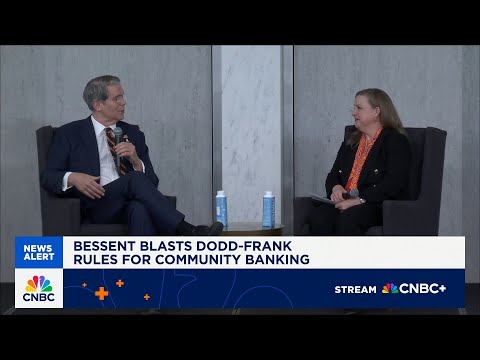
Treasury Sec. Bessent blasts Dodd-Frank rules for community banking
CNBC Television· 2025-10-09 17:15
Regulatory Landscape & Deregulation - The Treasury Secretary criticized the Dodd-Frank legislation for negatively impacting community banking and benefiting larger financial centers [1] - The Trump administration is planning sweeping deregulation in coordination with banking agencies to support community banks [2] - The number of applications and the overall count of community banks have decreased [3] - Deregulation is being considered as a tool to revitalize community banking [3] Economic Outlook - The US deficit is projected to be lower than expected this year, decreasing from 612% to approximately 59% of GDP [4] - Note: The original text contains a typo "6 12%" which is assumed to mean 612% and has been corrected to 6.12% for clarity and context, then converted to 5.9% [4] Federal Reserve & Leadership - The Treasury Secretary and a Fed Governor (Michelle Bowman) appeared together, which is considered unusual [4] - Michelle Bowman is a potential candidate to replace Fed Chair Jay Powell [4]

Treasury Secretary Scott Bessent blasts Dodd-Frank rules for community banking
CNBC Television· 2025-10-09 14:09
Treasury Secretary making some headlines in DC. For that, we'll get to Steve Leeman. Morning, Steve. >> Good morning, Carl.Uh, Treasury Secretary Scott Besson at the Federal Reserve here in Washington sitting down with Fed Vice Chair for supervision, uh, Michelle Bowman, and he's making some sharply critical remarks about the DoddFrank legislation, the banking legislation from 2010, and the effect on community banking. Uh, let's just give a listen to what he said. The postcrisis framework has left a tail tr ...
When Washington steps back: what deregulation means for corporate leaders
Yahoo Finance· 2025-10-09 13:35
Core Insights - U.S. companies are facing a new era of potential deregulation, leading to increased legal, financial, and reputational risks while the federal regulatory framework is diminishing [1][3][4] Group 1: The Disappearing Roadmap - The current business environment is characterized by the absence of clear regulatory guidelines, shifting the focus from traditional concerns like inflation and supply chains to the implications of disappearing rules [2][3] - Historically, federal regulations provided a roadmap and protection for companies, fostering investor confidence and competitive fairness, but this framework is now changing across various sectors [3][4] Group 2: Historical Context of Regulation - U.S. federal regulations have typically emerged in response to crises, creating national standards to protect workers, consumers, investors, and the environment [5][6] - Significant historical events, such as unsafe food practices and corporate fraud scandals, have led to the establishment of key regulations like the Pure Food and Drug Act, Sarbanes-Oxley, and Dodd-Frank, which aimed to reduce uncertainty and promote economic growth [5][6]
Exclusive: JPMorgan's Dimon Says a Recession Is Possible in 2026
Youtube· 2025-10-08 18:00
Market Overview - The current market is characterized as a bull market with high asset prices and low credit spreads, supported by a stable consumer job market [1] - There are concerns regarding inflation not decreasing as expected, influenced by significant government spending which may be inflationary [2][4] Economic Outlook - There is a possibility of a recession occurring in 2026, although it is not a primary concern at the moment [3] - The US government shutdown is not seen as critical to market performance, with previous shutdowns having minimal economic impact [5][6] Inflation and Federal Reserve - The market is pricing in approximately 100 basis points of interest rate cuts from the Federal Reserve over the next year, but there are doubts about the accuracy of these forecasts [6][7] - If inflation rises unexpectedly, it may complicate the Fed's ability to implement the anticipated rate cuts [8]

X @Bloomberg
Bloomberg· 2025-10-07 11:08
Trump’s push for US deregulation is dividing economists on what effects it will actually have https://t.co/QaaACoH2sR ...