
Federal Funds Rate

Search documents
美国_FOMC会议纪要指出,“大多数” 与会者认为通胀上行风险大于就业下行风险-USA_ FOMC Minutes Note “Majority” of Participants Saw Upside Risks to Inflation Greater Than Downside Risks to Employment Before
2025-08-21 04:44
Summary of FOMC Meeting Minutes Industry Overview - The document pertains to the Federal Open Market Committee (FOMC) and its assessment of the U.S. economy, particularly focusing on inflation and employment dynamics. Key Points and Arguments 1. **Inflation vs. Employment Risks** - A majority of FOMC participants viewed the upside risk to inflation as greater than the downside risk to employment. Some participants considered the risks to be roughly balanced, while a couple of participants highlighted the downside risk to employment as more significant [2][7]. 2. **Payroll Growth Data** - The FOMC meeting occurred before the July employment report, which indicated weaker-than-expected payroll growth. The 3-month average of payroll growth was 150,000 at the time of the meeting, compared to a revised figure of 35,000 now [2]. 3. **Expectations on Inflation** - Participants generally expected inflation to rise in the near term but expressed uncertainty regarding the timing, magnitude, and persistence of tariff effects on prices. There was acknowledgment of potential lags between tariff increases and consumer price hikes due to various factors [3]. 4. **Tariff Impact on Prices** - Some participants noted that foreign exporters were absorbing a modest portion of the increased tariffs, while others anticipated that companies would increasingly pass these costs onto consumers over time. However, a few participants mentioned that companies were attempting to avoid raising prices due to weak final demand [3]. 5. **Economic Conditions** - The economy was considered to be at or near maximum employment, with a low unemployment rate. Some participants indicated that slower economic growth might lead to weaker labor market conditions, but others argued that this was not necessarily indicative of economic slack due to a decline in immigration affecting payroll growth [7]. 6. **Fed's Economic Forecast** - The Fed staff's economic forecast remained similar to the previous meeting, reflecting weaker-than-expected data and a slower pace of immigration. The staff projected a rise in the unemployment rate above the natural rate and a slight downgrade in inflation projections due to lower estimates of tariff passthrough to prices [7]. 7. **Balance Sheet and Monetary Policy** - The FOMC noted that the balance sheet runoff had proceeded smoothly, with reserves remaining abundant. Some participants expressed concerns that the rebuilding of the Treasury General Account could create pressures in money markets, but existing Fed tools could mitigate this [8]. 8. **Monetary Policy Framework Review** - The FOMC was close to finalizing changes to its monetary policy framework, with expectations to shift back to responding to deviations from maximum employment rather than just shortfalls, and to return to flexible inflation targeting as the main strategy [9]. Additional Important Content - The document includes various disclosures and regulatory information related to Goldman Sachs and its analysts, emphasizing the importance of considering this report as one factor in investment decisions [5][11][12]. This summary encapsulates the critical insights from the FOMC meeting minutes, highlighting the ongoing concerns regarding inflation, employment, and the broader economic landscape.
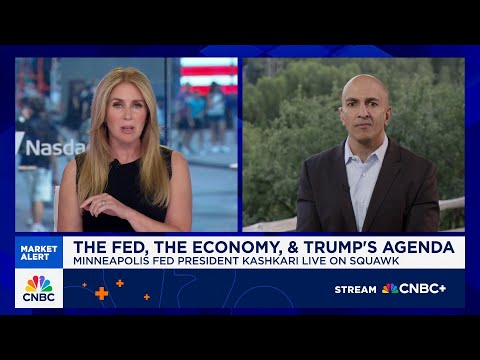
Minneapolis Fed Pres. Neel Kashkari: Two cuts this year 'still seem reasonable to me'
CNBC Television· 2025-08-06 13:32
Economic Slowdown & Inflation - The economy is slowing, with housing services inflation gently declining, non-housing services inflation coming down, and wage growth decreasing [4][5] - Consumer spending is cooling, further indicating a slowdown in the real underlying economy [5] - The ultimate effects of tariffs on inflation are uncertain and may not be known for quarters or a year or more [5] - The average effective tariff being paid at the border is around 10%, well short of the 16% headline rate [7] Monetary Policy - It may become appropriate to start adjusting the federal funds rate in the near term due to the slowing economy [6] - Two rate cuts this year still seem reasonable, but the actual number could vary depending on the impact of tariffs on inflation [14][15] - If inflation really increases due to tariffs, the possibility of pausing or even raising rates again exists [15] - The FOMC is aware of the potential need to adjust course (cutting and then raising rates) due to the uncertain effects of tariffs [18][19] Data & Uncertainty - The effects of tariffs are taking longer to become clear, making policy decisions difficult [19] - Companies hoarded inventory in advance of tariffs, delaying the passing of costs onto customers and obscuring the immediate inflationary impact [10][17] - The BLS job numbers are subject to large revisions and declining survey response rates, making them less reliable [21][22] - Wage growth is declining, indicating a cooling labor market [23]

Watch CNBC's full interview with Minneapolis Fed President Neel Kashkari
CNBC Television· 2025-08-06 13:30
Economic Slowdown & Inflation - The economy is slowing, with housing services inflation gently declining, non-housing services inflation coming down, and wage growth decreasing [3][4] - Consumer spending is cooling, further suggesting a slowdown in the real underlying economy [4] - The ultimate effects of tariffs on inflation are uncertain and may not be known for quarters or a year or more [4] - The average effective tariff being paid at the border is around 10%, climbing month after month, but still short of the 16% headline rate [6] - It is uncertain how high core goods inflation will get and whether it will spill over into other categories and be persistent [11] Monetary Policy - It may become appropriate to start adjusting the federal funds rate in the near term due to the slowing economy [5] - Two rate cuts this year still seem reasonable, but the actual number could vary depending on the effect of tariffs on inflation [13][14] - If tariffs have a bigger effect on inflation, the Fed could do one or more rate cuts and then pause, or even raise rates again [14] - The FOMC is aware of the potential need to adjust course (cut and then raise rates) due to the uncertain effects of tariffs [17][18] Data & Credibility - The BLS data is subject to revisions and declining survey response rates, requiring the Fed to look at other data sources [21][22] - There are concerns about the credibility of economic data following the firing of the head of the BLS, but it is difficult to fake economic reality [25][28] - Wage growth is declining, indicating a cooling labor market [22] Tariffs Impact - Companies have not taken up prices in the way they did during the pandemic, possibly due to the complexities of tariffs compared to the pandemic [7][8] - Some companies hoarded inventory to protect themselves and their customers from tariffs [9][16] - The market is discounting that the tariffs, at least as we know them today, stay that way [12]
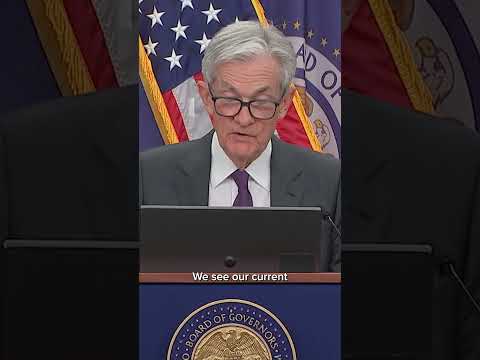
Powell says Fed is 'well positioned' for more data before lowering rates
CNBC Television· 2025-07-30 19:45
Monetary Policy Stance - The industry aims to keep longer-term inflation expectations well-anchored [1] - The industry intends to prevent a one-time price level increase from becoming an ongoing inflation problem [1] - The current policy stance is seen as appropriate to guard against inflation risks [1] - The industry is attentive to risks on the employment side of its mandate [2] Economic Assessment - The industry is well-positioned to learn more about the likely course of the economy and the evolving balance of risks [1] - The industry will receive a good amount of data in coming months to inform its assessment of the balance of risks [2] - This data will help determine the appropriate setting of the federal funds [2]
Fed Chair Powell: Economy's not performing as if restrictive policy is holding it back
CNBC Television· 2025-07-30 18:58
Monetary Policy Stance - The Federal Reserve decided to maintain the current policy rate, characterizing it as "modestly restrictive" [2] - The committee believes the economy is not being inappropriately held back by the current modestly restrictive policy [3] - The Federal Reserve has made no pre-decisions regarding potential rate adjustments in September [5] Economic Indicators - Inflation is running slightly above 2%, even when excluding tariff effects [2] - The labor market is solid, with historically low unemployment rates [2] - Financial conditions are accommodative [2] Future Considerations - Downside risks to the labor market exist [3] - The Federal Reserve will receive two rounds of jobs and inflation data before the September meeting to inform their assessment of risks and the appropriate federal funds rate [4][5]
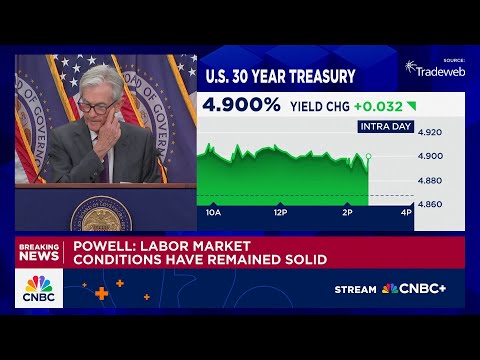
Bond yields move higher as market begins to 'look for less'
CNBC Television· 2025-07-17 18:59
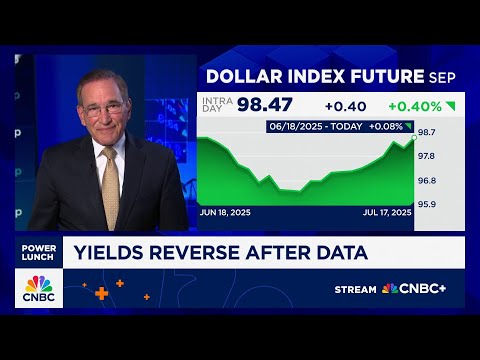
Bond Market & Yields - The 10-year yield remains stagnant at 446%, mirroring levels from November, indicating a lack of movement in borrowing costs [1] - Despite positive economic data, bond yields experienced an initial rise followed by a slight decrease, influenced by technical factors [4] - Key psychological levels for yields are identified: just under 2% for 2-year, 450% for 10-year, and 500% for 30-year maturities [5] Economic Data & Fed Policy - Retail sales show a healthy rebound, and initial jobless claims hit a three-month low at 221000 [2][3] - Market expectations for Fed funds imply less easing, shifting from over two quarter-point cuts to 170% [3] - Strong economic data initially pushed yields higher, aligning with typical market behavior [4] Dollar Index - The dollar index is nearing a one-month high, approaching the significant psychological level of 100 [7] - Increased interest rates and a decent labor market contribute to the strengthening of the dollar index [6]
Jim Cramer talks signals he looks for when making sense of the market
CNBC Television· 2025-06-17 23:50
Monetary Policy Impact - The Federal Reserve's actions, whether tightening or easing, significantly influence the economy and investment landscape [1][2] - Interest rate hikes by the Fed can lead to economic slowdown, stock market declines, and reduced business investment [1][3] - Conversely, interest rate cuts can stimulate economic activity by lowering borrowing costs and encouraging spending and investment [4][5] Economic Cycle - Higher interest rates increase borrowing costs for companies and individuals, leading to project cancellations and layoffs [3][4] - Lower interest rates decrease the incentive to save, prompting increased spending and investment in riskier assets [5] - A cycle of increased consumer spending and business expansion can be triggered by Fed easing, leading to job creation and further economic growth [6][7] Sector Analysis - Financials typically benefit from higher interest rates, but not as much from lower rates [6]
When will mortgage rates go down? Rates are barely moving.
Yahoo Finance· 2025-04-22 19:06
Core Insights - Mortgage rates have increased slightly but are lower than last year, with the average 30-year fixed-rate mortgage at 6.24%, down 54 basis points from 6.78% a year ago [2][4] - The Federal Reserve has lowered the federal funds rate twice in 2025, which typically influences mortgage rates, but the correlation is not always direct [5][6] - Current housing market conditions show a high demand for homes, leading to sustained high prices despite slight decreases in mortgage rates [14][15] Mortgage Rate Trends - As of November 13, 2025, the average 30-year fixed-rate mortgage is at 6.24%, while the 15-year fixed mortgage is at 5.49%, both lower than the previous year [2][12] - The 10-year Treasury yield is at 4.13%, down from 4.43% a year prior, which affects mortgage rates through a spread [11][12] - The spread between the 30-year mortgage rate and the 10-year Treasury yield has decreased from 2.35 percentage points to 2.11 percentage points, contributing to lower mortgage rates [12] Federal Reserve Influence - The Federal Reserve's actions, including two rate cuts in 2025, typically lead to expectations of lower mortgage rates, but historical trends show that rates may not continue to decrease after such cuts [5][8] - Anticipation of rate cuts often leads to a temporary decline in mortgage rates, but this is not guaranteed to persist [6][8] Housing Market Dynamics - The median sale price of single-family homes has increased from $208,400 in Q1 2009 to $410,800 by Q2 2025, indicating a long-term upward trend in home prices [15] - The current imbalance between buyers and available homes keeps prices high, particularly in affordable segments for first-time buyers [14][15] - Even with potential economic downturns, demand for homes may remain high if interest rates drop, as more buyers will seek to lock in lower rates [16] Buyer Strategies - Buyers are encouraged to consider various strategies, such as purchasing smaller homes or condos, to enter the market despite high prices and rates [18][24] - Exploring options like fixer-uppers or longer commutes to more affordable areas can also be beneficial [22][23] - Rate buydown options may provide temporary relief from high mortgage rates, making home purchases more feasible [26] Future Rate Predictions - The Mortgage Bankers Association predicts the 30-year fixed rate will remain around 6.4% through 2026, while Fannie Mae is more optimistic, forecasting a drop to 5.9% by the end of next year [27]
When will mortgage rates go down? Rates have hardly budged in the past 2 months.
Yahoo Finance· 2025-04-22 19:06
Core Insights - Mortgage rates have remained stable since late October, with slight annual decreases expected in 2026, but this does not indicate a poor time to buy or refinance [1][4] Mortgage Rate Trends - The average 30-year fixed-rate mortgage rate as of December 24 is 6.18%, down 3 basis points from the previous week and 67 basis points lower than a year ago when it was 6.85% [2] - The 15-year fixed mortgage rate has increased by 3 basis points to 5.50%, which is still 50 basis points lower than the same time last year [3] - Overall, mortgage rates are decreasing, but a drop to 6% in the near future seems unlikely [4] Federal Reserve Influence - The Federal Reserve has cut the fed funds rate three times in 2025, which typically influences mortgage rates, although they do not directly correlate [5][6] - Anticipation of fed funds rate cuts often leads to a temporary decrease in mortgage rates, but significant drops may not follow after the cuts [8] Housing Market Dynamics - The current housing market is characterized by high demand and limited supply, keeping home prices elevated despite fluctuations in mortgage rates [13] - The median sale price of single-family homes has risen from $208,400 in Q1 2009 to $410,800 by Q2 2025, indicating a long-term upward trend [14] Buyer Strategies - Buyers are encouraged to consider various strategies such as purchasing smaller homes, exploring fixer-uppers, or considering condominiums to navigate the current market [17][20][22] - Exploring rate buydown options can also make current mortgage rates more manageable [24] Future Rate Predictions - The Mortgage Bankers Association predicts the 30-year fixed rate will remain around 6.4% throughout 2026, while Fannie Mae forecasts a drop to 5.9% by the end of 2026 [25]
When will mortgage rates go down? The federal funds rate has decreased, but mortgage rates have increased.
Yahoo Finance· 2025-04-22 19:06
Core Insights - Mortgage rates have increased recently, with the average 30-year fixed-rate mortgage at 6.22%, but they are lower than last year’s average of 6.60% [2][3] - The Federal Reserve has cut the federal funds rate three times in 2025, which typically influences mortgage rates, but the relationship is not direct [4][5] - Predictions indicate that mortgage rates may remain stagnant or increase in late 2025, with expectations of only one rate cut in 2026 [8] Mortgage Rate Trends - The average 30-year fixed-rate mortgage increased by three basis points to 6.22%, while the 15-year fixed mortgage rate rose by 10 basis points to 5.54% [2] - Over the past year, the 30-year rate is down by 38 basis points, and the 15-year rate is down by 30 basis points [2] - Historical data shows that mortgage rates are currently above their annual lows, indicating a potential for further fluctuations [3] Federal Reserve Influence - The Federal Reserve's actions, including three rate cuts in 2025, typically lead to changes in mortgage rates, although the correlation is not always immediate [5][6] - Despite the Fed's rate cuts, mortgage rates have shown a tendency to bounce back up after initial declines [7] Housing Market Dynamics - The current housing market is characterized by high demand and limited supply, leading to sustained high home prices [14] - The median sale price of single-family homes has increased from $208,400 in Q1 2009 to $410,800 by Q2 2025 [15] - Buyers may not see significant relief in home prices even if interest rates drop, as lower rates could increase demand further [16] Buyer Strategies - Prospective buyers are encouraged to consider various strategies, such as purchasing smaller homes or condos, to navigate the current market [18][24] - Exploring options like fixer-uppers or longer commutes to more affordable areas can also be beneficial [21][23] - Buyers should be aware of financial tools like rate buydowns to make current mortgage rates more manageable [26] Future Rate Predictions - The Mortgage Bankers Association predicts the 30-year fixed rate will remain around 6.4% through 2026, while Fannie Mae forecasts a drop to 5.9% by the end of 2026 [27] - Historical context shows that while current rates may seem high compared to recent lows, they are not unprecedented when viewed over a longer timeline [28]