Large Language Models

Search documents
Nvidia: The Only Threat Is Alphabet
Seeking Alpha· 2025-12-18 16:50
Core Insights - The article highlights the dominance of GPUs in training and deploying large language models, emphasizing the importance of the CUDA software stack in enhancing their functionality [1]. Company and Industry Summary - GPUs are identified as the default hardware for large language model applications, indicating a strong market position for companies producing these components [1]. - The integration of CUDA software with GPUs is noted as a significant factor that contributes to their effectiveness in machine learning and AI applications [1].




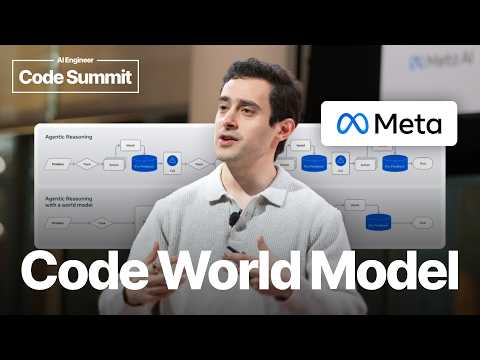
Code World Model: Building World Models for Computation – Jacob Kahn, FAIR Meta
AI Engineer· 2025-12-17 17:00
[music] Great to be here everyone. I'm Jacob Khan. I'm a researcher at at Farret Medai.I'm going to talk today about the code world model which I'll abbreviate as CWM and what it means to build world models for computation. This is work done by an incredible team at fair uh extends all over the world and I'm very grateful to be collaborating with them. So what's our goal with CWM.Our primary goal is to build models that reason, plan and make decisions. And we start with code because it's an interesting sand ...
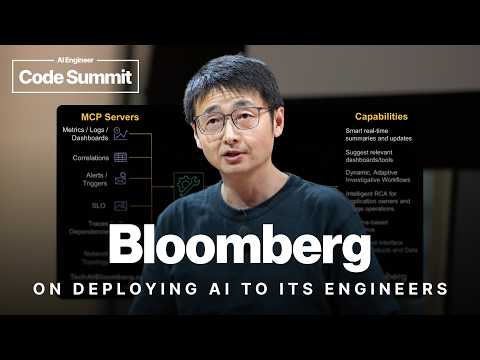
What We Learned Deploying AI within Bloomberg’s Engineering Organization – Lei Zhang, Bloomberg
AI Engineer· 2025-12-16 15:00
When it comes to using AI for software engineering, much of the spotlight falls on how large language models (LLMs) can write code—sometimes entirely from scratch. Countless studies highlight productivity gains from turning requirements directly into runnable code. But the reality of applying AI at scale inside a mature engineering organization is far more complex and nuanced. Over the past year, we’ve been on that journey at Bloomberg—integrating AI into the workflows of 9,000+ software engineers—and we’ve ...
Breaking the Pattern - AI and Homo sapiens | Giorgio Torre | TEDxDilmun
TEDx Talks· 2025-12-15 16:10
Historical Context & Societal Impact - Technological revolutions, from fire to AI, have historically created divides, empowering some while leaving others behind [3][4][5][6][7][8][19] - Agriculture, while powering civilization, led to inequality, hierarchy, slavery, and war [5] - The industrial revolution, despite increasing output and innovation, resulted in child labor and pollution [8] AI's Current Divides - Algorithmic divide: A few companies control the algorithms that dictate the rules [14] - Compute and energy divide: Africa, with 14 亿 (1.4 billion) people, has access to less than 1% of global compute [14] - Data divide: 95% of large language models (LLMs) are trained in English, despite it being only the fifth language by native speakers [16] - Capital divide: Developing LLMs requires hundreds of billions of dollars, creating a barrier to market entry [17][18] Digital Inclusion & The Internet - Only 67% of the global population has access to the internet, leaving 26 亿 (2.6 billion) individuals cut off from the digital economy [10] Call to Action - Learn how to use AI and integrate it into daily life [20] - Share AI knowledge with peers, network, family, and friends to ensure no one is left behind [20][21] - Demand responsibility from organizations regarding data usage [21]

BlackRock Announces Expansion of Liquid Alternatives Offering with Multi-Strategy Active ETF
Crowdfund Insider· 2025-12-12 02:24
Group 1 - BlackRock has enhanced its liquid alternative platform with the launch of the iShares Systematic Alternatives Active ETF (IALT), aimed at providing differentiated returns across market cycles through ETF transparency [1] - IALT employs a multi-asset approach that integrates various liquid alternative strategies, including equity market neutral, diversified bonds, and managed futures, to achieve lower correlation with traditional markets [2] - The fund is managed by a team experienced in liquid alternative strategies, leveraging BlackRock's $378 billion systematic investment platform, which combines human insight with data analytics, AI, and Large Language Models [2] Group 2 - BlackRock's ETF platform manages over $5 trillion in assets, with more than $100 billion in active ETFs, reflecting the company's commitment to expanding investor choices in a changing market environment [2] - The company anticipates that global assets in the ETF category will exceed $4.2 trillion by 2030, indicating the growing importance of ETFs in modern portfolio construction [2] - iShares, as part of BlackRock, aims to facilitate financial well-being for consumers by making investing more accessible and affordable, with approximately $5.2 trillion in assets under management as of September 30, 2025 [3]


X @The Economist
The Economist· 2025-12-11 17:30
AI发展趋势 - Artificial intelligence can now act, not just generate text, due to the development of "agents": software that equips large language models with tools to perform tasks [1]
X @The Economist
The Economist· 2025-12-11 15:25
Large language models are being brought to bear on the word of God https://t.co/tNgZDYgNkA ...
Prediction: Why Alphabet Will Be the Artificial Intelligence (AI) Winner of 2026
The Motley Fool· 2025-12-10 10:05
Occasionally counted out, Alphabet is best positioned for 2026 AI dominance.It's impossible to read financial news these days without seeing multiple articles about artificial intelligence (AI). These headlines range from the demand for cutting-edge semiconductors to which company is winning the race for large language models (LLMs). Which one is ahead and which is behind seems to change daily, with no shortage of opinions on who the winners will be in our AI future.Alphabet (GOOG +1.05%) and its Gemini LLM ...

北航一篇304页的Code Agent综述!近30家机构参与
自动驾驶之心· 2025-12-10 00:04
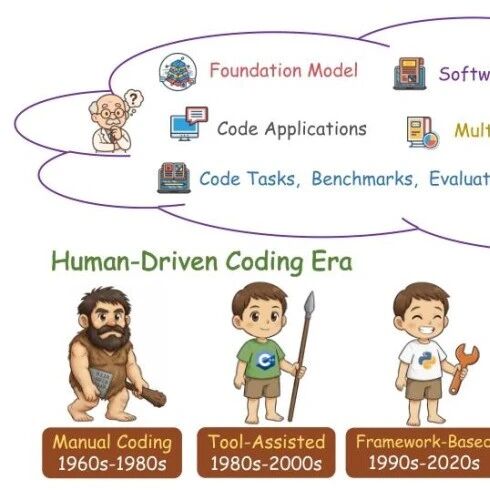
Core Insights - The article discusses the transformative shift in code intelligence from being an "assistive tool" to becoming an "autonomous developer" driven by advancements in large language models (LLMs) [2][8] - A comprehensive review paper by 28 institutions outlines the evolution of code models and establishes a complete technical framework for intelligent software engineering [2][8] Evolution of Code Intelligence - The evolution of code intelligence spans six distinct phases from manual coding in the 1960s to the anticipated AI autonomous era post-2025, highlighting key technological advancements at each stage [8][9] - The core driving force behind this evolution is the transition from rule-based systems to transformer-based models, enabling significant improvements in code understanding and generation capabilities [9][11] Code Foundation Models - Current mainstream models are categorized into General LLMs and Code-Specialized LLMs, each with unique advantages and technological synergies [11][12] - Code-specialized models have emerged through focused data, architectural innovations, and task-specific fine-tuning, surpassing general models in coding tasks [15][18] Training and Evaluation - The paper outlines a comprehensive evaluation system for code tasks, categorized into statement/function/class-level tasks, repository-level tasks, and intelligent agent system tasks [18][19] - Evaluation metrics have evolved to include execution-based indicators, emphasizing the importance of not just generating code but ensuring its functionality [19][22] Alignment Techniques - Two primary alignment techniques are discussed: Supervised Fine-Tuning (SFT) and Reinforcement Learning (RL), both crucial for ensuring models meet human requirements [22][28] - Various data synthesis methods for alignment tasks are highlighted, including single and multi-round SFT, as well as RL methods that leverage human and AI feedback [25][27] Software Engineering Agents (SWE Agents) - SWE Agents are described as advanced systems capable of autonomously completing complex engineering tasks across the software development lifecycle [31][32] - The paper identifies four key stages of SWE Agents' application: requirements engineering, software development, software testing, and software maintenance [31] Future Trends - The article identifies three core trends for the next 3-5 years: the shift from general to specialized models, increased autonomy of SWE Agents, and the integration of multimodal inputs for enhanced code intelligence [33][34][35] - The ultimate goal of code intelligence is to automate repetitive coding tasks, thereby allowing human developers to focus on higher-level creative tasks [37][38]
1 Billion Lives — Revolutionizing Medical Education | Dr. Muhammad Azib | TEDxDUHS
TEDx Talks· 2025-12-09 17:54
And as somebody who represents DHS and Silicon Valley and you know and technology conferences around the world, it's so good to be back here. So today I want to talk to you about something very important to my heart, my life's mission, and that is how do we impact a billion lives and how can we revolutionize medical education to redefine the future of healthcare. Good afternoon.My name is Dr. . Mohammed Azid. So in the audience, how many of you have ever been to the doctor or taken someone that you love or ...