
Tariffs

Search documents
Blue Bird(BLBD) - 2025 Q4 - Earnings Call Transcript
2025-11-24 22:32
Financial Data and Key Metrics Changes - Blue Bird achieved record sales and adjusted EBITDA for Fiscal 2025, with adjusted EBITDA of $221 million, representing 15% of revenue, which is $38 million higher than the previous year [7][20][21] - Total revenue for Fiscal 2025 reached $1.48 billion, an increase of $133 million compared to the prior year [7][19] - Adjusted net income for the fourth quarter was $43.4 million, a 68% improvement year-over-year [17] Business Line Data and Key Metrics Changes - The company sold 9,409 buses in Fiscal 2025, with an average bus revenue per unit of $146,000, up $8,000 from the previous year [7][19] - Electric vehicle (EV) sales totaled 901 units for the year, marking a 30% increase compared to the previous year [7][19] - Parts revenue for the year remained flat at $103 million, indicating strong demand due to an aging fleet [19] Market Data and Key Metrics Changes - The backlog at the end of Q4 was 3,100 units, which included 680 EVs, but has since increased to nearly 4,000 units [8][16] - Year-over-year selling prices for buses increased by almost $8,300 per unit, reflecting pricing actions and tariff recovery [9] - The company maintains a strong position in the alternative powered vehicles segment, with all powered buses representing 56% of mixed unit sales for the year [9] Company Strategy and Development Direction - Blue Bird is focusing on long-term manufacturing strategies, including automation and production efficiency improvements [4][6] - The company plans to invest in projects with clear returns and aims to maintain a disciplined pricing strategy [5][6] - The outlook for EVs remains optimistic, with expectations of stable demand supported by government funding programs [10][11] Management's Comments on Operating Environment and Future Outlook - Management expressed confidence in navigating tariff volatility and maintaining margin-neutral outcomes [7] - The company anticipates a heavy replacement cycle in the school bus market, driven by an aging fleet and pent-up demand [9] - Management remains cautious about the impact of tariffs and material costs but expects strong demand to continue [24] Other Important Information - Blue Bird ended the year with $229 million in cash and a liquidity of $371 million, reflecting a strong financial position [22][23] - The company has repurchased $40 million worth of shares during the year and plans to continue returning value to shareholders [23][30] Q&A Session Summary Question: Importance of federal EV bus program for Fiscal 2026 guidance - Management indicated that Fiscal 2026 guidance does not rely on rounds four and five of the federal EV program, with a strong backlog supporting the outlook [39][41] Question: Order season and demand outlook - Management acknowledged that while the order season typically picks up after the Christmas break, they are confident in the underlying demand fundamentals [43][45] Question: Commercial chassis project details - Management confirmed that prototypes are being tested and received positively by customers, indicating potential for market entry [47][48] Question: EV backlog and state incentive programs - Management noted that New Jersey's updated incentive program reflects a trend of increasing state-level funding for EVs, which is expected to continue [70][72] Question: Pricing dynamics and guidance for first half versus second half - Management explained that pricing stability and the new price increase will impact the second half of the fiscal year, with a ramp expected in production [60][80]

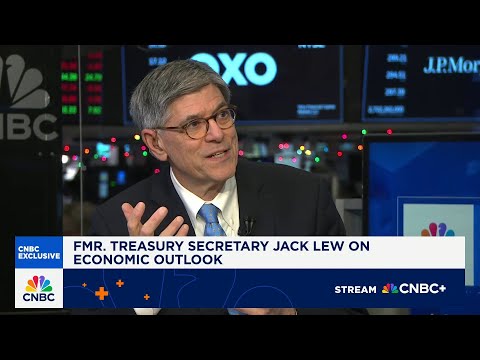
Former U.S. Treasury Secretary Jack Lew: A shock could come & we're not poised to handle it
CNBC Television· 2025-11-24 16:14
Economic Outlook & Uncertainty - The economic outlook for 2026 is uncertain due to confusing economic indicators [1][2] - Policy driving inflation and a large, growing deficit contribute to economic uncertainty [3] - The economy is not well-poised to handle a shock [3] Tariffs & Inflation - Tariffs are considered inflationary [4] - Wholesalers initially absorbed tariff costs, but these are now starting to impact prices, including food [5] - Economic analysis suggests tariffs ultimately translate to higher prices [6] - Tariff revenue is offsetting the deficit increase from the budget bill, but this may not continue if tariffs are challenged [8] Trade Deficit & Tariff Effectiveness - Tariffs have not rescued the deficit [9] - The trade deficit is wider year-to-date [10] - The primary benefit of tariffs has been creating a negotiating environment, though this is not considered a sustainable approach [11] - Higher prices and a weaker global economy are negative consequences of tariffs [12] Impact on American Households - Americans are worried about the cost of healthcare, housing, and food, which consume most of their paycheck [13] - Potential loss of healthcare support could lead to significant cost increases or lack of coverage for millions [14] - An eighth of the country faces extreme insecurity when nutrition benefits (SNAP) are threatened [16] - The economy is lopsided, with those living paycheck to paycheck struggling [17]

X @Bloomberg
Bloomberg· 2025-11-24 15:12
The EU wants the US to reduce tariffs on the bloc’s exports of weapons below the 15% tariff ceiling agreed for many of its goods https://t.co/qqagkibKor ...
Lutnick expects Supreme Court to side with Trump on tariffs, opening door to $2K payouts
Fox Business· 2025-11-24 14:11
Core Viewpoint - The Trump administration is confident in winning a Supreme Court trade case regarding new tariffs aimed at protecting American manufacturing from unfair foreign competition [1][4]. Group 1: Tariff Implementation and Economic Impact - Tariffs are considered a key component of the administration's national security and economic protection strategy for Americans [1]. - The administration plans to use tariff revenues to provide $2,000 dividend payments to low and middle-income Americans, which is seen as a way to demonstrate the benefits of tariffs [5][6]. - Since the announcement of the "Liberation Day" tariffs, tariff revenues have significantly increased, with total duty revenue reaching $215.2 billion in fiscal year 2025 and $40.4 billion collected in the first month of fiscal year 2026 [8]. Group 2: Political and Legal Context - The administration has various policies and tools available under U.S. trade law to impose tariffs or restrictions, even if the Supreme Court rules against them [4]. - Concerns about the potential inflationary impact of the $2,000 payments have been dismissed by trade representatives, who argue that it will not alter the overall macroeconomic situation [9].

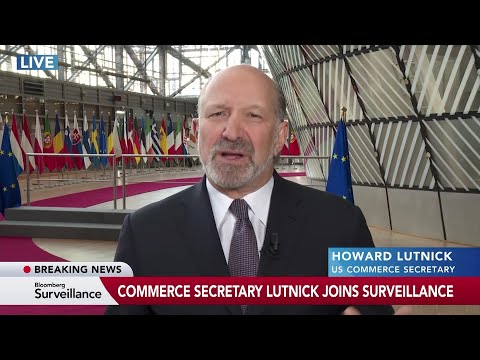
Lutnick Talks EU Tech Rules, Nvidia H200 Chips, SCOTUS Tariff
Bloomberg Television· 2025-11-24 14:03
I want to start on your discussions with the European Union. We were hearing some noise that it doesn't necessarily include reducing steel and aluminum tariffs from 50% to 15%. Is that off the table for now.Know what we're talking about. Everything is on the table When you have such a great partner as the European Union. They have 450 million people and a $20 trillion economy.So the opportunity is great. They would like to have steel and aluminum as part of this package. And we think it is very, very import ...
Lutnick Talks EU Tech Rules, Nvidia H200 Chips, SCOTUS Tariff
Youtube· 2025-11-24 14:03
I want to start on your discussions with the European Union. We were hearing some noise that it doesn't necessarily include reducing steel and aluminum tariffs from 50% to 15%. Is that off the table for now.Know what we're talking about. Everything is on the table When you have such a great partner as the European Union. They have 450 million people and a $20 trillion economy.So the opportunity is great. They would like to have steel and aluminum as part of this package. And we think it is very, very import ...


X @Bloomberg
Bloomberg· 2025-11-24 14:02
US Commerce Secretary Howard Lutnick told Bloomberg News that any concessions for the EU on steel and aluminum tariffs are contingent on the bloc rolling back rules on the digital industry. https://t.co/jaoMYDH2yd ...
X @The Economist
The Economist· 2025-11-24 13:50
♦️ Donald Trump plays down tensions with prominent MAGA Republicans.♦️ Zohran Mamdani says he is “establishing a productive relationship” with the president.♦️ The rise in inflation had “nothing to do with tariffs”, treasury secretary insists.Keep up with US politics https://t.co/ba6UUGssU0 ...
‘NOT PARTICULARLY WORRIED': Fed gov downplays inflation fears, backs rate cut
Youtube· 2025-11-24 13:45
Core Viewpoint - Federal Reserve Governor Christopher Waller advocates for a quarter-point rate cut at the upcoming policy meeting, citing a weak labor market and manageable inflation as key factors [1][3][4]. Economic Indicators - The labor market is showing signs of continued weakness, with the latest jobs report indicating only 119,000 jobs added in September, which is expected to be revised down by approximately 50,000 to 60,000 [6][7]. - Inflation is not perceived as a significant concern moving forward, with expectations that it will begin to decline. Current inflation is estimated to be around 2.4% to 2.5% [9][10]. Future Outlook - The approach to monetary policy may become more cautious and data-dependent starting in January, as a significant amount of economic data will be released [5][6]. - Waller does not foresee a turnaround in the labor market in the next 6 to 8 weeks, indicating a continued focus on labor market conditions in future policy decisions [6][8]. Communication and Transparency - Waller emphasizes the importance of transparency and accountability in monetary policy, suggesting that press conferences after every meeting should continue to communicate decisions to the public and financial markets [12][13].

Jim Cramer Believes “Best Buy Will Be Okay”
Yahoo Finance· 2025-11-24 13:40
Core Insights - Best Buy Co., Inc. is highlighted as a stock to watch, with expectations of being impacted by higher interest rates and tariffs, but potentially benefiting from a PC refresh cycle [1] Company Overview - Best Buy sells a variety of technology products, electronics, appliances, and entertainment items, along with services such as delivery, installation, and technical support [2] - The company was previously considered a strong dividend stock, yielding 4.5%, but was removed from a list of interesting prospects due to its reliance on strong consumer growth and tariff relief [2] Market Context - The upcoming earnings report for Best Buy is anticipated to be affected by external economic factors, including tariffs and interest rates [1] - There is a comparison made with AI stocks, suggesting that while Best Buy has potential, certain AI stocks may offer greater upside potential and less downside risk [3]
