《反叛乱法》

Search documents
美国联邦政府与州政府均“调兵遣将”,明尼苏达州对峙再升级
Huan Qiu Shi Bao· 2026-01-18 23:04
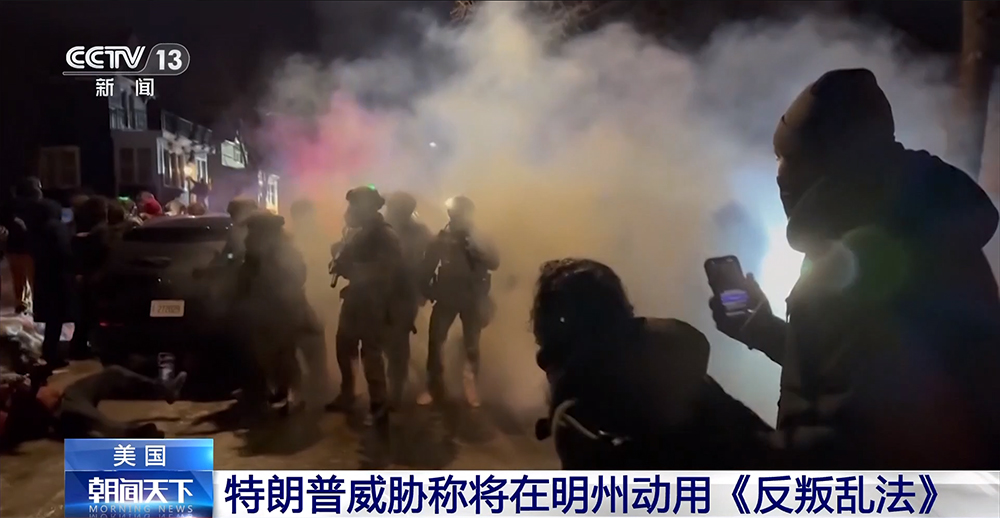
Core Viewpoint - Protests in Minneapolis are escalating following the shooting of civilian Renee Good by ICE agents, highlighting issues of excessive law enforcement and the involvement of federal and state authorities in managing the situation [1][3]. Group 1: Government Response - Minnesota National Guard troops were deployed to assist local law enforcement and emergency management, focusing on traffic control and protecting citizens' rights to peaceful assembly [3]. - Approximately 1,500 soldiers from the U.S. Army's 11th Airborne Division are on standby to be sent to Minnesota if necessary, indicating a significant federal response to the unrest [3]. - President Trump mentioned the potential use of the Insurrection Act, a law that allows federal control over state National Guard forces during civil unrest, although he later stated that it was not the right time to implement it [3]. Group 2: Protests and Incidents - Protests occurred in Minneapolis, including one at an ICE temporary command center, where demonstrators faced off against law enforcement in extreme cold, resulting in multiple arrests [4]. - Over 2,400 arrests have been made in Minnesota as part of ICE's large-scale immigration enforcement actions, with reports of violence affecting innocent civilians, including a six-month-old baby [4]. - A federal judge issued an order prohibiting the use of pepper spray and tear gas by law enforcement during these operations unless justified, reflecting growing concerns over the tactics used by ICE [4]. Group 3: Public and Political Reactions - The actions of ICE have sparked outrage in the U.S., with criticism directed at the agency's perceived lack of accountability and aggressive tactics under the Trump administration [5]. - Minnesota's governor and Minneapolis' mayor are under investigation for allegedly obstructing federal law enforcement, raising questions about the balance of power between state and federal authorities [5]. - The governor criticized the federal government's approach, suggesting that using the judicial system as a weapon against political opponents is a dangerous tactic [5].

美国,突发!全美特工出动!国民警卫队进入“待命状态”
Zheng Quan Shi Bao Wang· 2026-01-18 04:05
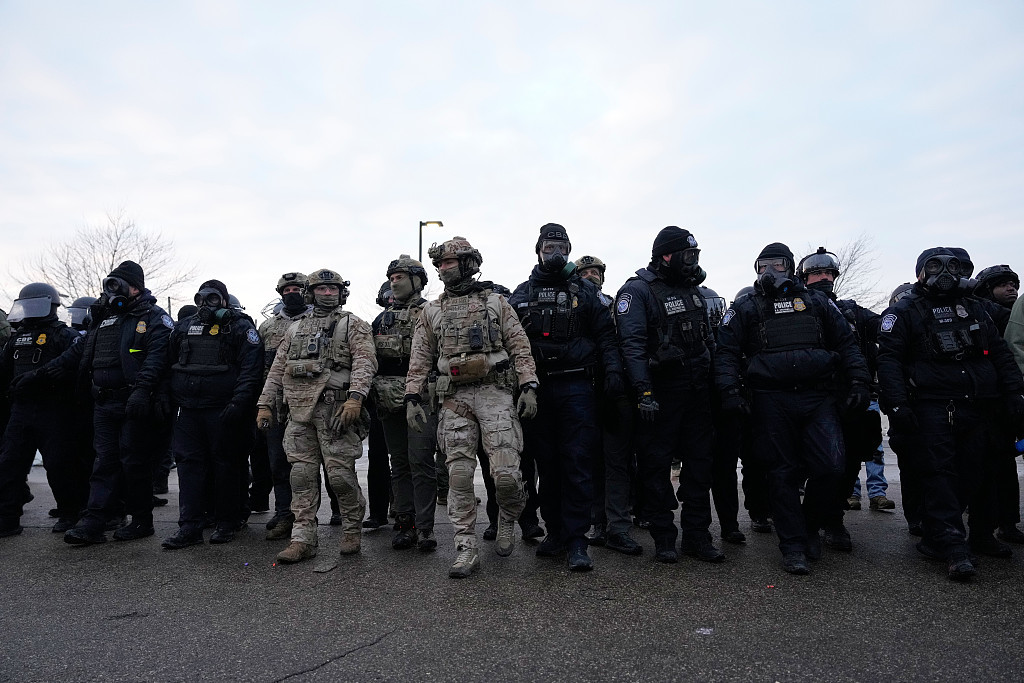
Core Viewpoint - Tensions in Minneapolis, Minnesota, have escalated, prompting the National Guard to enter a "standby status" and the FBI to request agents nationwide to assist in the situation [1][2][4]. Group 1: Government Response - The Minnesota National Guard has been mobilized under Governor Tim Walz's directive but has not yet been deployed to the streets [2]. - President Trump criticized local officials for their handling of the situation, stating they have "lost control" and warned of potential federal intervention if necessary [3][5][6]. - The U.S. Department of Justice has issued subpoenas to Governor Walz and Minneapolis Mayor Jacob Frey, alleging they obstructed federal law enforcement [3]. Group 2: Protests and Conflicts - Protests have erupted in Minneapolis, with clashes occurring between pro-immigration and anti-immigration groups [2]. - A conservative influencer involved in the January 6 Capitol riots organized a rally that led to confrontations with opposing groups [2]. Group 3: FBI Involvement - The FBI is recruiting agents from across the country for temporary assignments in Minneapolis, although specific tasks have not been disclosed [4]. - FBI Director Kash Patel indicated ongoing efforts to combat violence and investigate funding networks supporting criminal activities [4].
特朗普,又改口了
Xin Lang Cai Jing· 2026-01-17 05:22
Core Viewpoint - President Trump indicated that he currently sees no need to deploy troops in Minnesota under the Insurrection Act, but he retains the option to do so if necessary [1] Group 1: Government Response - Trump warned Minnesota leaders that he may intervene if protests continue during immigration enforcement actions [1] - The Minnesota governor's office stated that the state is in ongoing communication with the White House regarding Immigration and Customs Enforcement actions and the Minneapolis unrest [1] Group 2: Presidential Threats - Trump previously threatened via social media to invoke the Insurrection Act if the Minnesota government does not stop the actions of what he termed "insurrectionists" [1]
特朗普改口 称暂无理由在明尼苏达州动用《反叛乱法》
Xin Lang Cai Jing· 2026-01-17 03:19
Core Viewpoint - President Trump stated that he currently sees "no reason" to invoke the Insurrection Act in Minnesota, despite having previously threatened to do so [1][3]. Group 1: Insurrection Act - The Insurrection Act allows the President to deploy military forces to quell unrest in specific areas [3]. - The last invocation of the Insurrection Act dates back to the early 1990s [3]. Group 2: Recent Events - A large-scale enforcement operation by ICE in Minneapolis resulted in the shooting of 37-year-old American citizen Ryan Nicole Good, which sparked ongoing protests and significant media attention [3].
特朗普改口:目前没必要在明尼苏达州动用《反叛乱法》
Yang Shi Xin Wen Ke Hu Duan· 2026-01-16 20:34
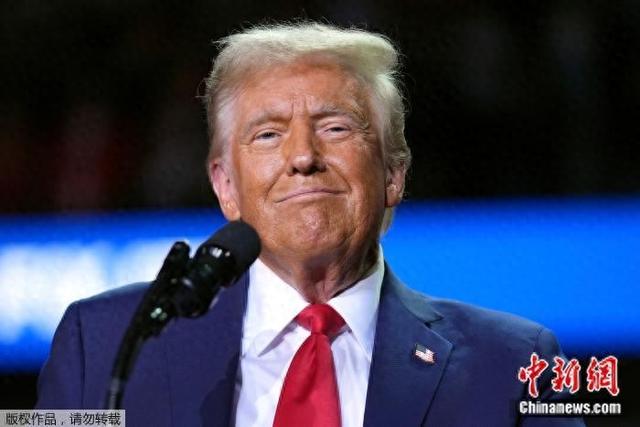
Core Viewpoint - President Trump currently sees no need to deploy troops in Minnesota under the Insurrection Act, but he retains the option to do so if necessary [1] Group 1 - Trump warned Minnesota leaders that he may intervene if protests continue during immigration enforcement actions [1] - The Minnesota governor's office stated that the state is in ongoing communication with the White House regarding immigration and Customs Enforcement actions and the Minneapolis unrest [1] - Trump previously threatened via social media to invoke the Insurrection Act if the Minnesota government does not stop the actions of what he termed "insurrectionists" [1]
特朗普威胁称将在明尼苏达州动用《反叛乱法》
Yang Shi Wang· 2026-01-16 03:28
Group 1 - A U.S. citizen was killed during a law enforcement operation in Minnesota, leading to ongoing protests in the area [1] - President Trump threatened to invoke the Insurrection Act if the Minnesota government does not stop the actions of what he termed "insurgents" [1] - Minnesota's Attorney General Keith Ellison stated that he would sue if Trump uses the Insurrection Act against the state, highlighting previous legal actions against federal immigration enforcement [3] Group 2 - The Insurrection Act of 1807 allows the President to deploy military forces if state authorities are deemed unable to enforce laws, granting significant military deployment authority [3]
【史海回眸】1992年,洛杉矶上演“美国20世纪最大骚乱”
Huan Qiu Shi Bao· 2025-06-12 22:28
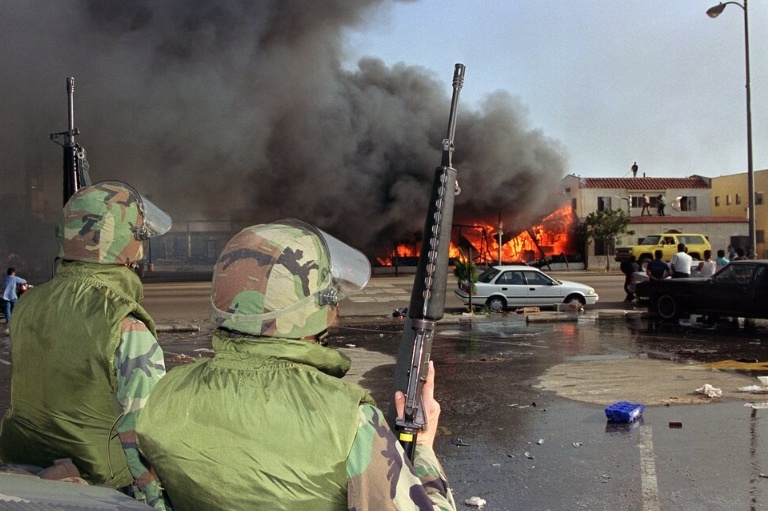
Core Viewpoint - The article discusses the recent deployment of federal armed forces in response to riots in Los Angeles, highlighting the historical context and implications of such actions by the federal government [1][6]. Group 1: Federal Response - President Trump has bypassed local government to deploy 4,000 National Guard members and approximately 700 Marines to California amid ongoing riots [1]. - The last federal deployment of the National Guard to address riots occurred in 1992 during the Los Angeles riots, where nearly 6,000 National Guard personnel and about 4,500 federal soldiers were mobilized [1]. Group 2: Historical Context - The 1992 Los Angeles riots were triggered by the acquittal of four police officers involved in the brutal beating of African American Rodney King, leading to widespread violence and civil unrest [3][4]. - The riots resulted in over 60 deaths, more than 2,000 injuries, and approximately 1,000 buildings being destroyed, with thousands arrested [6]. Group 3: Military Involvement - The military's involvement in the riots led to a significant reduction in crime rates in previously high-risk areas, although it also instilled fear among residents due to the military presence [6]. - A specific incident involving Marines firing over 200 rounds at a residential building highlighted the risks associated with military and police collaboration during civil unrest [7]. Group 4: Legal and Ethical Concerns - The use of the Insurrection Act to justify military deployment raises concerns about the blurred lines between federal and local jurisdiction, as well as the implications for civil liberties [7][8]. - Legal experts criticize the Insurrection Act for its vague provisions, which could grant the President excessive discretionary power in deploying the National Guard [8].