
不动产信托登记试点

Search documents
从制度破冰到生态重塑——2025年信托业“1+N”体系回顾
Xin Lang Cai Jing· 2025-12-30 03:55
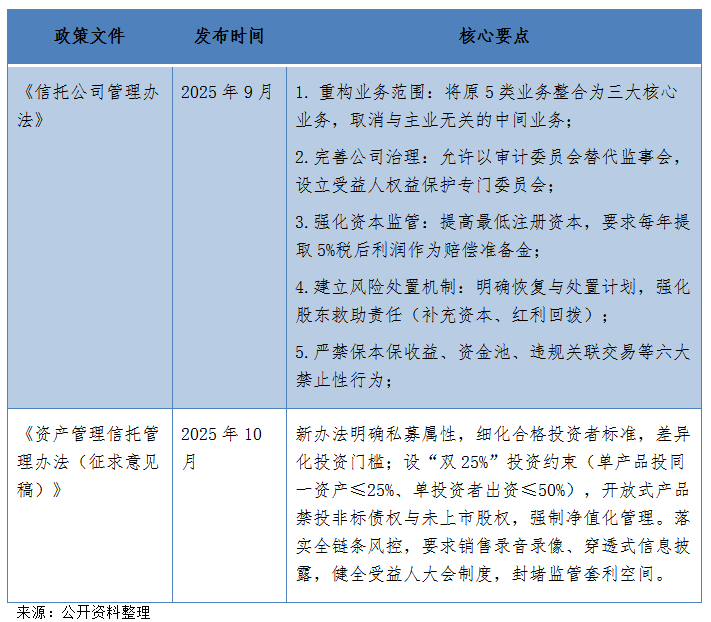
Core Viewpoint - The trust industry is undergoing a significant transformation with the implementation of the "1+N" regulatory framework, which aims to enhance supervision, prevent risks, and promote high-quality development in the sector [1][2][17]. Group 1: Policy Overview - The "1+N" system consists of a core policy document and various supporting regulations that focus on three main categories of trust business: asset management trusts, asset service trusts, and charitable trusts [1][2]. - The key policy document, "Opinions on Strengthening Supervision, Preventing Risks, and Promoting High-Quality Development of the Trust Industry," sets development goals for 2029 and 2035, emphasizing the importance of the trust industry in serving the real economy and improving people's lives [2][17]. - The policy mandates stricter entry standards, enhanced governance, and the establishment of a "blacklist" system to manage risks effectively [2][17]. Group 2: Regulatory Framework - The "Trust Company Management Measures," revised for the first time in 18 years, restructures the business scope into three core categories and strengthens capital supervision by raising minimum registered capital requirements [19][20]. - The "Asset Management Trust Management Measures" outlines the private placement nature of asset management trusts and introduces specific investment constraints to ensure compliance and risk management [20]. - A pilot program for real estate trust registration is set to begin in December 2024 in Beijing, with expansion to other cities, establishing a dual registration system to solidify asset service trust foundations [21][22]. Group 3: Self-Regulatory Guidelines - The trust industry is accelerating the introduction of self-regulatory guidelines, including the "Green Trust Guidelines" and "Trust Culture Construction Guidelines," to standardize operations and enhance compliance [26]. - Ongoing discussions include the "Family Trust Business Guidelines" and "Insurance Trust Business Guidelines," which aim to align with new regulatory frameworks and improve operational standards [26]. Group 4: Industry Impact - The trust industry's asset scale has shown steady growth, reaching 32.43 trillion yuan by mid-2025, with a year-on-year increase of 20.11%, driven by the optimization of business structures under the "three categories" policy [12][27]. - The new regulatory framework is expected to lead to a significant restructuring of the industry, with traditional non-standard and channel models being phased out in favor of asset management and service trusts [29]. - The competition within the industry is shifting from scale expansion to a focus on professional capabilities and service quality, with a greater emphasis on investment research and wealth management services [29][30].

深度|“把房子装进信托”扩围,全国多地探索不动产信托登记试点
券商中国· 2025-12-02 01:25
Core Viewpoint - The pilot program for real estate trust property registration is rapidly expanding, with Suzhou becoming the sixth city to implement this initiative, addressing long-standing issues related to property rights and transaction complexities [1][3][4]. Group 1: Expansion of Real Estate Trust Registration - The real estate trust involves transferring property to a trust institution, which manages and disposes of it according to the client's wishes, addressing the high proportion of real estate in social assets [3]. - The pilot program has expanded to six cities: Beijing, Shanghai, Guangzhou, Xiamen, Tianjin, and Suzhou, within a year, indicating strong market interest [4]. - The first real estate trust registration in Suzhou involved transferring property and related rights into the trust system, marking a significant step in clarifying property rights [3][4]. Group 2: Challenges in Implementation - Despite the rapid expansion, challenges remain, including high costs and the need for better alignment between supply and demand, as well as legal and top-level design improvements [2][9]. - The current tax structure poses a significant barrier, as transferring property into a trust is treated as a transaction, leading to high transfer taxes and potential double taxation [9][10]. - There is a need for a unified top-level institutional arrangement to facilitate the large-scale promotion of real estate trust registration, as many regions lack the necessary legal basis for property registration [11]. Group 3: Recommendations for Improvement - Recommendations include establishing a national standard for real estate trust registration procedures, optimizing tax policies to reduce costs, and encouraging the development of specialized third-party management institutions [12]. - It is suggested to create a differentiated tax incentive system based on the non-transactional nature of trust transfers to lower the establishment costs of trust registrations [12]. - The industry calls for a collaborative approach to enhance the legal framework, tax arrangements, and governance structures surrounding real estate trusts to support their future development [12].

上海落地两单不动产信托登记试点案例
Jin Rong Shi Bao· 2025-06-11 01:50
Core Insights - The successful implementation of real estate trust registration cases by Shanghai Trust and Aijian Trust marks an expansion of real estate trust applications into areas such as family wealth inheritance and special needs for elderly individuals, reflecting a response to the notice issued by six governmental departments [1][2] Group 1: Case Studies - The Shanghai Trust case involves a middle-aged woman who places a commercial property and cash assets into a trust to generate stable cash flow for her mother's pension, with the property intended for inheritance by her children, showcasing a mixed asset trust model for family wealth management [1] - The Aijian Trust case addresses the needs of an elderly individual living alone, who entrusts her only property to a trust company, using rental income as supplementary retirement funds while ensuring the property is passed on to her nephew after her passing, highlighting the trust's adaptability to different demographic needs [2] Group 2: Operational Efficiency - The entire process from the issuance of the notice to the registration of real estate trust products was completed within 10 working days, demonstrating the efficiency of the real estate trust registration process in Shanghai and the effective collaboration among multiple departments [3]