Trusts

Search documents
痛惜!55岁信托公司董事长离世
证券时报· 2026-03-25 11:51
Core Viewpoint - The sudden passing of Tang Jian, the chairman of GuoTong Trust, highlights the importance of leadership in risk management and investor protection within the trust industry [1][2]. Group 1: Leadership and Contributions - Tang Jian was appointed as the chairman of GuoTong Trust on December 26, 2022, and was previously involved with Hubei Financial Leasing Company [1]. - He was known for his dedication to risk prevention and actively engaged in business supervision and risk resolution [2]. - Tang led discussions on key projects, such as the Yangguang City project, emphasizing the protection of investors' rights and the importance of collaboration among trust companies [2]. Group 2: Risk Management Initiatives - After his appointment, Tang frequently conducted on-site inspections to oversee risk management for various trust plans, including the Dongxing 653 and 909 plans in Zhengzhou [4]. - He actively participated in risk resolution efforts across multiple regions, including Fujian and Anhui, focusing on the recovery of troubled trust projects [4]. - Tang's leadership included setting clear objectives for the company's strategic direction and risk management during the 2026 "Opening Red" meeting [5][6].


基金转换后亏损70万,法院:银行未重新评估,担责70%
21世纪经济报道· 2026-03-19 09:16
Core Viewpoint - The implementation of the "Financial Institutions Product Appropriateness Management Measures" aims to establish standards for the appropriateness management system, ensuring that financial institutions understand their clients and products, thereby protecting investors' rights in financial disputes [1]. Group 1: Case Studies - The first case involves an elderly investor, Mr. Li, who was misled into purchasing a trust product despite not meeting the investment criteria. The court ruled that the bank failed to fulfill its appropriateness obligations, resulting in a 30% compensation for Li's losses [3][4]. - The second case features Mr. Shang, who faced losses after converting his fund to a higher-risk product without proper risk assessment by the bank. The court determined that the bank did not adequately inform Shang about the new product's risks, leading to a 70% compensation for his losses [6][8]. - The third case concerns Mr. Cai, an experienced investor who claimed that the trust company did not fulfill its appropriateness obligations. The court ruled in favor of Cai, ordering the trust company to compensate him for his losses, emphasizing that investment experience does not exempt financial institutions from their responsibilities [10]. Group 2: Regulatory Insights - The new regulations prohibit sales personnel from influencing risk assessment results, highlighting the importance of investors completing risk questionnaires truthfully [4]. - Financial institutions are required to provide special financial services and risk prevention measures for elderly investors, ensuring they understand the risks associated with financial products [8]. - The regulations clarify that financial institutions are responsible for collecting accurate client information and conducting thorough risk assessments, with investment experience serving only as a reference for risk awareness [10].

信托,正在扎堆做LP
母基金研究中心· 2026-03-12 09:04
Core Viewpoint - Trust companies are increasing their investment in venture capital (VC) by acting as limited partners (LPs) in various funds, focusing on hard technology, biomedicine, and strategic emerging industries [2][4]. Group 1: Trust Companies' Investment Activities - In 2023, several trust companies, including Minmetals Trust and CITIC Trust, have invested in multiple venture capital funds, indicating a trend towards early-stage and small-scale investments in hard technology [2]. - Trust companies are exploring new business models in private equity (PE) and venture capital (VC) due to market saturation and increasing risks in traditional real estate investments [3][4]. - The establishment of mother funds by trust companies, such as the 4 billion yuan industry guidance mother fund initiated by Guotai Junan and Haitong Securities, highlights their growing involvement in the VC/PE sector [4][5]. Group 2: Investment Strategies and Preferences - Trust companies prefer to invest in strategic emerging industries, including semiconductors, biomedicine, and intelligent manufacturing, as they seek to support the real economy [5][6]. - The shift towards investment-type business models is driven by the need to diversify risks and enhance asset transparency, with many trust companies increasingly adopting specialized funds [6]. - Trust companies are favoring general partners (GPs) with strong industry backgrounds and advantages in niche markets, indicating a preference for established and reputable GPs [5]. Group 3: Challenges and Opportunities - Trust companies face challenges in the private equity investment space, including regulatory restrictions and a lack of professional management teams, which may hinder their ability to scale quickly [7]. - Despite the potential for growth in equity investment trusts, the long investment cycles and uncertain returns may not meet investors' short-term return expectations [6][7]. - The current environment presents both opportunities and challenges for trust companies to establish equity investment trusts as new profit growth points, contingent on their ability to navigate regulatory and operational hurdles [7].


全国政协委员金李:信托财产登记让更多家庭和企业触手可及
2 1 Shi Ji Jing Ji Bao Dao· 2026-02-27 03:46
Core Viewpoint - 2025 is a pivotal year for the transformation of China's trust industry, with significant advancements in real estate and equity trust property registration, providing institutional support for "housing for elderly care" and revitalizing existing assets [1][12]. Group 1: Real Estate Trust Developments - The successful implementation of real estate trust property registration trials in multiple cities allows "real estate" to become a liquid "retirement resource," enriching the multi-tiered pension security system [3][14]. - Real estate trust registration addresses the "trust" issue, ensuring that properties remain independent of the pension institution, thus safeguarding the elderly's rights even if the institution fails [3][14]. - The trust structure enables the elderly to convert property into stable cash flow without selling ownership, enhancing the quality of retirement living [3][14][15]. - Real estate trusts can flexibly set beneficiaries and distribution rules, promoting intergenerational harmony and reducing family disputes over inheritance [4][15]. Group 2: Equity Trust Developments - The registration of equity trusts in Beijing and Hangzhou marks a milestone in the trust system, providing a "safety net" for private entrepreneurs and addressing succession challenges [7][17]. - Equity trust registration clarifies the legal status of equity as trust property, allowing for the separation of ownership, management, and beneficiary rights, thus ensuring stability in family business succession [7][17]. - This development encourages the trust industry to return to its core purpose of asset management and wealth transfer, with initiatives like the equity charitable trust in Hangzhou reflecting the social value of the trust system [8][18]. Group 3: Challenges and Recommendations - Establishing a unified national trust property registration system faces challenges, including legal coordination, departmental collaboration, and tax-related issues [9][19]. - The key to addressing tax burdens in trust setups lies in establishing a "tax neutrality" principle, which would treat property transfers to trusts as non-transactional, thus avoiding excessive taxation [10][20]. - Promoting pilot programs in existing real estate and equity trust registration areas could help reduce institutional costs and facilitate wealth transfer and public service [10][20]. Group 4: Inclusive Trust Products - The rise of inclusive trust products, such as family service trusts, lowers participation barriers, allowing middle-income families to access trust services [11][21]. - This trend reflects a return to the core of the trust industry, emphasizing the importance of wealth preservation and risk isolation for ordinary families [11][21][22]. - The promotion of inclusive trusts encourages a shift from short-term asset appreciation to long-term planning and family asset allocation, representing a new growth avenue for the trust industry [22].
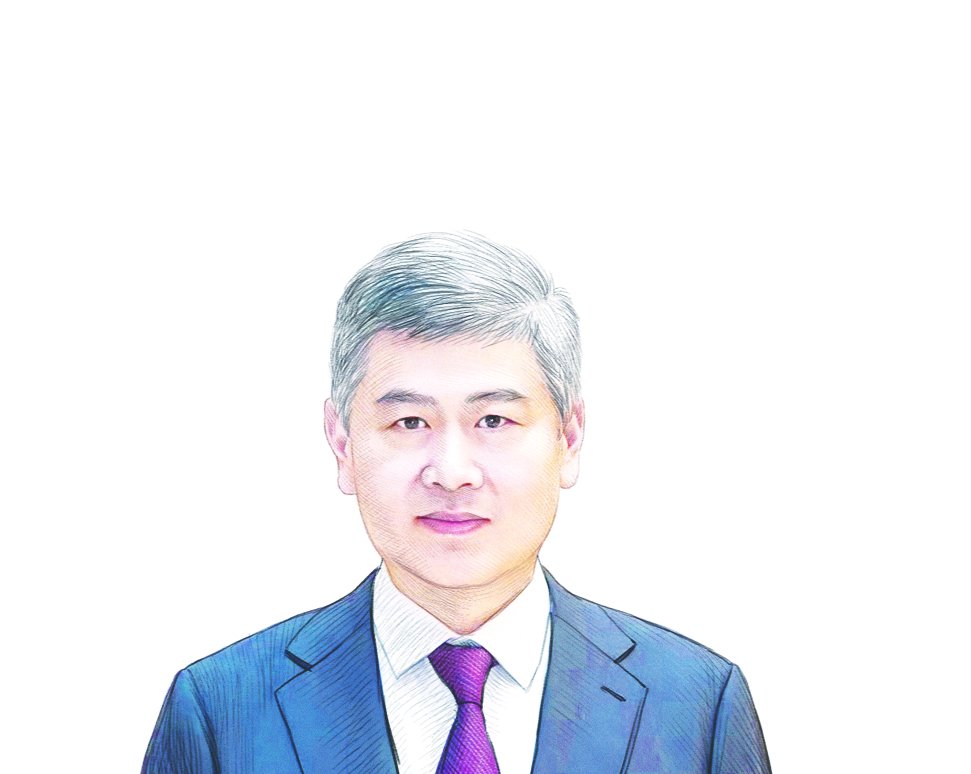
专访全国政协委员金李:信托财产登记让更多家庭和企业触手可及
2 1 Shi Ji Jing Ji Bao Dao· 2026-02-26 04:41
Core Viewpoint - The trust industry in China is undergoing significant reforms in 2025, with the implementation of real estate trust property registration trials in multiple cities, which supports "housing for elderly" initiatives and revitalizes existing assets [1] Group 1: Real Estate Trusts - The successful implementation of real estate trust property registration trials allows "real estate" to become a liquid "retirement resource," enriching the multi-tiered pension security system in China [2] - Real estate trust registration addresses the "trust" issue, ensuring that property remains independent of the pension institution, thus safeguarding the elderly's rights even if the institution fails [2] - The trust structure enables the elderly to convert property into stable cash flow without selling ownership, enhancing the quality of retirement living [2][3] - Real estate trusts can activate dormant assets, particularly state-owned properties, by isolating them from the original enterprise's debt risks, thus improving asset credit ratings [5] - The introduction of professional management through real estate trusts enhances operational efficiency, allowing for better rental income and asset value [5] - Real estate trusts facilitate a closed loop of investment, financing, management, and exit, effectively transforming illiquid hard assets into tradable financial products [6] Group 2: Equity Trusts - The registration trials for equity trusts in Beijing and Hangzhou represent a milestone in the trust system, providing legal clarity for private enterprises and addressing succession challenges [8] - Equity trust registration offers private entrepreneurs a "reassurance" by ensuring the separation of ownership, management, and beneficiary rights, thus stabilizing control over the enterprise [8] - The development of equity trusts encourages the trust industry to return to its core purpose of asset management and wealth transfer, with initiatives like charitable equity trusts enhancing social value [8] Group 3: National Unified Trust Property Registration System - Local trials contribute valuable practical experience for establishing a national unified trust property registration system, validating the feasibility of the system through specific cases [9] - Challenges to establishing a unified system include legal coordination, inter-departmental collaboration, and tax-related issues, which need to be addressed for effective implementation [9] Group 4: Taxation Issues - Addressing tax burdens associated with trust property transfers is crucial, with a proposed shift to a "tax neutrality" principle to alleviate the financial burden on families and enterprises [10] - Recommendations include redefining tax points to treat trust property transfers as "non-transaction transfers," potentially exempting them from immediate taxation [10] Group 5: Inclusive Trust Services - The trend of making trust services accessible to ordinary families reflects the industry's return to its roots and the deepening of inclusive finance, allowing middle-income families to utilize trust structures for asset protection [11] - The promotion of inclusive trusts encourages a shift in focus from short-term asset appreciation to long-term wealth planning and risk isolation, fostering a culture of long-term investment [11]

信托公司如何应对 信披新规“大考”
Jin Rong Shi Bao· 2026-02-26 02:50
Core Viewpoint - The upcoming regulations on information disclosure for trust companies, specifically the "Charity Trust Information Disclosure Measures" and the "Asset Management Product Information Disclosure Management Measures," are set to be implemented in 2026, prompting varying levels of preparedness among trust companies [1][2]. Group 1: Industry Response to New Regulations - Trust companies are showing differing levels of awareness and readiness regarding the new regulations, with leading firms being more proactive in analyzing and preparing for the changes, while smaller firms tend to adopt a wait-and-see approach [1][2]. - Some trust companies have initiated internal studies to address operational challenges posed by the new regulations, focusing on establishing internal management systems and revising agreements with partners to clarify information flow and responsibilities [2][5]. Group 2: Challenges and Solutions - Key challenges identified include the implementation of transparent disclosures, standardization of performance benchmarks, system upgrades, and cross-departmental collaboration [2][5]. - Trust companies are encouraged to enhance their information disclosure capabilities by investing in technology and establishing a unified data governance system to ensure accurate and standardized data [2][5]. Group 3: Regulatory Implications - The new regulations signify a shift towards unified standards for information disclosure across the industry, impacting all participants in charity trusts and asset management trusts [4][5]. - The emphasis on compliance and transparency is critical, as non-compliance has been a major reason for regulatory penalties in recent years [2][3]. Group 4: Recommendations for Improvement - Trust companies should develop assessment metrics that balance compliance and effectiveness, incorporating indicators for timeliness and completeness of disclosures [6]. - Establishing a feedback mechanism from investors can help optimize disclosure strategies, ensuring that information meets regulatory requirements while providing valuable decision-making insights [6].
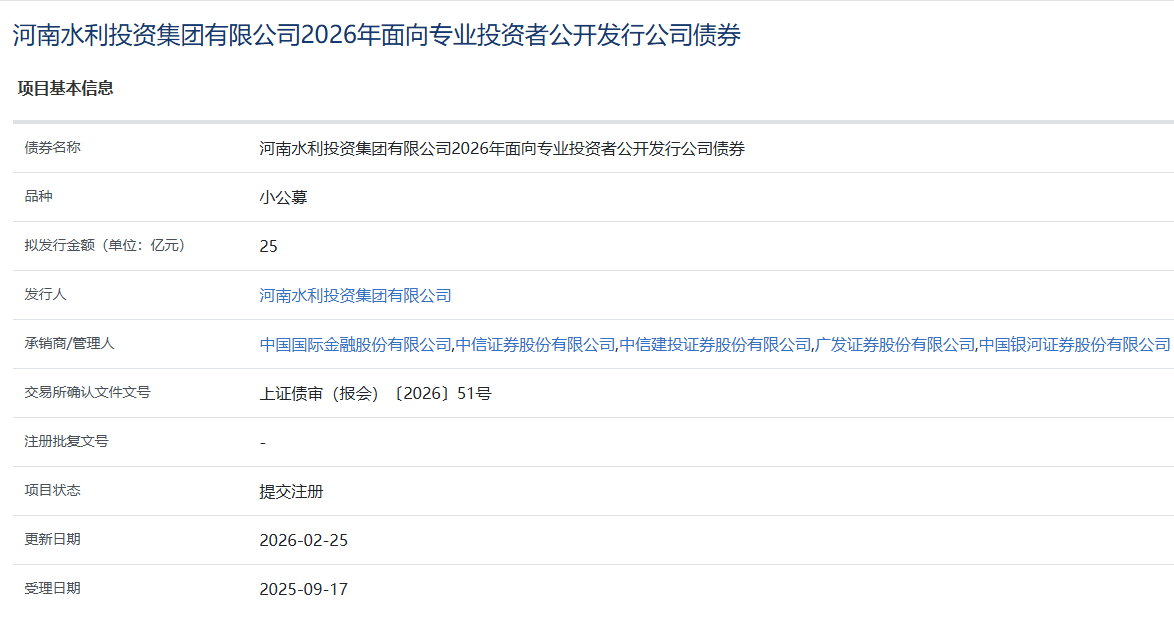
河南水利投资集团拟发行25亿元公司债,已提交注册
Sou Hu Cai Jing· 2026-02-25 02:00
Core Viewpoint - Henan Water Investment Group Co., Ltd. is set to issue corporate bonds worth 2.5 billion yuan aimed at professional investors, with a stable credit rating of AAA as assessed by Shanghai New Century [1][2]. Group 1: Bond Issuance Details - The proposed bond issuance amount is 2.5 billion yuan [1][2]. - The underwriters and managers for this bond issuance include China International Capital Corporation, CITIC Securities, CITIC Construction Investment Securities, GF Securities, and China Galaxy Securities [1][2]. - The bond is registered under the Shanghai Stock Exchange with the document number "上证债审(报会)〔2026〕51号" [2]. Group 2: Fund Utilization - The funds raised from this bond issuance, after deducting issuance costs, will be used to repay maturing debts totaling 2.5 billion yuan [3]. - Specific debts to be repaid include: - 23 million yuan to Bank of China, due on April 28, 2026 [3]. - 60 million yuan to Industrial International Trust, due on March 31, 2026 [3]. - 62 million yuan to Bohai International Trust, due on November 21, 2026 [3]. - 20 million yuan to China Construction Bank, due on June 16, 2026 [3]. - 65 million yuan and 20 million yuan to China Insurance Asset Management, due on August 25, 2026, and October 30, 2026, respectively [3]. - The total amount of debts to be repaid is 250 million yuan [3].
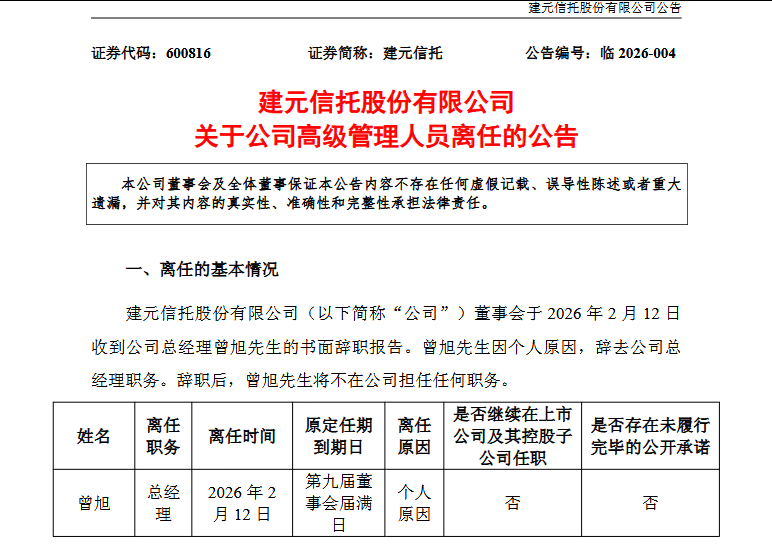
春节将至,年薪超300万元建元信托总经理突然辞职
Shen Zhen Shang Bao· 2026-02-13 13:52
Group 1 - The core point of the news is the resignation of Mr. Zeng Xu, the General Manager of Jianyuan Trust, due to personal reasons, which has raised significant attention in the financial sector [1][2] - Mr. Zeng's resignation is effective immediately upon delivery of his resignation report to the board, and he will not hold any position in the company thereafter [2] - The board has appointed Chairman Qin Yi to act as the General Manager for a period of up to six months while a suitable replacement is found [2] Group 2 - Mr. Zeng, aged 48, has extensive experience in the securities, asset management, and digital finance sectors, having previously held several key positions at Industrial Securities before joining Jianyuan Trust [3] - During his tenure, Mr. Zeng's annual salary was reported to be 3.268 million yuan [4] - Jianyuan Trust has faced significant legal challenges, with total litigation amounts reaching 936 million yuan, including a notable case involving a 498 million yuan dispute with Sanxia Capital [5] Group 3 - The company's financial performance has been under pressure, with total operating revenue for the first three quarters of 2025 at 189 million yuan, a year-on-year decline of 24.61% [6] - The core business revenue from fees and commissions dropped significantly by 41.0% to 135 million yuan compared to the previous year [6] - Despite a year-on-year increase of 24.25% in net profit attributable to shareholders, this was primarily due to a substantial reduction in income tax expenses rather than improvements in core business operations [6]
新版金融许可证换发提速,24家信托公司率先领证,业务全面适配“三分类”新规
Xin Lang Cai Jing· 2026-02-11 02:43
Core Viewpoint - The trust industry is undergoing a significant transformation with the implementation of the new "Trust Company Management Measures," leading to a wave of license renewals among trust companies, indicating a shift towards high-quality development in the sector [2][3][4]. Group 1: License Renewal Progress - Dongguan Trust has received approval to renew its financial license, marking a step in the broader trend of trust companies adapting to new regulations [1][7]. - As of February 10, 2026, 24 trust companies have successfully completed the renewal process, all citing "business scope change" as the reason for renewal [2][9]. - The renewed licenses align with the new "three-category" framework, categorizing businesses into asset service trusts, asset management trusts, and public welfare trusts [2][9]. Group 2: Industry Transformation - The renewal of licenses signifies the trust industry's transition into a new phase of high-quality development, characterized by increased industry concentration and a shift in competition from scale to professional and risk management capabilities [2][3][9]. - Trust companies are focusing on core business areas, shedding non-core activities, and enhancing compliance and risk management to align with regulatory requirements [3][4][9]. - The "standardization + differentiation" business model is expected to drive the industry from homogeneous competition to a more stratified development approach [3][9]. Group 3: Future Outlook - More than half of the trust companies have yet to complete the license renewal process, with significant attention on those facing risks, such as Zhongrong Trust and Minsheng Trust, regarding their ability to obtain new licenses [4][11]. - The industry is expected to complete the license renewal process by the end of March 2026, with a focus on compliance and business transformation being crucial post-renewal [12]. - The overall structure of the trust industry is anticipated to optimize further, reshaping the competitive landscape and enhancing risk prevention capabilities, ultimately better serving the real economy and wealth management needs [13].
慈善信托备案规模突破百亿,哪些信托公司在发力?
第一财经· 2026-02-11 02:11
Core Viewpoint - The report indicates that by the end of 2025, the cumulative scale of charitable trusts in China will exceed 10 billion yuan, highlighting the significant growth and transformation in the trust industry driven by regulatory encouragement and market demand [2][4]. Summary by Sections Charitable Trust Scale and Growth - As of the end of 2025, there will be a total of 2,757 charitable trust registrations with a cumulative scale of 10.231 billion yuan. In 2025 alone, 1.694 billion yuan will be added through new registrations [4]. - The number of new charitable trust registrations in 2025 includes 508 new cases with a scale of 926 million yuan, while 151 existing trusts will see an additional scale of 768 million yuan [5]. Participant Composition - Natural persons and private enterprises remain the primary participants in establishing charitable trusts. In 2025, 82 of the new trust registrations involved natural persons, accounting for over 16% of the total [9]. - Among the 160 corporate participants, 103 are private enterprises, representing over 64% of the corporate participants [9]. Focus Areas of Charitable Trusts - The most popular areas for charitable trusts are poverty alleviation and education, followed by assistance for the disabled and elderly. The structure of the scale shows a significant concentration in smaller trust amounts, with over 70% of new registrations being in the range of 10,000 to 1 million yuan [5]. Institutional Participation and Performance - Trust companies are the primary trustees for charitable trusts, with 54 out of 114 institutions acting as trustees in 2025 being trust companies. The top three trust companies by new registration scale include CITIC Trust (481 million yuan), China Resources Trust (175 million yuan), and Guotou Taikang Trust (116 million yuan) [6]. - The leading institutions in managing charitable trusts from 2016 to 2025 are Wanxiang Trust (300 cases), Everbright Trust (221 cases), and Kunlun Trust (186 cases) [6]. Regional Development Disparities - There are significant regional disparities in the development of charitable trusts, with 25 provinces establishing new trusts in 2025. Guangdong, Beijing, and Zhejiang are the leading regions, while several provinces have fewer than five new registrations [9]. - Guangdong province leads with a registration scale of 462 million yuan, followed by Beijing and Zhejiang with 427 million yuan and 316 million yuan, respectively [9]. Regulatory Environment and Future Outlook - The regulatory environment for charitable trusts is improving, with new disclosure regulations expected to enhance transparency and operational efficiency. The implementation of these regulations is anticipated to accelerate the growth and innovation in the charitable trust sector [10].