不良贷款拨备覆盖率

Search documents
空缺8个月后悬念揭晓?杭州银行或迎47岁新行长!
Xin Lang Cai Jing· 2025-12-26 09:03
Core Viewpoint - Hangzhou Bank is undergoing a leadership transition with the potential promotion of Vice President Zhang Jingke to President, following the resignation of former President Yu Liming due to personal reasons. Despite this change, the bank has maintained revenue growth, although at its lowest rate in recent years [1][18]. Group 1: Leadership Changes - Zhang Jingke, born in August 1978, is expected to be promoted to President, marking a significant internal advancement as he has been with Hangzhou Bank for over 20 years [1][18]. - Yu Liming, the former President, resigned on April 2, 2023, after being reported missing, leading to a temporary appointment of Chairman Song Jianbin as acting President until a new President is approved [8][26]. - The bank's executive team has expanded to seven Vice Presidents following the return of Wang Lixiong to the role, enhancing the management structure [25][24]. Group 2: Financial Performance - For the first three quarters, Hangzhou Bank reported a revenue of 28.88 billion yuan, a year-on-year increase of 1.35%, marking the lowest growth rate in recent years [10][30]. - The net profit for the same period reached 15.885 billion yuan, reflecting a 14.53% increase year-on-year, indicating strong profitability despite revenue growth challenges [10][30]. - The bank's total assets grew to 2.3 trillion yuan, an 8.67% increase from the previous year, showcasing overall financial stability [10][30]. Group 3: Revenue Breakdown - Net interest income increased by 9.96% to 20.093 billion yuan, while net fee and commission income rose by 12.65% to 3.298 billion yuan [11][30]. - Investment income saw a significant increase of 22.3% to 7.307 billion yuan, although the bank faced a loss of 2.294 billion yuan from fair value changes, contrasting with a gain of 1.033 billion yuan in the previous year [11][30]. - The decline in total revenue was primarily attributed to the negative fair value changes, which had a substantial impact on overall performance [30][33]. Group 4: Risk Management and Profitability - The bank's credit impairment losses decreased by 38.47% year-on-year to 2.82 billion yuan, contributing to the maintenance of double-digit net profit growth [33]. - Hangzhou Bank's non-performing loan coverage ratio remains high at 513.64%, indicating a conservative approach to risk management [33]. - Despite strong profit growth, the bank's cash dividend payout ratio has been below 25% for four consecutive years, raising concerns about shareholder returns compared to peers [35][36].



六大国有行日赚38亿!最新披露
Nan Fang Du Shi Bao· 2025-09-02 04:53
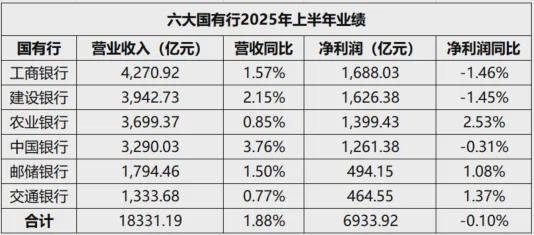
Core Insights - The six major state-owned banks in China reported mixed performance in their mid-year results for 2025, with total assets exceeding 200 trillion yuan and a combined net profit of 693.9 billion yuan, averaging a daily profit of 3.8 billion yuan [1][4]. Financial Performance - All six banks achieved revenue growth year-on-year, with China Bank leading at 3.76% and Construction Bank following at 2.15%, while net profit showed a "three up, three down" trend [2][3]. - Agricultural Bank recorded the highest net profit growth at 2.53%, while Industrial and Commercial Bank, Construction Bank, and China Bank experienced declines in net profit ranging from -1% to -2% [2][3]. Asset Quality and Risk Management - By the end of June 2025, the non-performing loan (NPL) ratio for the six banks decreased, with Postal Savings Bank being the only bank to see an increase, maintaining the lowest NPL ratio at 0.92% [9][10]. - The provision coverage ratio for non-performing loans varied, with China Bank's ratio falling below 200%, while Agricultural Bank maintained the highest at 295% [11][12]. Capital Adequacy and Dividends - The core Tier 1 capital adequacy ratio showed mixed results, with three banks increasing their ratios and three decreasing, while all banks maintained a ratio above 10% [12][13]. - The six banks proposed a total interim dividend of 204.66 billion yuan, with each bank distributing 30% of their net profit as cash dividends [12][14]. Interest Margin and Fee Income - The net interest margin continued to decline across the banks, with Postal Savings Bank having the highest margin at 1.7%, despite a year-on-year decrease [5][6]. - Fee and commission income showed growth for four banks, with Postal Savings Bank leading at an increase of 11.59%, while Industrial and Commercial Bank and Construction Bank saw declines [7].