业绩为王

Search documents
英大证券晨会纪要-20260318
British Securities· 2026-03-18 02:48
Market Overview - The A-share market experienced a short-term adjustment but maintains a medium-term slow bull pattern, with close attention needed on the geopolitical situation in the Middle East [2][8] - On Tuesday, the three major indices opened high but fell back, with financial stocks leading the rise, while growth stocks, particularly in the ChiNext index, saw declines exceeding 2% [4][5] - Overall, the market showed more declines than gains, with a significant reduction in trading volume, as the total transaction amount shrank to approximately 2.2 trillion yuan [5][9] Sector Analysis - Financial stocks, including insurance, banks, and securities, supported the index on Tuesday, driven by regulatory updates aimed at enhancing market stability and development [6] - The real estate sector saw an increase due to supportive government policies aimed at stabilizing the market, with expectations for continued policy support and improvement in supply-demand dynamics [7] - The oil and gas sector is highlighted as a focus for investment, particularly in companies with strong dividend yields and performance certainty [3][8] Future Outlook - Despite short-term fluctuations, the medium-term outlook remains positive, with strategies suggested for investors to capitalize on dips in specific sectors [3][8] - The upcoming reporting season in late March and April is expected to shift focus back to performance, with opportunities to identify stocks that exceed earnings expectations [3][8] - Investors are advised to adopt strategies of buying on dips or selling high, as market conditions evolve [3][8]
从“百货商场”到“精品超市”基金公司主动“瘦身”重塑增长逻辑
Zheng Quan Shi Bao· 2025-12-14 22:24
Core Viewpoint - The public fund industry in China is undergoing a transformation from a focus on scale expansion to a more refined approach emphasizing quality and performance, marking a shift towards "muscle growth" rather than just "fat growth" [1][2][4] Group 1: Industry Trends - Fund companies are increasingly rational about scale growth, opting to "slim down" their product offerings instead of aggressively marketing during peak performance periods [1][2] - A notable trend is the implementation of purchase limits on high-performing funds, indicating a shift in strategy from open solicitation to selective engagement [2][4] - The industry is moving away from a "mixed bag" of products towards a strategy that prioritizes high-quality offerings, akin to a "boutique supermarket" [4][5] Group 2: Fund Management Practices - Many fund companies are showing unprecedented openness towards the liquidation of underperforming products, reflecting a new mindset in the industry [3][5] - The decision to close funds that do not align with a manager's core competencies is becoming more common, demonstrating a focus on optimizing resource allocation [3][5] - The shift from a scale-centric approach to one that values performance is evident in the proactive measures taken by fund managers [3][6] Group 3: Regulatory Influence - Recent regulatory policies aim to shift the industry focus from "scale" to "returns," emphasizing the need for a performance-based fee structure [6][7] - The introduction of performance-linked management fees and a new evaluation system for fund managers is designed to align their interests with those of investors [6][7] - The regulatory framework is pushing for a redefinition of success in the industry, moving away from mere asset accumulation to sustainable performance [6][7] Group 4: Long-term Strategy - The industry is recognizing the importance of building long-term trust with investors, which requires a focus on sustainable performance rather than short-term gains [9][10] - There is a consensus that strong research capabilities and differentiated product offerings are essential for maintaining competitive advantage in the evolving market [10] - The transformation from a "scale is king" mentality to one that prioritizes "performance is king" is reshaping the competitive landscape of the public fund industry [10]
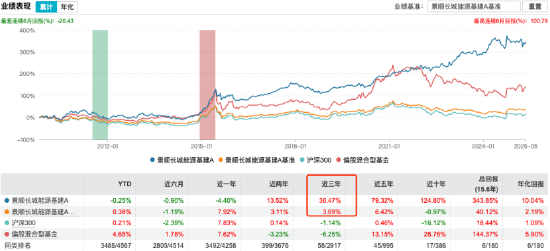
景顺长城能源基建近三年跑赢基准超33%,百亿基金经理鲍无可或受益薪酬改革
Xin Lang Ji Jin· 2025-05-15 10:00
Group 1 - The core viewpoint of the article is the implementation of the CSRC's "Action Plan for Promoting High-Quality Development of Public Funds," which links fund manager compensation to long-term performance, shifting the industry focus from "scale expansion" to "performance-oriented" [1] - The plan highlights the success of fund manager Bao Wuke from Invesco Great Wall, whose fund, Invesco Great Wall Energy Infrastructure A, has achieved significant excess returns, outperforming its benchmark by over 33% in the past three years [1][3] - Bao Wuke's investment strategy emphasizes long-term value extraction from "high-barrier enterprises," focusing on bottom-up stock selection to avoid short-term volatility [1] Group 2 - As of Q1 2025, Bao Wuke manages eight funds with a total scale of 16.207 billion yuan, with his flagship fund achieving a three-year return of 36.47% [1][3] - The fund's performance over various time frames is impressive, with returns of 79.32% over five years and 124.8% over ten years, consistently outperforming benchmarks [3] - The top holdings of Invesco Great Wall Energy Infrastructure A include resource and manufacturing sectors, indicating a focus on structural opportunities amid economic differentiation [5] Group 3 - Bao Wuke has expressed concerns about the AI industry's future, stating that the recent advancements may lead to a plateau in AI capabilities unless new iterative points are found [5] - The market is expected to be influenced by tariff policies, geopolitical conflicts, and the evolution of AI technology, but the long-term value of high-barrier enterprises is anticipated to remain intact [5] - The regulatory shift towards "performance-oriented" metrics is reshaping the public fund industry, making the ability to generate excess returns the primary measure of fund manager value [5]