两岸文化交融

Search documents
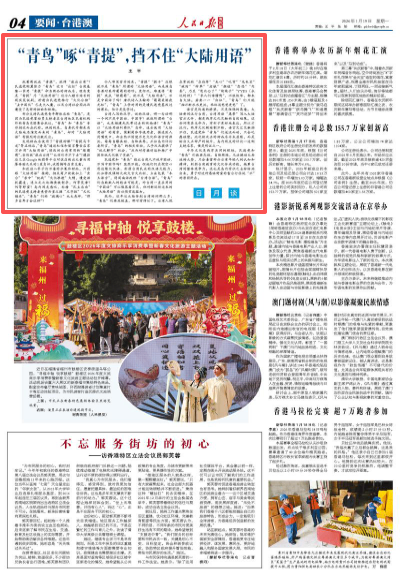
“青鸟”啄“青提”,挡不住“大陆用语”(日月谈)
Ren Min Ri Bao Hai Wai Ban· 2026-01-18 22:50
Core Viewpoint - The article highlights the absurdity of political and cultural censorship in Taiwan, particularly by the Democratic Progressive Party (DPP) and its youth group "Qingniao," which targets businesses for using terms deemed as "mainland Chinese language" [1][2][3]. Group 1: Cultural and Political Context - The DPP and its supporters are accused of promoting "cultural independence" and "de-Sinicization," leading to a distorted societal perception in Taiwan [1][2]. - The term "青提" (green grape) used by a dessert shop was criticized by "Qingniao" for being a "mainland term," despite its origins in Hong Kong [2][3]. - The actions of "Qingniao" reflect a broader trend of cultural suppression, where even benign terms are politicized, leading to harassment of businesses [2][3]. Group 2: Language and Identity - The article argues that the DPP's attempts to marginalize Mandarin Chinese and promote local languages weaken the cultural and linguistic ties between Taiwan and mainland China [3][4]. - The youth group "Qingniao" is portrayed as hypocritical, as they use a name derived from a mainland city while condemning the use of "mainland terms" [1][2]. - The article emphasizes that language is a bridge for communication and cultural exchange, and attempts to sever these ties are ultimately futile [3][4]. Group 3: Public Reaction and Support - The dessert shop targeted by "Qingniao" received significant support from the public, indicating a backlash against the group's actions [3][4]. - Online comments from Taiwanese netizens largely sided with the shop, showcasing a collective resistance to the censorship imposed by the DPP and its affiliates [3][4].

马蹄踏浪 潮连两岸
Xin Lang Cai Jing· 2026-01-09 00:10
Core Viewpoint - The article highlights the cultural significance of the "Ma Dui Ying Wang" ceremony in Tong'an, Fujian, which symbolizes the historical maritime trade and cultural exchanges between the mainland and Taiwan, emphasizing the deep-rooted connections and shared heritage of the two regions [1][2][3] Group 1: Historical Context - The "Ma Dui Ying Wang" ceremony, originating from maritime trade, features 108 horses and represents the loyalty and integrity of the Zhang family, serving as a historical "credit card" across the strait [1] - Tong'an has been a transportation hub since the Western Jin Dynasty, leveraging its geographical advantages to facilitate trade and cultural exchanges, with significant maritime activities recorded during the Ming and Qing Dynasties [1] Group 2: Cultural Significance - The deep connection between horses, the sea, faith, and livelihood reflects a shared memory of "living by the sea," making this custom a cultural bridge between the two sides of the Taiwan Strait [2] - The participation of nearly 800 people from 32 temples across Kinmen and Taiwan in the ceremony illustrates the common faith and cultural identity that binds the regions together [2] Group 3: Preservation and Development - Fujian boasts over 200 city-level intangible cultural heritage projects related to the sea, ranking among the top in the country, with notable examples including Mazu beliefs and traditional salt-making techniques [2] - Recent efforts to integrate these cultural practices through the internet and community planning aim to create a sustainable cycle of heritage protection and utilization, potentially serving as a model for the development of maritime culture in Fujian [2] Group 4: Future Outlook - The article expresses hope for the younger generation to continue the legacy of maritime culture, ensuring that historical roots are preserved while also paving the way for future development, contributing to the vision of a maritime power [3]
我在四川很安逸|台青程逸萱:成都让我的音乐梦想生根
Zhong Guo Xin Wen Wang· 2025-12-03 12:39
Core Viewpoint - The article highlights the cultural and musical exchange between Taiwan and Sichuan, emphasizing the personal journey of Cheng Yixuan as she finds inspiration and belonging in Chengdu's vibrant atmosphere [2] Group 1: Cultural Exchange - Cheng Yixuan appreciates the cultural similarities between Taiwan and Sichuan, believing that their shared acceptance of diverse cultures can lead to new musical collaborations [2] - The article suggests that the interaction between the two regions can foster a rich cultural dialogue, potentially enhancing the music scene in both areas [2] Group 2: Personal Journey - Cheng Yixuan has found a sense of belonging in Chengdu, which has positively influenced her music creation process [2] - The article describes how the scenic beauty and warm hospitality of Chengdu have helped alleviate her stress and provided her with creative inspiration [2]
两岸艺术家以画为笔“讲述”上海台北双城故事
Xin Hua She· 2025-11-27 08:53
Core Viewpoint - The Shanghai-Taipei Twin Cities Story Exhibition showcases the cultural connections and shared memories between Shanghai and Taipei through 119 artworks, highlighting the vitality of Chinese culture and the importance of cross-strait exchanges [1][2]. Group 1: Exhibition Overview - The exhibition features 119 paintings that depict iconic landmarks, local delicacies, and traditional cultural elements from both cities, emphasizing the shared heritage and emotional ties [1]. - The event is organized by the Shanghai Taiwan Compatriots Service Center, aiming to foster cultural exchange and deepen the understanding of the "Two sides of one family" concept [1]. Group 2: Cultural Exchange Initiatives - Shanghai has hosted over 500 cross-strait exchange activities this year, covering various fields such as science, education, culture, and sports, with a focus on youth engagement [1]. - The exhibition is seen as a bridge connecting the two cities and enhancing mutual trust and cooperation for future prosperity [1]. Group 3: Future Plans - The curator, a Taipei artist, expressed intentions to incorporate more formats like short videos, literature, and decorative arts in future exhibitions to enhance the emotional impact of the twin cities' stories [2]. - The exhibition will run until mid-December, with an online gallery available for broader access [3].
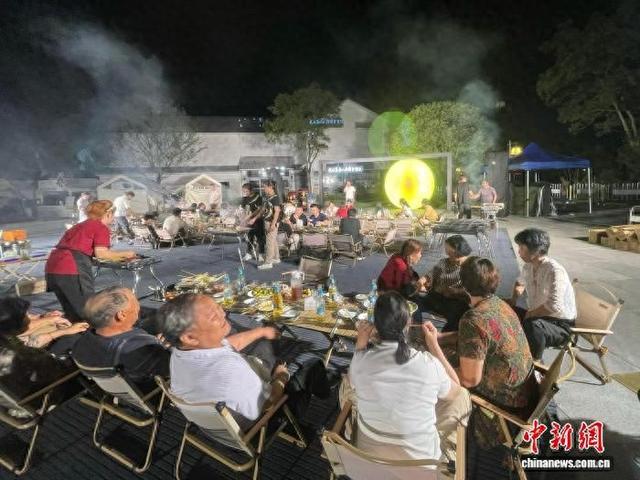
中秋寻味公望两岸圆缘园:烤肉飘香处,团圆情更浓
Zhong Guo Xin Wen Wang· 2025-10-06 09:33
Core Viewpoint - The article highlights the growing cultural exchange and integration between Taiwan and mainland China, particularly during the Mid-Autumn Festival, as Taiwanese individuals gather in Hangzhou to celebrate and share their traditions, creating a sense of community and belonging [1][2][5]. Group 1: Cultural Exchange - Taiwanese individuals are increasingly crossing the strait to live and work in mainland China, enriching their experiences by blending traditional Taiwanese customs with local practices [1]. - The event features a variety of Taiwanese and mainland Chinese foods, showcasing a "culinary reunion" that emphasizes the fusion of flavors and cultures [2]. - The presence of traditional Taiwanese performances, such as the "Zhong Ji Fang" drum troupe, adds to the festive atmosphere, enhancing cultural appreciation [5]. Group 2: Community and Belonging - Many Taiwanese participants express a sense of belonging and warmth in their new environment, with local residents showing kindness and hospitality, which helps them feel at home [7]. - The establishment of businesses and community ties among Taiwanese entrepreneurs in the area reflects a shift from feelings of homesickness to a commitment to building a life in mainland China [7]. - The narrative of shared experiences and mutual support among Taiwanese individuals in the region illustrates the deep emotional connections that transcend geographical boundaries [7].