中国电影市场发展

Search documents
节假日消费观察|元旦档票房破7亿元,《疯狂动物城2》领跑
Di Yi Cai Jing· 2026-01-03 12:25
Group 1 - The core viewpoint of the articles highlights the performance of the Chinese film market during the New Year period, with a box office exceeding 700 million yuan, driven by films like "Zootopia 2" and "Avatar 3" [1][2] - The New Year box office performance is lower than the previous year's 1.5 billion yuan but significantly higher than the 300 million yuan in 2025, indicating a recovery trend in the market [1] - "Zootopia 2" has achieved remarkable success, grossing over 4.2 billion yuan and becoming the highest-grossing imported animated film in Chinese history, while "Avatar 3" has underperformed compared to its predecessor [1] Group 2 - In 2025, the total box office in China reached 51.8 billion yuan, reflecting a positive trend in the film market driven by strong IP films and leading titles [2] - The Chinese film market still has room for growth, and there is a need to balance between genre maturity, emotional resonance, and market sustainability in response to changing audience preferences [2]
神坛上的陈佩斯:九十年代的因,今日的果
Hu Xiu· 2025-07-28 04:12
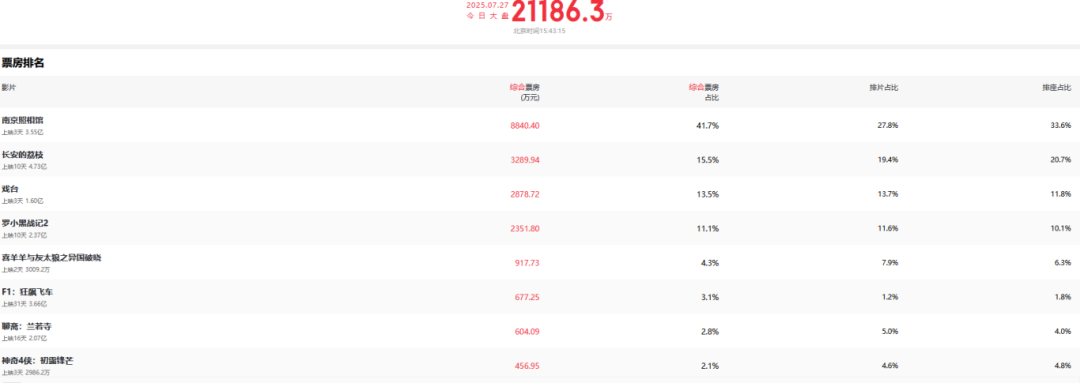
Group 1 - The overall box office market for the summer of 2025 is bleak, but Chen Peisi's film "Xitai" has grossed over 100 million in just two days, surpassing "Nihang Nihang" which took nine days to reach the same figure [1][3] - The film "Xitai" has received mixed reviews, indicating a potential decline in the long-standing "Chen Peisi myth" [1][4] - The exit of national comedy kings like Chen Peisi and Zhao Benshan from the film industry has had a profound impact on the domestic box office market, which has shifted towards urban middle-class audiences [4][5] Group 2 - The film industry in China has faced structural issues since the 1990s, with a significant reliance on a few successful directors and their works, leading to a fragile middle market [5][6] - The transition from a planned economy to a market economy in the late 1980s and early 1990s led to a crisis in the film industry, with a decline in both the quantity and quality of domestic films [6][7] - The introduction of Hollywood films in the 1990s further exacerbated the challenges faced by domestic productions, as they struggled to compete with the precision and appeal of foreign films [19][20] Group 3 - The real estate boom in the 2000s provided a temporary revival for the film industry, leading to a surge in commercial cinemas and a renewed interest in local films [22][23] - However, the current film market is highly capitalized and entertainment-driven, making it difficult for traditional artists like Chen Peisi and Zhao Benshan to participate meaningfully [24][25] - The absence of crowd-pleasing films has resulted in a weak middle market, which is crucial for sustaining the industry and nurturing talent [25][26] Group 4 - The historical context of the film industry reveals a pattern of misalignment between production and audience interests, leading to a decline in viewership and engagement [10][14] - The lack of a robust middle market has resulted in a reliance on blockbuster films, which can be risky if they fail to perform [26][27] - The current state of the film industry reflects a departure from the grassroots, community-oriented storytelling that characterized earlier successful films [24][31]