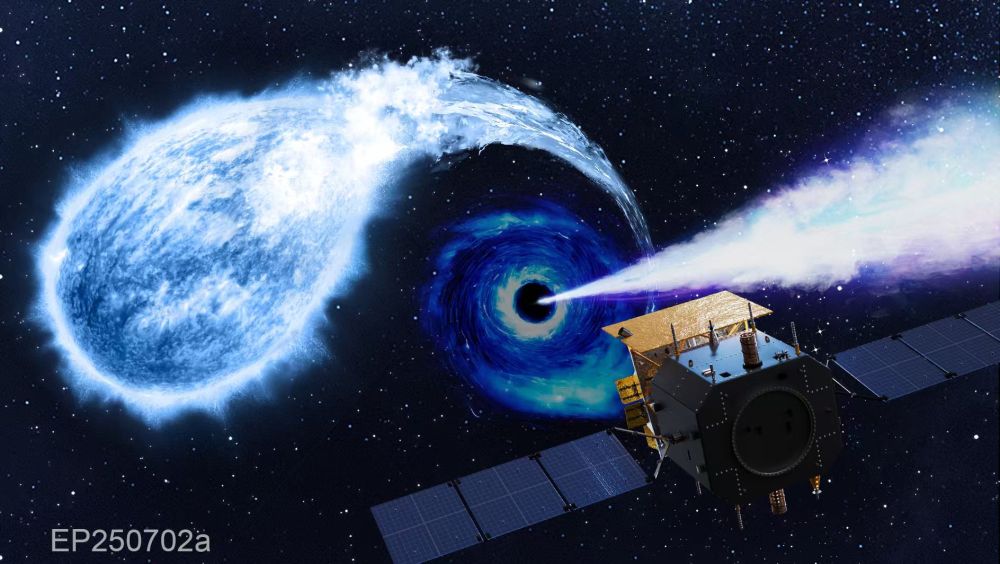
中等质量黑洞撕裂白矮星

Search documents
载人登月中国又近一步
Xin Lang Cai Jing· 2026-02-11 16:40
Core Viewpoint - The successful test of the Long March 10 rocket and the Dream Boat manned spacecraft marks a significant step towards China's goal of manned lunar exploration, demonstrating advancements in both rocket and spacecraft technology [5][6][8]. Group 1: Long March 10 Rocket - The Long March 10 rocket successfully conducted a low-altitude flight test, transitioning from static ignition to dynamic flight, and achieved successful recovery of the first stage [5][9]. - This test is the first flight of the Long March 10 rocket in its initial sample state, validating the rocket's ascent and recovery capabilities [9]. - The rocket's design includes a single-stage configuration, which has undergone two preliminary tethered ignition tests prior to this flight [8]. Group 2: Dream Boat Manned Spacecraft - The Dream Boat spacecraft successfully executed its first maximum dynamic pressure escape flight test, ensuring the safety of astronauts during emergencies [5][6]. - This spacecraft is intended for China's manned lunar exploration and is capable of multiple reuses, enhancing its operational efficiency [8]. - The successful escape system test adds a crucial layer of safety for astronauts, confirming the reliability of the spacecraft's emergency protocols [5][6]. Group 3: Overall Mission Progress - The test on February 11 is part of a series of planned milestones leading to China's first manned lunar landing by 2030, with various systems being developed in an orderly manner [6][7]. - The successful recovery of the spacecraft's return capsule at sea represents a significant achievement, providing valuable experience for future space station operations and lunar missions [7][8]. - The overall progress reflects China's commitment to innovation and self-reliance in its space endeavors, aiming for high-quality and rapid development in its space program [6].


我国卫星捕捉到罕见事件
券商中国· 2026-02-11 01:48
Core Viewpoint - The discovery of an exceptionally bright and rapidly changing X-ray source, designated EP250702a, is likely a medium-mass black hole tearing apart and consuming a white dwarf star, marking the first time such an extreme black hole "feeding" event has been captured by humans [1][2]. Group 1 - The "Tian Guan" satellite detected the unusual X-ray source during routine sky surveys, prompting a global observational effort with multiple telescopes [1]. - The event's brightness variation and spectral characteristics are significantly different from any previously known outbursts, indicating a unique astrophysical phenomenon [1][2]. - The research team proposed a coherent physical model suggesting that only medium-mass black holes, with masses between hundreds to hundreds of thousands of solar masses, can effectively tear apart such dense white dwarfs using tidal forces [2]. Group 2 - The characteristics of the event, including ultra-short timescales and high peak luminosity, support the hypothesis of a medium-mass black hole interacting with a white dwarf [2]. - The "Tian Guan" satellite's mission is to capture unpredictable extreme transient phenomena in the universe, showcasing China's contributions to global astronomical exploration [2].
我国卫星捕捉到罕见事件
第一财经· 2026-02-11 01:27
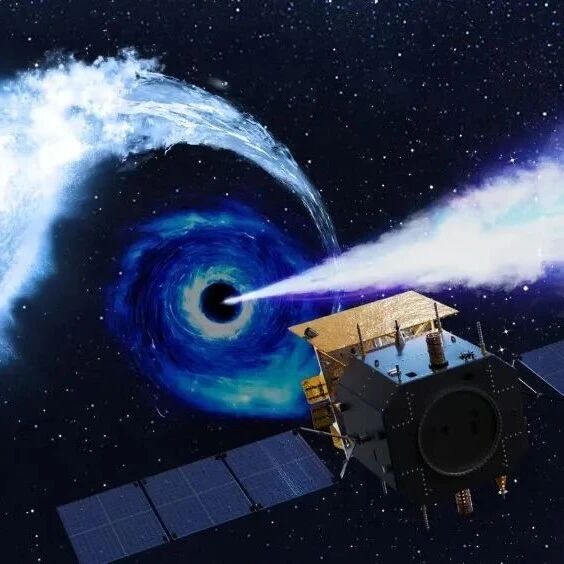
Core Viewpoint - The article discusses the discovery of an unusual X-ray source, EP250702a, by China's "Tian Guan" satellite, which is believed to be a medium-mass black hole tearing apart and consuming a white dwarf star, marking a significant event in astronomical research [3][4]. Group 1: Discovery and Observation - The "Tian Guan" satellite captured an exceptionally bright and rapidly changing X-ray source during its sky survey, leading to a global observational effort with multiple telescopes [3]. - The event, designated EP250702a (also known as GRB 250702B due to its gamma-ray burst), exhibits brightness variations and spectral features that are significantly different from any previously known outbursts [3][4]. Group 2: Scientific Explanation - Researchers propose that the observed phenomenon is likely a medium-mass black hole consuming a white dwarf star, a process that is theorized to release intense energy and produce bright, rapid jets [4][5]. - The average density of a white dwarf can reach up to one million times that of the Sun, and only medium-mass black holes, with masses between hundreds to hundreds of thousands of solar masses, can effectively tear apart such dense objects without simply swallowing them whole [4][5]. Group 3: Significance of the Discovery - The discovery of EP250702a highlights the unique monitoring capabilities of the "Tian Guan" satellite, showcasing China's contributions to global astronomical exploration [5]. - The event demonstrates the satellite's ability to capture extreme transient phenomena in the universe, emphasizing the importance of such observations in understanding cosmic events [5].
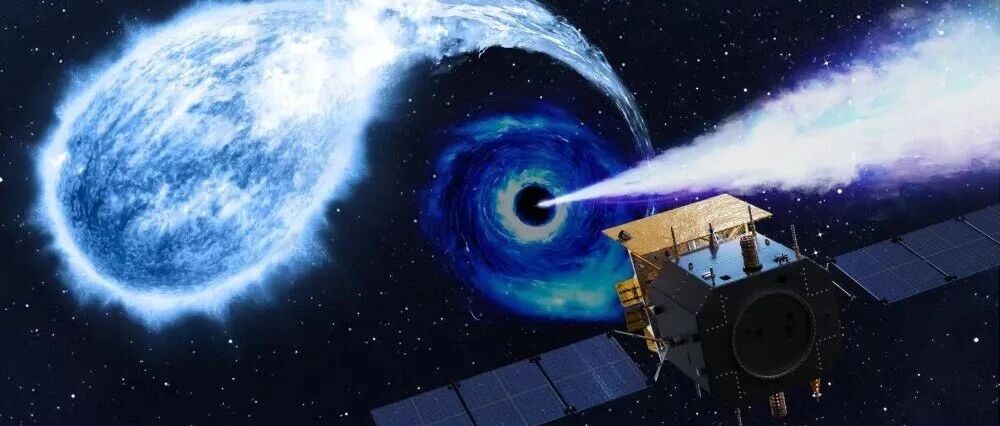
“天关”卫星捕捉到黑洞“进食”现场
Xin Hua She· 2026-02-10 01:19
Core Viewpoint - The "Tian Guan" satellite has captured an unprecedented astronomical event, designated EP250702a, which is believed to be a medium-mass black hole tearing apart and consuming a white dwarf star, marking the first time such an extreme black hole "feeding" event has been observed by humanity [1][5]. Group 1: Discovery and Observation - The "Tian Guan" satellite, equipped with the wide-field X-ray telescope WXT, detected a sudden and bright transient source during routine sky surveys on July 2, 2025 [3]. - This event, EP250702a, exhibited brightness variations and radiation patterns that are significantly different from any previously known outbursts, prompting a global observational effort using multiple telescopes [1][4]. Group 2: Scientific Explanation - The research team proposed a coherent physical model suggesting that a medium-mass black hole, with a mass between hundreds to hundreds of thousands of solar masses, is capable of tearing apart a dense white dwarf star using tidal forces [5]. - The expected energy release from this process is extremely brief and intense, accompanied by bright and rapid jets, aligning perfectly with the characteristics observed in EP250702a [5]. Group 3: Significance and Contribution - The discovery of EP250702a highlights the unique monitoring capabilities of the "Tian Guan" satellite, showcasing China's contributions to global astronomical exploration [5]. - The event serves as a testament to the satellite's mission to capture unpredictable extreme transient phenomena in the universe [5].