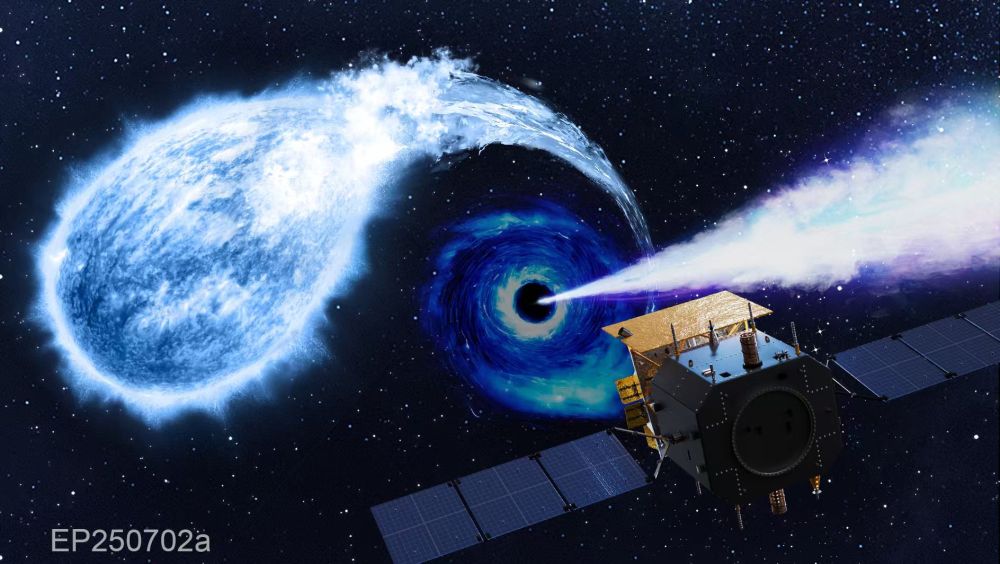
宽视场X射线望远镜WXT(万星瞳)

Search documents
我国卫星捕捉到罕见黑洞“进食”现场
Xin Lang Cai Jing· 2026-02-11 06:24
Core Viewpoint - The "Tian Guan" satellite has captured an unprecedented event involving a medium-mass black hole tearing apart and consuming a white dwarf star, marking the first time such an extreme black hole "feeding" event has been observed by humanity [1][3]. Group 1: Discovery and Observation - The "Tian Guan" satellite detected an unusually bright and rapidly changing X-ray source, designated EP250702a (also known as GRB 250702B), during its routine sky survey [1][3]. - This event's brightness variation, radiation rhythm, and spectral characteristics are significantly different from any previously known outbursts, prompting a global observational effort using multiple telescopes [1][3]. Group 2: Scientific Explanation - The research team proposed that the observed phenomenon is likely a medium-mass black hole ripping apart and consuming a white dwarf star, which is a dense remnant left after a star's death [3]. - The average density of a white dwarf can reach up to one million times that of the Sun, and only medium-mass black holes, with masses between hundreds to hundreds of thousands of solar masses, can effectively tear apart such a dense object without "gulping" it whole [3]. Group 3: Implications and Contributions - The findings provide strong support for the theory of a medium-mass black hole tearing apart a white dwarf, characterized by extremely short timescales, high peak luminosity, and soft X-ray "afterglow" observed post-explosion [3]. - The discovery of EP250702a highlights the unique monitoring capabilities of the "Tian Guan" satellite and underscores China's contributions to global astronomical exploration [3].

我国卫星捕捉到罕见事件
券商中国· 2026-02-11 01:48
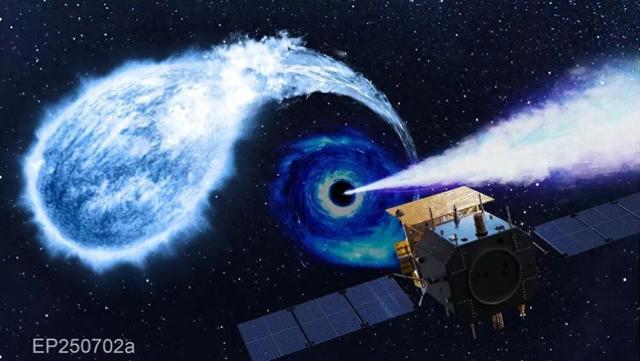
Core Viewpoint - The discovery of an exceptionally bright and rapidly changing X-ray source, designated EP250702a, is likely a medium-mass black hole tearing apart and consuming a white dwarf star, marking the first time such an extreme black hole "feeding" event has been captured by humans [1][2]. Group 1 - The "Tian Guan" satellite detected the unusual X-ray source during routine sky surveys, prompting a global observational effort with multiple telescopes [1]. - The event's brightness variation and spectral characteristics are significantly different from any previously known outbursts, indicating a unique astrophysical phenomenon [1][2]. - The research team proposed a coherent physical model suggesting that only medium-mass black holes, with masses between hundreds to hundreds of thousands of solar masses, can effectively tear apart such dense white dwarfs using tidal forces [2]. Group 2 - The characteristics of the event, including ultra-short timescales and high peak luminosity, support the hypothesis of a medium-mass black hole interacting with a white dwarf [2]. - The "Tian Guan" satellite's mission is to capture unpredictable extreme transient phenomena in the universe, showcasing China's contributions to global astronomical exploration [2].
我国卫星捕捉到罕见事件
第一财经· 2026-02-11 01:27
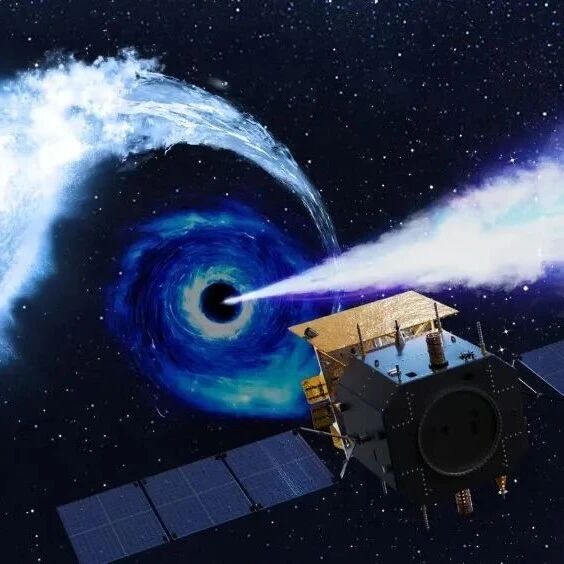
Core Viewpoint - The article discusses the discovery of an unusual X-ray source, EP250702a, by China's "Tian Guan" satellite, which is believed to be a medium-mass black hole tearing apart and consuming a white dwarf star, marking a significant event in astronomical research [3][4]. Group 1: Discovery and Observation - The "Tian Guan" satellite captured an exceptionally bright and rapidly changing X-ray source during its sky survey, leading to a global observational effort with multiple telescopes [3]. - The event, designated EP250702a (also known as GRB 250702B due to its gamma-ray burst), exhibits brightness variations and spectral features that are significantly different from any previously known outbursts [3][4]. Group 2: Scientific Explanation - Researchers propose that the observed phenomenon is likely a medium-mass black hole consuming a white dwarf star, a process that is theorized to release intense energy and produce bright, rapid jets [4][5]. - The average density of a white dwarf can reach up to one million times that of the Sun, and only medium-mass black holes, with masses between hundreds to hundreds of thousands of solar masses, can effectively tear apart such dense objects without simply swallowing them whole [4][5]. Group 3: Significance of the Discovery - The discovery of EP250702a highlights the unique monitoring capabilities of the "Tian Guan" satellite, showcasing China's contributions to global astronomical exploration [5]. - The event demonstrates the satellite's ability to capture extreme transient phenomena in the universe, emphasizing the importance of such observations in understanding cosmic events [5].
我国卫星捕捉到罕见事件
财联社· 2026-02-10 16:06
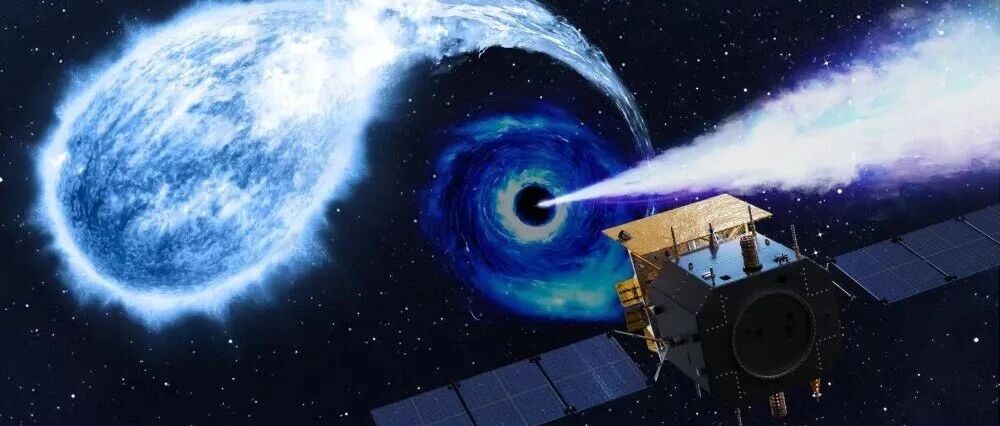
Core Viewpoint - The discovery of the EP250702a event by China's "Tian Guan" satellite represents a significant breakthrough in astrophysics, suggesting that a medium-mass black hole is tearing apart and consuming a white dwarf star, marking the first time such an extreme black hole "feeding" event has been captured [1][5]. Group 1: Discovery and Observation - The "Tian Guan" satellite detected an unusually bright and rapidly changing X-ray source, designated as EP250702a, during its sky survey [1][3]. - This event has distinct brightness variations, radiation rhythms, and spectral characteristics that differ significantly from any previously known outbursts [1]. Group 2: Scientific Explanation - The research team proposes that the event is likely caused by a medium-mass black hole, which has the capability to tear apart a dense white dwarf star using tidal forces [5]. - The average density of a white dwarf can reach up to one million times that of the Sun, making it a challenging target for such interactions [5]. Group 3: Implications and Contributions - The findings provide strong support for the theory of medium-mass black holes interacting with white dwarfs, characterized by extremely short time scales and high peak luminosity [5]. - The discovery highlights the unique monitoring capabilities of the "Tian Guan" satellite and underscores China's contributions to global astronomical exploration [5].
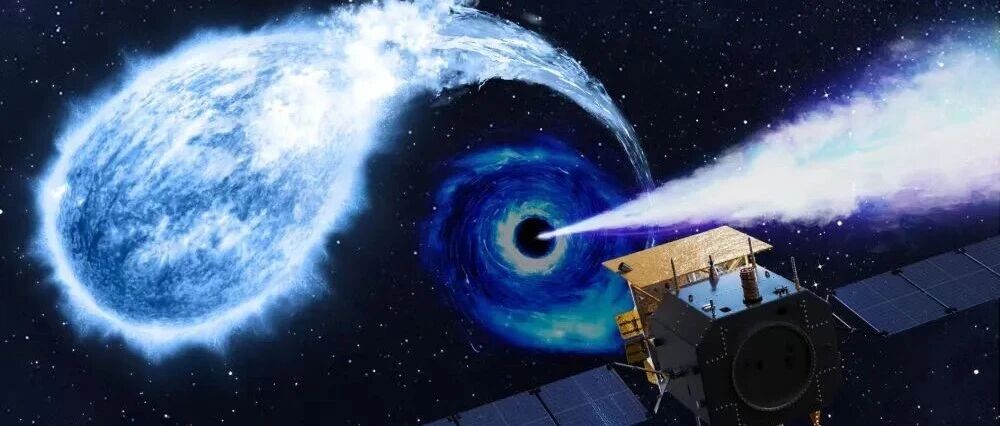
黑洞研究又有新发现!
Xin Lang Cai Jing· 2026-02-10 14:55
Core Viewpoint - The "Tian Guan" satellite (Einstein Probe Satellite) has captured an unprecedented high-energy cosmic explosion, which is believed to be the process of a medium-mass black hole tearing apart a white dwarf star, as reported in the academic journal "Science Bulletin" [1][2]. Group 1: Event Details - The "Tian Guan" satellite detected an exceptionally bright and rapidly changing X-ray source, designated "EP250702a," on July 2, 2025 [1]. - Following the detection, multiple global telescopes conducted a coordinated observation, confirming the source's location at the outskirts of a galaxy with a redshift of 1.04 [1]. - The "WXT" (Wide Field X-ray Telescope) and "FXT" (Follow-up X-ray Telescope) on the "Tian Guan" satellite played crucial roles in the observation, with the brightness of the event decreasing over ten days by more than 100,000 times after an intense explosion lasting about one day [1]. Group 2: Scientific Implications - The event "EP250702a" exhibited a series of unconventional characteristics, including multiple explosions from billions of light-years away, emitting extremely high energy, and rapid, complex changes in brightness and energy spectrum [2]. - The observed phenomena resemble rare black hole tidal disruption events, suggesting that a medium-mass black hole is involved in the process of tearing apart a white dwarf star, which is a dense celestial body [2]. - This event may provide the first clear evidence of such processes, aiding in the understanding of the long-missing population of medium-mass black holes and opening new avenues for research in black hole growth and the ultimate fate of dense celestial objects [2].
黑洞研究又有新发现!
券商中国· 2026-02-10 14:49
Core Insights - The "Tian Guan" satellite (Einstein Probe Satellite) captured an unprecedented high-energy cosmic explosion, which exhibits significant differences in brightness variation, radiation rhythm, and spectral characteristics compared to any known explosions [1][2] - The event, designated as "EP250702a," was observed on July 2, 2025, and involved a bright and rapidly changing X-ray source, leading to a global collaborative observation effort [1] Summary by Sections - **Event Characteristics** - The explosion occurred billions of light-years away, displaying multiple bursts of high energy with rapid and complex changes in brightness and energy spectrum, which cannot be fully explained by existing astronomical event models [2] - The rapid decay in brightness, dropping over 100,000 times within twenty days, suggests the involved celestial body is a dense white dwarf, indicating a medium-mass black hole tearing apart and consuming it [2] - **Scientific Implications** - This event may provide the first clear evidence of such a process, aiding in the understanding of medium-mass black holes, their growth, the ultimate fate of dense celestial bodies, and opening new avenues in multi-messenger astronomy [2]
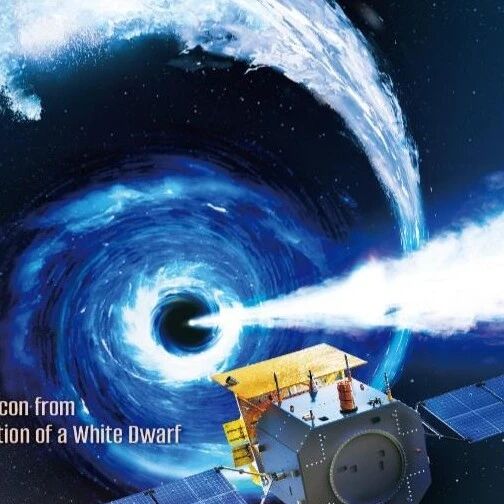
【新华社】“天关”卫星捕捉到黑洞“进食”现场
Xin Hua She· 2026-02-10 07:32
Core Viewpoint - The "Tian Guan" satellite has captured an exceptionally bright and rapidly changing X-ray source, designated EP250702a, which is believed to be a medium-mass black hole tearing apart and consuming a white dwarf star, marking a significant discovery in astronomical observations [2][3]. Group 1 - The event EP250702a, also referred to as GRB 250702B due to its gamma-ray burst, exhibits brightness variations and spectral characteristics that are significantly different from any previously known events [2]. - The discovery was made on July 2, 2025, during routine observations by the wide-field X-ray telescope WXT, nicknamed "Wan Xing Tong" [2]. - The phenomenon is likened to rare black hole stellar disruption events, suggesting a coherent physical model where a medium-mass black hole, with a mass between hundreds to hundreds of thousands of solar masses, can effectively tear apart a dense white dwarf star [3]. Group 2 - The extreme energy release and rapid evolution observed in EP250702a align perfectly with the expected outcomes of a medium-mass black hole consuming a white dwarf, supported by the characteristics of short time scales and high peak luminosity [3]. - The mission of the "Tian Guan" satellite is to capture unpredictable extreme transient phenomena in the universe, showcasing China's contributions to global astronomical exploration [3]. - The discovery of EP250702a highlights the unique monitoring capabilities of the "Wan Xing Tong" telescope, demonstrating the ability to capture extreme cosmic moments [3].
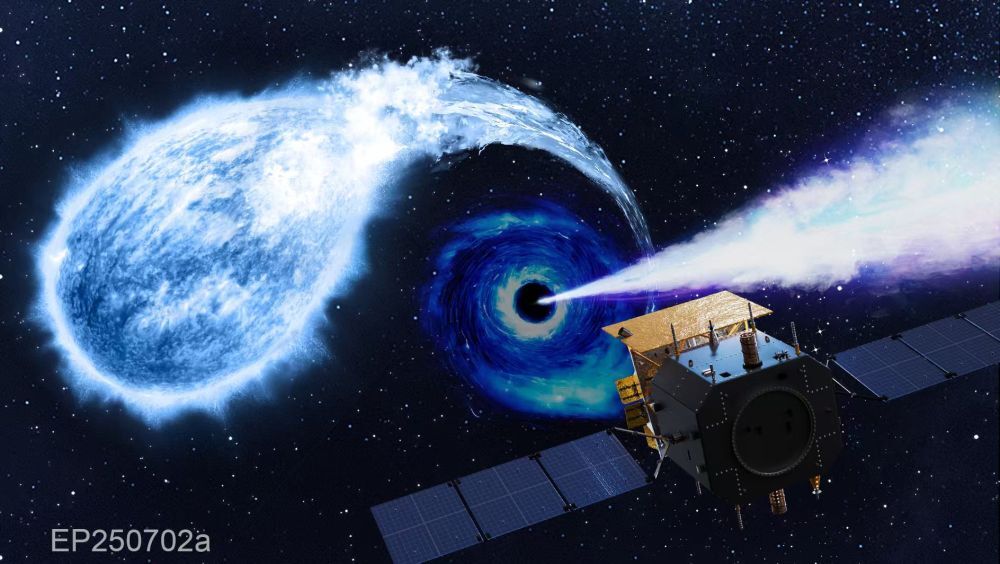
“天关”卫星捕捉到黑洞“进食”现场
Xin Hua She· 2026-02-10 01:19
Core Viewpoint - The "Tian Guan" satellite has captured an unprecedented astronomical event, designated EP250702a, which is believed to be a medium-mass black hole tearing apart and consuming a white dwarf star, marking the first time such an extreme black hole "feeding" event has been observed by humanity [1][5]. Group 1: Discovery and Observation - The "Tian Guan" satellite, equipped with the wide-field X-ray telescope WXT, detected a sudden and bright transient source during routine sky surveys on July 2, 2025 [3]. - This event, EP250702a, exhibited brightness variations and radiation patterns that are significantly different from any previously known outbursts, prompting a global observational effort using multiple telescopes [1][4]. Group 2: Scientific Explanation - The research team proposed a coherent physical model suggesting that a medium-mass black hole, with a mass between hundreds to hundreds of thousands of solar masses, is capable of tearing apart a dense white dwarf star using tidal forces [5]. - The expected energy release from this process is extremely brief and intense, accompanied by bright and rapid jets, aligning perfectly with the characteristics observed in EP250702a [5]. Group 3: Significance and Contribution - The discovery of EP250702a highlights the unique monitoring capabilities of the "Tian Guan" satellite, showcasing China's contributions to global astronomical exploration [5]. - The event serves as a testament to the satellite's mission to capture unpredictable extreme transient phenomena in the universe [5].