
天关卫星(爱因斯坦探针卫星)

Search documents
载人登月中国又近一步
Xin Lang Cai Jing· 2026-02-11 16:40
Core Viewpoint - The successful test of the Long March 10 rocket and the Dream Boat manned spacecraft marks a significant step towards China's goal of manned lunar exploration, demonstrating advancements in both rocket and spacecraft technology [5][6][8]. Group 1: Long March 10 Rocket - The Long March 10 rocket successfully conducted a low-altitude flight test, transitioning from static ignition to dynamic flight, and achieved successful recovery of the first stage [5][9]. - This test is the first flight of the Long March 10 rocket in its initial sample state, validating the rocket's ascent and recovery capabilities [9]. - The rocket's design includes a single-stage configuration, which has undergone two preliminary tethered ignition tests prior to this flight [8]. Group 2: Dream Boat Manned Spacecraft - The Dream Boat spacecraft successfully executed its first maximum dynamic pressure escape flight test, ensuring the safety of astronauts during emergencies [5][6]. - This spacecraft is intended for China's manned lunar exploration and is capable of multiple reuses, enhancing its operational efficiency [8]. - The successful escape system test adds a crucial layer of safety for astronauts, confirming the reliability of the spacecraft's emergency protocols [5][6]. Group 3: Overall Mission Progress - The test on February 11 is part of a series of planned milestones leading to China's first manned lunar landing by 2030, with various systems being developed in an orderly manner [6][7]. - The successful recovery of the spacecraft's return capsule at sea represents a significant achievement, providing valuable experience for future space station operations and lunar missions [7][8]. - The overall progress reflects China's commitment to innovation and self-reliance in its space endeavors, aiming for high-quality and rapid development in its space program [6].


黑洞研究又有新发现!
Xin Lang Cai Jing· 2026-02-10 14:55
Core Viewpoint - The "Tian Guan" satellite (Einstein Probe Satellite) has captured an unprecedented high-energy cosmic explosion, which is believed to be the process of a medium-mass black hole tearing apart a white dwarf star, as reported in the academic journal "Science Bulletin" [1][2]. Group 1: Event Details - The "Tian Guan" satellite detected an exceptionally bright and rapidly changing X-ray source, designated "EP250702a," on July 2, 2025 [1]. - Following the detection, multiple global telescopes conducted a coordinated observation, confirming the source's location at the outskirts of a galaxy with a redshift of 1.04 [1]. - The "WXT" (Wide Field X-ray Telescope) and "FXT" (Follow-up X-ray Telescope) on the "Tian Guan" satellite played crucial roles in the observation, with the brightness of the event decreasing over ten days by more than 100,000 times after an intense explosion lasting about one day [1]. Group 2: Scientific Implications - The event "EP250702a" exhibited a series of unconventional characteristics, including multiple explosions from billions of light-years away, emitting extremely high energy, and rapid, complex changes in brightness and energy spectrum [2]. - The observed phenomena resemble rare black hole tidal disruption events, suggesting that a medium-mass black hole is involved in the process of tearing apart a white dwarf star, which is a dense celestial body [2]. - This event may provide the first clear evidence of such processes, aiding in the understanding of the long-missing population of medium-mass black holes and opening new avenues for research in black hole growth and the ultimate fate of dense celestial objects [2].
黑洞研究又有新发现!
券商中国· 2026-02-10 14:49
Core Insights - The "Tian Guan" satellite (Einstein Probe Satellite) captured an unprecedented high-energy cosmic explosion, which exhibits significant differences in brightness variation, radiation rhythm, and spectral characteristics compared to any known explosions [1][2] - The event, designated as "EP250702a," was observed on July 2, 2025, and involved a bright and rapidly changing X-ray source, leading to a global collaborative observation effort [1] Summary by Sections - **Event Characteristics** - The explosion occurred billions of light-years away, displaying multiple bursts of high energy with rapid and complex changes in brightness and energy spectrum, which cannot be fully explained by existing astronomical event models [2] - The rapid decay in brightness, dropping over 100,000 times within twenty days, suggests the involved celestial body is a dense white dwarf, indicating a medium-mass black hole tearing apart and consuming it [2] - **Scientific Implications** - This event may provide the first clear evidence of such a process, aiding in the understanding of medium-mass black holes, their growth, the ultimate fate of dense celestial bodies, and opening new avenues in multi-messenger astronomy [2]
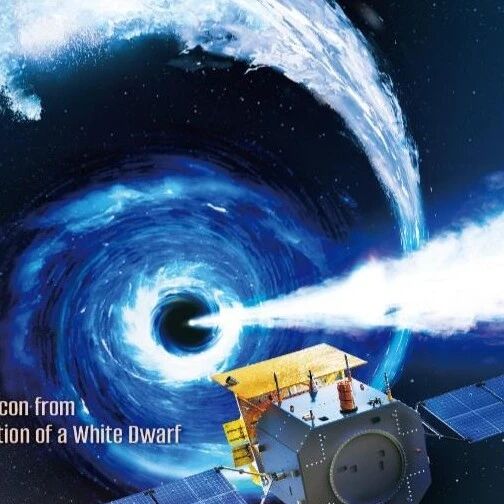
依托“天关”卫星 黑洞研究又有新发现
Xin Lang Cai Jing· 2026-02-10 09:48
Core Insights - The "Tian Guan" satellite (Einstein Probe Satellite) has captured an unprecedented high-energy cosmic explosion, differing significantly in brightness variation, radiation rhythm, and spectral characteristics from any known explosions [1] Group 1: Scientific Discovery - The explosion observed by the "Tian Guan" satellite is hypothesized to be the process of a medium-mass black hole tearing apart a white dwarf star [1] - The findings related to this cosmic event have been published in the academic journal "Science Bulletin" [1]