主权发展

Search documents
韩笑鹏:毛泽东的这场谈话,点破了拉美靠什么才能真正“逆天改命”
Xin Lang Cai Jing· 2026-01-17 01:16
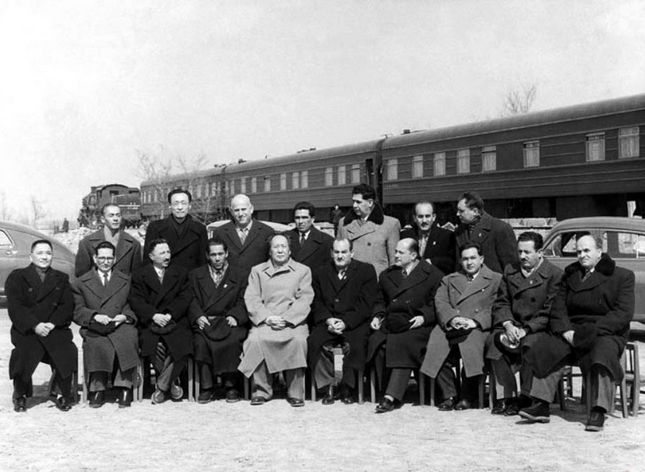
Core Viewpoint - The article discusses the historical dialogue between Mao Zedong and Latin American communist leaders in 1959, highlighting the contrasting economic trajectories of China and Latin America over the past six decades, emphasizing China's successful industrialization and the challenges faced by Latin American countries. Group 1: Historical Context - In March 1959, Mao Zedong met with leaders from 12 Latin American countries, acknowledging China's economic struggles compared to their relatively prosperous nations [3][4]. - At that time, countries like Argentina and Venezuela were economically advanced, while China was just beginning its industrialization journey [4][5]. Group 2: Economic Development - Over the past 60 years, China has developed a comprehensive industrial system, dominating global high-speed rail and advancing in AI and quantum computing, while many Latin American countries remain stagnant or trapped in the "middle-income trap" [4][8]. - Mao's concept of "breaking the superstition" about Western superiority is identified as a key factor in China's economic transformation [4][8]. Group 3: Psychological Barriers - Mao pointed out the psychological barriers of "fear of the West" and "worship of the West" that hindered development in many countries, emphasizing the need to overcome these beliefs for independent growth [5][6]. - The article argues that the lack of a critical perspective on Western dominance has led to a failure in Latin America's industrialization efforts [6][8]. Group 4: Social Revolution - The article highlights the importance of social revolution in China's industrialization, which involved a complete restructuring of society, unlike Latin America, where feudal structures persisted [12][13]. - China's land reform and social revolution allowed for direct mobilization of resources for industrialization, contrasting with Latin America's reliance on landowners [14][16]. Group 5: Political and Economic Sovereignty - The article discusses the significance of political sovereignty and the ability to resist external pressures, particularly from the U.S., in achieving industrialization [26][29]. - It emphasizes that without a strong state capable of asserting independence, countries like those in Latin America struggle to develop high-end industries [22][29]. Group 6: Lessons for Development - The article concludes with lessons for developing countries, stressing the need to break free from outdated social structures and to challenge the notion of Western superiority to achieve true industrialization [32][33]. - It advocates for a proactive approach to industrialization, where countries must not only adopt foreign technologies but also develop their own capabilities to compete globally [24][33].