
社会革命

Search documents
韩笑鹏:毛泽东的这场谈话,点破了拉美靠什么才能真正“逆天改命”
Xin Lang Cai Jing· 2026-01-17 01:16
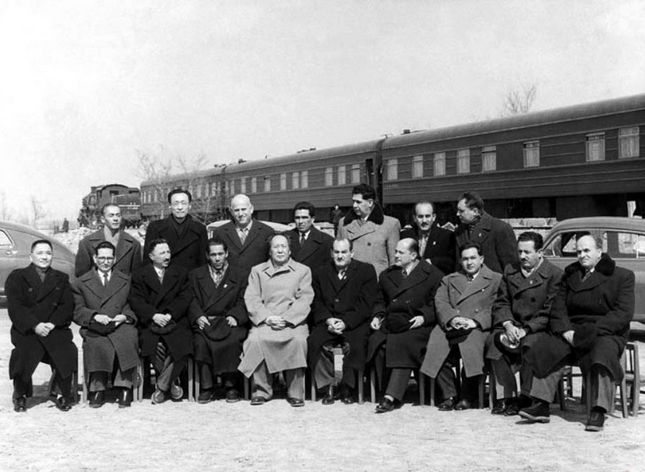
Core Viewpoint - The article discusses the historical dialogue between Mao Zedong and Latin American communist leaders in 1959, highlighting the contrasting economic trajectories of China and Latin America over the past six decades, emphasizing China's successful industrialization and the challenges faced by Latin American countries. Group 1: Historical Context - In March 1959, Mao Zedong met with leaders from 12 Latin American countries, acknowledging China's economic struggles compared to their relatively prosperous nations [3][4]. - At that time, countries like Argentina and Venezuela were economically advanced, while China was just beginning its industrialization journey [4][5]. Group 2: Economic Development - Over the past 60 years, China has developed a comprehensive industrial system, dominating global high-speed rail and advancing in AI and quantum computing, while many Latin American countries remain stagnant or trapped in the "middle-income trap" [4][8]. - Mao's concept of "breaking the superstition" about Western superiority is identified as a key factor in China's economic transformation [4][8]. Group 3: Psychological Barriers - Mao pointed out the psychological barriers of "fear of the West" and "worship of the West" that hindered development in many countries, emphasizing the need to overcome these beliefs for independent growth [5][6]. - The article argues that the lack of a critical perspective on Western dominance has led to a failure in Latin America's industrialization efforts [6][8]. Group 4: Social Revolution - The article highlights the importance of social revolution in China's industrialization, which involved a complete restructuring of society, unlike Latin America, where feudal structures persisted [12][13]. - China's land reform and social revolution allowed for direct mobilization of resources for industrialization, contrasting with Latin America's reliance on landowners [14][16]. Group 5: Political and Economic Sovereignty - The article discusses the significance of political sovereignty and the ability to resist external pressures, particularly from the U.S., in achieving industrialization [26][29]. - It emphasizes that without a strong state capable of asserting independence, countries like those in Latin America struggle to develop high-end industries [22][29]. Group 6: Lessons for Development - The article concludes with lessons for developing countries, stressing the need to break free from outdated social structures and to challenge the notion of Western superiority to achieve true industrialization [32][33]. - It advocates for a proactive approach to industrialization, where countries must not only adopt foreign technologies but also develop their own capabilities to compete globally [24][33].

【好评中国】把“窑洞之问”的答案写在人民心中
Xin Lang Cai Jing· 2026-01-13 04:19
Group 1 - The core message emphasizes the importance of self-revolution within the Communist Party to lead social revolution and achieve modernization during the "14th Five-Year Plan" period [1][2] - The Party's self-revolution is described as a continuous journey, essential for maintaining political integrity and addressing corruption [2][3] - The implementation of the Central Eight Regulations is highlighted as a significant measure for party governance, aiming to enhance discipline and accountability among party members [2][3] Group 2 - The ongoing strict governance of the Party has successfully addressed previously entrenched issues and improved public perception of the Party's integrity [3][4] - The focus on self-revolution aims not only to strengthen the Party's leadership but also to facilitate social progress and the rejuvenation of the Chinese nation [4] - Continuous efforts are being made to reduce bureaucratic burdens on grassroots officials, allowing them to focus on effective governance and community engagement [4]
笔谈丨让政治监督更加精准有效
Zhong Yang Ji Wei Guo Jia Jian Wei Wang Zhan· 2025-12-25 01:04
Core Viewpoint - The article emphasizes the importance of the disciplinary inspection and supervision agencies in promoting the self-revolution of the Party and ensuring the effective implementation of the Central Committee's decisions and policies through precise and regular political supervision [1][2]. Group 1: Supervision Mechanisms - The article discusses the establishment of a supervision ledger to track the implementation of important speeches and directives from General Secretary Xi Jinping, creating a closed-loop system for learning, task decomposition, tracking effectiveness, and evaluating results [1]. - A comprehensive chain of supervision is proposed, focusing on the entire process from policy formulation to execution, ensuring that decisions align with political requirements and that the implementation process is scrutinized for any deviations [1]. Group 2: Targeted Problem Correction - The article highlights the need to focus on the "key minority," including top leaders, to ensure the implementation of strict party governance and democratic centralism as key areas of political supervision [2]. - It suggests the establishment of a negative list for power operations and enhancing risk prevention in key areas where corruption is prevalent, utilizing big data technology to create an intelligent analysis model for political supervision [2]. Group 3: Long-term Supervision Framework - The article advocates for a regular reporting system for political supervision, encouraging party committees to periodically review the implementation of important directives from General Secretary Xi Jinping [2]. - It emphasizes the importance of integrating political supervision outcomes into key assessment indicators for leadership teams and the selection of cadres, promoting a coordinated approach among various supervisory mechanisms [2].
学有所悟丨始终绷紧自我革命这根弦
Zhong Yang Ji Wei Guo Jia Jian Wei Wang Zhan· 2025-10-23 00:10
Group 1 - The core viewpoint emphasizes the importance of continuous self-revolution within the Communist Party to maintain discipline and unity, which is crucial for the party's success and development [1][3][4] - The concept of self-revolution is highlighted as a distinguishing feature of Marxist parties, with historical references to the importance of discipline in achieving success [2][3] - The practice of strict discipline and anti-corruption measures has been reinforced since the 18th National Congress, leading to significant improvements in party governance and public trust [3][5] Group 2 - The self-revolution of the party is framed as essential for leading social revolutions, ensuring that the party remains a strong core of socialism with Chinese characteristics [4][5] - The need for a strong ideological foundation and collective consensus is emphasized, advocating for deep understanding and adherence to the party's innovative theories [5][6] - The importance of accountability and clear responsibility within the party structure is stressed, with mechanisms in place to ensure that power is exercised transparently and responsibly [6]