互信息

Search documents
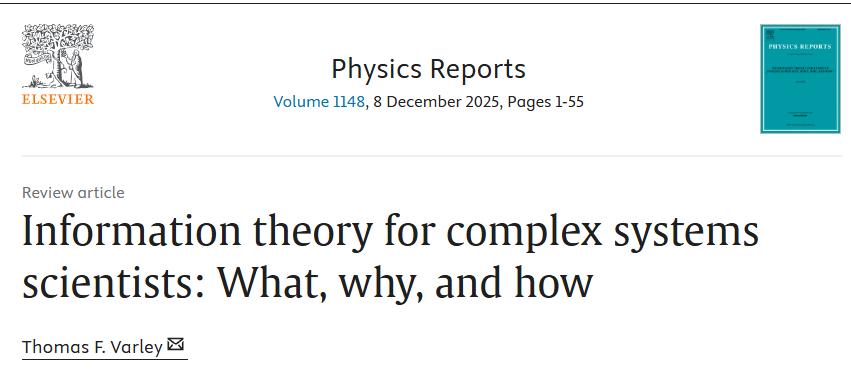
信息论如何成为复杂系统科学的核心工具
3 6 Ke· 2025-12-24 08:51
Group 1 - The article discusses the importance of information theory as a foundational tool for understanding complex systems, emphasizing its ability to quantify interactions among components and their environment [1][2] - Information theory is increasingly recognized as essential in the study of complex systems due to its capacity to describe, quantify, and understand emergent phenomena [1][2] - The article aims to elaborate on why and how information theory serves as a cornerstone for complex systems science, detailing its core concepts, advanced tools, and practical applications [1] Group 2 - The article introduces key metrics of information theory, starting with entropy, which quantifies uncertainty in a random variable [3][5] - Joint entropy and conditional entropy are explained, highlighting their roles in measuring uncertainty in multiple random variables [6] - Mutual information is presented as a measure of statistical dependence between variables, capable of capturing non-linear relationships [7][8] Group 3 - Transfer entropy is introduced as a dynamic measure of information flow in time series, useful for determining causal relationships in complex systems [13][14] - Active information storage (AIS) quantifies how much past information influences a system's current state, with implications for predicting future behavior [17] - Integrated information theory, proposed by Giulio Tononi, attempts to measure consciousness based on the degree of information integration within a system [19][20] Group 4 - The article discusses partial information decomposition (PID) as a method to analyze shared information among multiple variables, distinguishing between redundancy and synergy [26][27] - The concept of statistical complexity is introduced, measuring the minimum information required to predict future states based on historical data [22][23] - The article emphasizes the significance of network representations in modeling complex systems, differentiating between physical and statistical networks [34][35] Group 5 - The balance of integration and separation in complex systems is highlighted, with examples from neuroscience and economics illustrating the importance of this dynamic [36] - The article discusses the challenges of applying information theory in practice, particularly in estimating probability distributions from limited data [41][42] - Future directions in the application of information theory are suggested, including the use of neural networks for estimating information metrics and guiding evolutionary algorithms [43][44]

信息论如何成为复杂系统科学的核心工具
腾讯研究院· 2025-12-24 08:33
Core Concept - The article discusses the significance of information theory as a foundational tool for understanding complex systems, emphasizing its ability to quantify interactions among components and the system's environment [2][3]. Group 1: Key Metrics in Information Theory - Entropy is introduced as a fundamental measure of uncertainty, quantifying the expected level of surprise regarding the outcome of a random variable [5][7]. - Joint entropy measures the uncertainty of two random variables together, while conditional entropy reflects the uncertainty of one variable given the other [9]. - Mutual information quantifies the amount of information gained about one variable through the observation of another, capturing both linear and non-linear dependencies [10]. Group 2: Dynamic Features of Complex Systems - Transfer entropy extends mutual information to time series, measuring the directed information flow between variables, which is crucial for understanding causal relationships [16]. - Active information storage quantifies how much past information influences the current state of a system, indicating memory capacity [18]. - Integrated information theory, proposed by Giulio Tononi, attempts to measure consciousness based on the degree of information integration among system components [20]. Group 3: Information Decomposition - Partial information decomposition (PID) aims to break down the total information shared between variables into components such as redundancy, unique information, and synergy [29]. - Statistical complexity measures the minimum amount of information required to predict future states based on historical data, reflecting the internal structure and dynamics of a system [25]. Group 4: Network Representation of Complex Systems - Networks serve as a universal language for modeling complex systems, with edges representing statistical dependencies, and can be categorized into physical and statistical networks [40]. - The balance between integration and segregation within a system is crucial for its functionality, as seen in examples from neuroscience and economics [42]. Group 5: Practical Applications and Challenges - The article highlights the challenges of estimating probability distributions and information measures from limited data, which can lead to biases in results [49]. - Future directions include the use of neural information estimators to handle large and complex datasets, as well as the application of information theory in machine learning and evolutionary algorithms [52][53].

重磅发现!大模型的「aha moment」不是装腔作势,内部信息量暴增数倍!
机器之心· 2025-07-03 04:14
Core Insights - The article discusses a groundbreaking study that reveals the reasoning dynamics of large language models (LLMs) through the lens of mutual information, identifying "thinking tokens" as critical indicators of information peaks during reasoning [3][4][24]. Group 1: Key Findings - The study uncovers the phenomenon of "information peaks" in the reasoning trajectories of LLMs, indicating that the presence of thinking tokens correlates with a significant increase in the information related to the correct answer [3][4][5]. - Researchers demonstrated that higher accumulated mutual information during reasoning leads to a tighter bound on the probability of answering correctly, thus enhancing the model's performance [6][8]. - The research indicates that reasoning models exhibit more pronounced mutual information peaks compared to non-reasoning models, suggesting that enhanced training improves the encoding of relevant information [9][10]. Group 2: Thinking Tokens - Thinking tokens, which include phrases like "Hmm," "Wait," and "Therefore," are identified as linguistic manifestations of information peaks, playing a crucial role in guiding the model's reasoning process [10][11][15]. - Experimental results show that suppressing the generation of thinking tokens significantly impacts the model's performance on mathematical reasoning datasets, confirming their importance in effective reasoning [16][25]. Group 3: Applications - Two novel methods are proposed to enhance LLM reasoning performance: Representation Recycling (RR) and Thinking Token based Test-time Scaling (TTTS), both of which leverage the insights gained from the study [18][26]. - The RR method involves re-inputting representations associated with thinking tokens for additional computation, leading to improved performance on various reasoning benchmarks [20][26]. - The TTTS method encourages the model to generate thinking tokens when additional computation resources are available, resulting in sustained performance improvements across different datasets [21][22][26].