互补性原理

Search documents
我国科学家首次完整实现!
Zhong Guo Ji Jin Bao· 2025-12-04 07:48
Core Viewpoint - Chinese scientists have successfully conducted the "recoil slit" thought experiment proposed by Einstein and Bohr in 1927, demonstrating the gradual change in interference contrast of atomic momentum and proving the complementarity principle under the Heisenberg limit [1][2] Group 1: Research Achievements - The research team from the University of Science and Technology of China utilized a single rubidium atom trapped by optical tweezers as a "movable slit" to achieve the experiment [2] - The atom was prepared in a three-dimensional motion ground state using Raman sideband cooling technology, reducing its momentum uncertainty to a level comparable to that of a single photon [2] - The experiment showed that after photon recoil, the overlap of the atomic momentum wave function increased, leading to a decrease in entanglement between the photon and the atom, which in turn improved the interference contrast of the photon [2] Group 2: Implications and Future Directions - This research marks the first realization of Einstein's thought experiment at the quantum limit nearly a century after the debate between Einstein and Bohr, utilizing a ground state single atom as a sensitive "movable slit" [2] - The findings contribute to the development of high-precision single-atom manipulation, single atom-single photon entanglement, and interference techniques, laying the groundwork for future exploration of large-scale neutral atom arrays, compressed state error correction coding, and further studies on decoherence and the quantum-to-classical transition [2]
我国科学家首次完整实现!
中国基金报· 2025-12-04 07:40
Core Viewpoint - The research team from the University of Science and Technology of China successfully conducted the "recoil slit" thought experiment proposed by Einstein and Bohr in 1927, demonstrating the gradual change in interference contrast of atomic momentum and proving the complementarity principle under the Heisenberg limit [2][3][4]. Group 1 - The team utilized a single rubidium atom trapped by optical tweezers as a "movable slit," achieving the most sensitive measurement under quantum limit conditions [3]. - The experiment involved cooling the atom to its three-dimensional ground state, reducing its momentum uncertainty to a level comparable to that of a single photon [3]. - The results indicated that after photon recoil, the overlap of the atomic momentum wave function increased, leading to a decrease in entanglement between the photon and the atom, thus enhancing the interference contrast of the photon [3][4]. Group 2 - This research marks the first realization of Einstein's thought experiment nearly a century after the debate between Einstein and Bohr, utilizing a ground state single atom as a sensitive movable slit [4]. - The findings contribute to advancements in high-precision single-atom manipulation, single-atom-single-photon entanglement, and interference techniques, laying the groundwork for future explorations in large-scale neutral atom arrays and quantum error correction [4].


量子研究,有新进展
财联社· 2025-12-03 13:07
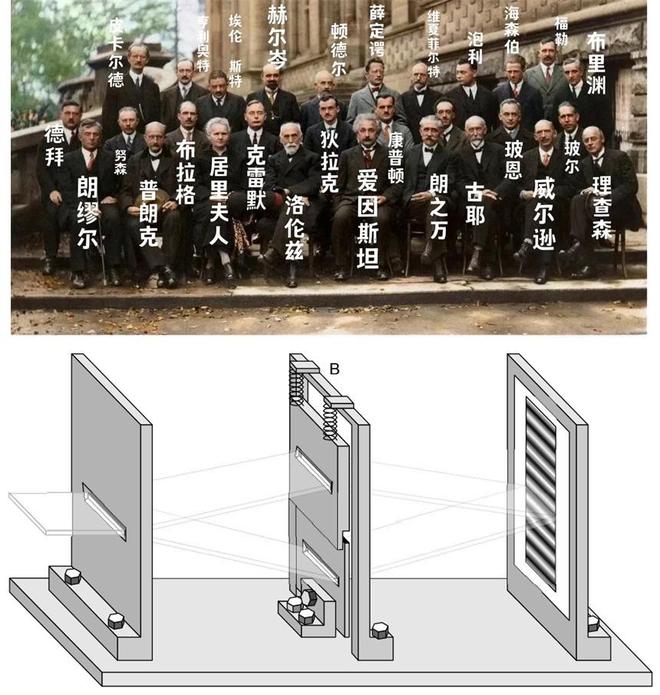
Core Viewpoint - A research team from the University of Science and Technology of China successfully realized Einstein's "recoil slit" quantum interference thought experiment, demonstrating the gradual change of interference contrast with tunable atomic momentum, thus proving the complementarity principle at the Heisenberg limit and showcasing the continuous transition from quantum to classical [1][6]. Group 1 - The research achieved a faithful implementation of Einstein's thought experiment nearly a century after the debate with Bohr, utilizing a ground state single atom as a "movable slit" sensitive to single photon momentum [6]. - The experiment not only confirmed the principles of quantum mechanics but also advanced precision quantum technologies such as high-precision single atom manipulation and single atom-single photon entanglement [6]. - The findings lay the groundwork for future explorations into large-scale neutral atom arrays, compressed state error correction coding, and further investigations into decoherence and the quantum-to-classical transition [6]. Group 2 - The original thought experiment proposed by Einstein during the 1927 Solvay Conference aimed to challenge Bohr's complementarity principle by allowing a single photon to pass through a movable slit, suggesting that measuring the recoil could reveal the photon's path while preserving interference patterns [5]. - This thought experiment is considered one of the most profound paradoxes in quantum mechanics, directly addressing the question of whether complete information about both wave and particle properties can be obtained simultaneously [5].

终结爱因斯坦与玻尔世纪之辩!我国科学家取得量子研究新进展
Guan Cha Zhe Wang· 2025-12-03 12:29
Core Viewpoint - Chinese scientists have made significant progress in quantum research, successfully demonstrating a thought experiment proposed by Einstein and Bohr in 1927, thereby resolving a long-standing debate in quantum mechanics [1][8]. Group 1: Research Achievements - The research team from the University of Science and Technology of China, led by Professors Pan Jianwei, Lu Zhaoyang, and Chen Mingcheng, utilized a single atom trapped by optical tweezers to faithfully realize the "recoil slit" quantum interference thought experiment [1]. - The experiment observed the gradual change in interference contrast of atomic momentum, proving the complementarity principle under the Heisenberg limit and showcasing a continuous transition from quantum to classical [1][8]. - The results were published in the journal Physical Review Letters and received special coverage in the Physics section of the American Physical Society [1]. Group 2: Experimental Methodology - The key to achieving this thought experiment was measuring an effective recoil signal, which required the momentum uncertainty of the slit to be smaller than the impact momentum of the photon [3][5]. - The research group developed the most sensitive "movable slit" under quantum limit conditions by using a single rubidium atom as the movable slit and cooling it to the three-dimensional motion ground state [5]. - The experiment involved actively controlling the atomic fluorescence interference path to a nanometer level, ensuring stable interference [7]. Group 3: Observations and Implications - The experiment demonstrated that as the optical trap deepened, the spatial confinement of the atom increased, leading to a higher overlap of the atomic momentum wave function after photon recoil, which improved the interference contrast [7]. - The team also observed a decrease in interference contrast due to classical noise from atomic heating, which was calibrated and removed, aligning the experimental data with the ideal quantum limit scenario [7][8]. - This work not only realized Einstein's thought experiment but also laid the groundwork for advanced quantum technologies, including large-scale neutral atom arrays and quantum error correction coding [8].