亚洲优先战略

Search documents
恒生指数,再无“恒生”!汇丰银行押注亚太的关键一招
Xin Lang Cai Jing· 2026-01-28 16:48
Core Viewpoint - The privatization of Hang Seng Bank marks the end of an era for a historic Hong Kong bank, with HSBC acquiring it for HKD 106.1 billion, reflecting a strategic shift in the banking landscape of Hong Kong and a response to the challenges faced by Hang Seng Bank [1][2][19]. Group 1: Privatization Process - The privatization process was swift, taking just over three months from announcement to delisting, significantly faster than market expectations [3]. - HSBC announced its plan to acquire the remaining shares of Hang Seng Bank at HKD 155 per share, a premium of 30.3% over the previous day's closing price and 33.1% over the average price of the last 30 days [3][4]. - The acquisition received overwhelming support from shareholders, with 85.8% voting in favor, and was approved by the Hong Kong High Court shortly thereafter [5]. Group 2: Strategic Rationale - HSBC's acquisition of Hang Seng Bank is part of its strategy to focus on Asian markets, consolidating resources to enhance its presence in Hong Kong and the Greater Bay Area [6][7]. - Hang Seng Bank's established local presence and customer base make it an ideal platform for HSBC to expand its operations in the region [7]. - The privatization allows HSBC to streamline operations and eliminate internal competition between the two entities, enhancing overall efficiency [6][12]. Group 3: Challenges Faced by Hang Seng Bank - Hang Seng Bank has faced significant challenges, including a 30% drop in profits in the first half of 2025 and a high bad debt ratio of 6.7%, which is above the industry average [8][11]. - The bank's independent operational model has become increasingly untenable, leading to inefficiencies and regulatory issues [10][11]. - The pressure to deliver short-term results as a public company has hindered Hang Seng's ability to invest in long-term growth initiatives [11][13]. Group 4: Benefits of Privatization - Privatization allows Hang Seng Bank to focus on long-term strategies without the pressure of quarterly earnings reports, enabling more strategic planning [15]. - The integration with HSBC's global resources will enhance Hang Seng's ability to offer cross-border services and expand its business scope [15][16]. - The move is expected to strengthen the overall competitiveness of the Hong Kong banking sector, signaling confidence in the market [16][19].

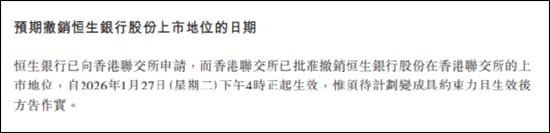
溢价30%收购,汇丰为何必须“完全拥有”恒生?
Tai Mei Ti A P P· 2026-01-09 12:51
Core Viewpoint - The privatization plan of Hang Seng Bank has been approved by the court and shareholders, marking a significant financial consolidation in Hong Kong's banking sector, with the bank set to delist from major indices on January 15, 2026 [1][5]. Group 1: Privatization Process - The privatization process began with HSBC's proposal in September 2025, leading to negotiations and a formal announcement in October 2025, where HSBC offered HKD 155 per share, a premium of approximately 30.3% over the previous closing price [2][3]. - The transaction involves around HKD 1,061.56 billion, and the market reacted positively, with Hang Seng Bank's stock price jumping 25.88% on the announcement day [3]. - The plan was further solidified with regulatory approvals and a clear timeline for completion, indicating a well-structured approach to the privatization [4][6]. Group 2: Strategic Rationale - HSBC's decision to fully acquire Hang Seng Bank is driven by the need to eliminate operational complexities and enhance resource allocation, especially in a competitive banking environment characterized by low margins and rising costs [6][7]. - The integration aims to leverage HSBC's global network and technological capabilities, which are crucial for addressing the challenges posed by fintech and market competition [7][8]. - The privatization is seen as a strategic move to strengthen HSBC's position in the Asian market, particularly in retail banking and wealth management [7][8]. Group 3: Financial Implications - Post-privatization, Hang Seng Bank is expected to benefit from significant cost savings, estimated at around HKD 3 billion annually, through operational synergies [9]. - The bank's financial performance may face short-term pressures due to integration challenges, but long-term growth prospects are anticipated to improve as synergies materialize [14][15]. - Analysts predict that Hang Seng Bank's assets under management could exceed HKD 3 trillion within three years post-privatization, with a potential annual profit growth rate of 5%-8% [14][15]. Group 4: Market Signals - The privatization signifies a shift towards consolidation in Hong Kong's banking sector, reflecting a trend where smaller banks may face increasing pressure to either differentiate or merge [12]. - HSBC's investment in Hang Seng Bank is viewed as a vote of confidence in Hong Kong's financial market, emphasizing the city's role as a global financial hub [12][13]. - Regulatory bodies have set conditions to ensure the continuity of services and support for small businesses, indicating a balanced approach to market concentration [13].


欧洲银行业战略分野!法巴接管汇丰这一业务
券商中国· 2025-07-03 07:41
Core Viewpoint - BNP Paribas has reached an agreement to acquire HSBC's custody and depository bank business in Germany, which will enhance BNP Paribas's position as the largest domestic custodian bank in Europe and deepen its market presence [1][4]. Group 1: Transaction Details - The agreement involves the gradual migration of custody services currently provided by HSBC's German branch to BNP Paribas's securities services division in Germany [2]. - The transaction is expected to initiate a phased customer migration starting in early 2026 to ensure a smooth transition [3]. Group 2: Market Position and Strategy - BNP Paribas is currently the fifth-largest global custodian bank by assets under custody, with the top four being U.S.-based banks [5]. - The custody and depository banking business is a core backend service for institutional investors, providing essential functions such as asset safekeeping, transaction settlement, corporate action processing, reporting, and risk management [5]. - The European custody market exhibits a "dual-track competition" where U.S. giants like BNY Mellon and State Street dominate, while local institutions like Clearstream and BNP Paribas leverage regional regulatory advantages and customer loyalty [6]. Group 3: HSBC's Strategic Shift - For HSBC, the sale of its German custody business aligns with its global strategic adjustment, focusing on high-return markets in Asia and divesting non-core assets [7][8]. - The capital recovered from this transaction will be redirected to support high-growth businesses in Asia, optimizing the group's profit structure [8]. - HSBC's Asian operations have contributed over 100% of its pre-tax profits from 2015 to 2020, while European operations have mostly been in the red [10]. Group 4: Industry Trends and Challenges - The European custody market is facing transformation pressures, including fee rate pressures due to the dominance of passive investments, rising demand for alternative asset custody, and increasing compliance costs driven by regulatory requirements [15][16]. - The balance between localized service depth and global operational efficiency is crucial for international financial groups in the European custody market [17].