
产业外移

Search documents
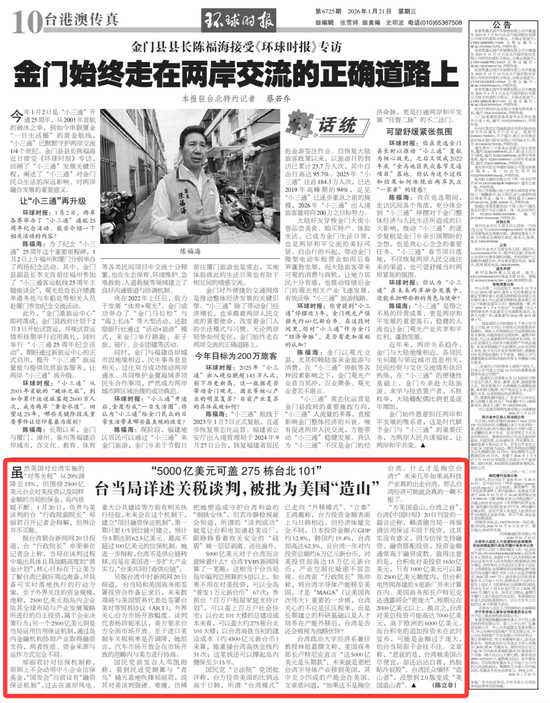
岛内怒了!“5000亿美元可盖275栋台北101”
Xin Lang Cai Jing· 2026-01-20 23:40
Group 1 - The U.S. has reduced the "equivalent tariff" on Taiwan from 20% to 15%, but there are ongoing doubts regarding the $250 billion investment from Taiwanese companies and the same amount in government guarantees [1][6] - Taiwan's Executive Yuan has proposed a "golden plan" to demonstrate readiness for strategic cooperation with the U.S., emphasizing that the $250 billion investment is based on companies' independent decisions and the other $250 billion involves a credit guarantee mechanism [1][6][7] - The credit guarantee mechanism is expected to establish a project financing guarantee mechanism, with an initial phase requiring only 1/5 of the total to be in place, aiming for a maximum of $10 billion [7] Group 2 - Taiwan's government has signed an investment cooperation memorandum with the U.S. and plans to sign a U.S.-Taiwan equivalent trade agreement (ART), with the U.S. demanding comprehensive market opening from Taiwan [2][8] - Critics argue that Taiwan's investment in the U.S. is disproportionately high compared to Japan and South Korea, raising concerns about economic hollowing out [3][9] - The total investment from Taiwan to the U.S. could reach $700 billion, surpassing Europe's $600 billion, with significant implications for Taiwan's semiconductor industry and overall economic stability [4][10]


岛内舆论:民进党当局“以投资换税率” 恐掏空台湾产业优势
Xin Lang Cai Jing· 2026-01-16 11:54
Group 1 - The Taiwan-US trade agreement has raised concerns in Taiwan, with opinions suggesting that it may lead to the relocation of core industrial chains and result in a loss of talent and resources for Taiwan [1] - The agreement includes a reduction of the so-called "reciprocal tariffs" imposed by the US on Taiwan to 15%, in exchange for Taiwan's technology sector increasing investments in the US by $500 billion [1] - There are fears that the semiconductor industry, particularly TSMC, will accelerate its investments in the US, which could lead to a gradual erosion of Taiwan's irreplaceable position in the global supply chain [1][2] Group 2 - The Taiwan People's Party criticized the agreement for including investments in the US energy sector, arguing that it undermines local industry development at a time when Taiwan is struggling with energy transition and supply issues [2] - An analysis by a professor from National Central University indicates that the requirement for Taiwan's tech industry to significantly increase investments in the US will limit local investment opportunities [2] - Concerns were raised about the scale of the investment, which is equivalent to approximately 80 times the annual budget of the Taipei City Government, and the potential for Taiwan's semiconductor supply chain to be entirely relocated [2]