
产品市场契合点

Search documents
a16z CTO 带你深度解析代币种类及去中心化路径
Xin Lang Cai Jing· 2026-02-14 16:41
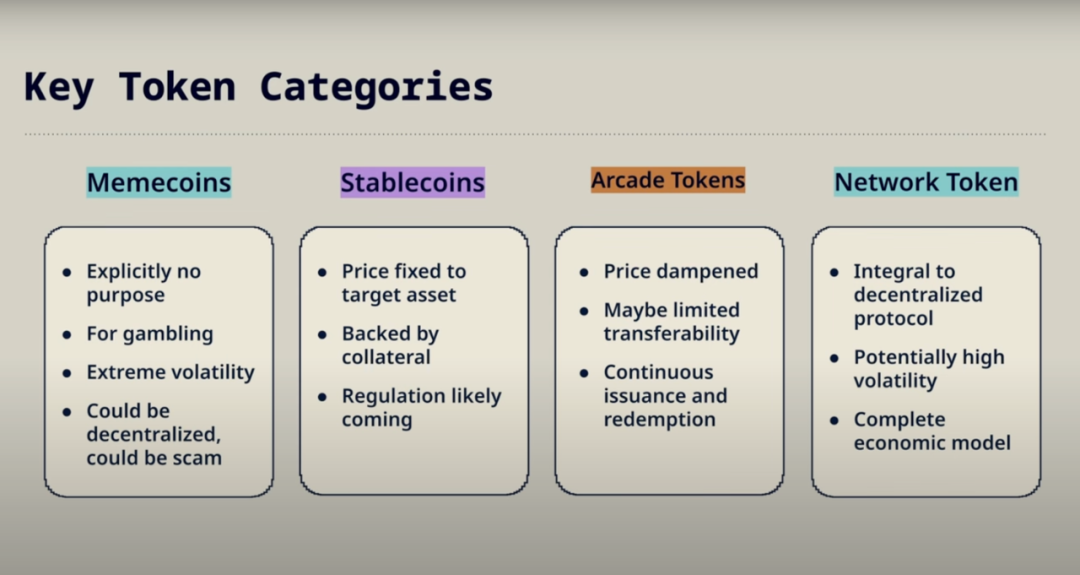
Core Insights - The discussion focuses on the evolution and categorization of tokens in the cryptocurrency space, emphasizing the differences between various types of tokens such as Memecoins, Stablecoins, Arcade Tokens, and Network Tokens [4][6][12]. Group 1: Memecoins - Memecoins are characterized by their lack of clear purpose, making them speculative tools rather than functional tokens [4][5]. - The volatility of Memecoins is a defining feature, but they may also harbor risks such as information asymmetry and potential scams [5]. - The historical context of Memecoins shows that they have existed since the early days of cryptocurrency, often created by forking Bitcoin's code [4]. Group 2: Stablecoins - Stablecoins play a significant role in protocols, primarily as collateral, although their potential for payment applications has been a topic of discussion [5]. Group 3: Arcade Tokens - Arcade Tokens, often referred to as "soft coins," typically serve as the second token in a dual-token model, with limited price appreciation potential due to their infinite supply [5]. Group 4: Network Tokens - Network Tokens are integrated into decentralized protocols and are part of the economic model of systems like Ethereum and Uniswap, with their issuance and redemption closely tied to the overall protocol [6][12]. - The design of these tokens requires careful consideration of issuance and destruction mechanisms to maintain a sustainable economic model [7]. Group 5: Token Design Considerations - A balance between supply and demand is crucial in token design, ensuring that the issuance of tokens supports the protocol's value while preventing inflation [7][11]. - The concept of a "faucet" represents the ability to create tokens, which must be managed to avoid excessive inflation [9]. - The importance of understanding the actual utility and mechanisms of tokens is emphasized, as assumptions about their value can lead to misalignment with market needs [8]. Group 6: Governance and Security - Governance mechanisms can enhance security but also introduce risks, necessitating careful design to minimize potential failure points [37]. - The relationship between token value and network security is highlighted, with the need for tokens to capture value from secure services provided by the protocol [26][42]. Group 7: Decentralization Pathways - The goal is to achieve a balance between decentralization and functionality, with a gradual transition from centralized to decentralized systems [43][51]. - Initial token issuance in a centralized context carries high legal risks, which decrease as decentralization progresses [44][50]. Group 8: Token Issuance Timeline - A hypothetical timeline for token issuance suggests a minimum of six months for preparation, including protocol design, security audits, and negotiations with exchanges [56].

对于AI创业者而言,风投真正想要什么?
Hu Xiu· 2025-04-30 03:30
Core Insights - The article emphasizes the evolving investment landscape for AI startups, highlighting the shift from initial hype to a demand for tangible results and customer validation before funding [3][8]. Group 1: Investment Philosophy - Rebecca Lynn advocates for a "fast follower" strategy over the "first mover" advantage, arguing that entering a market later allows companies to learn from early entrants' mistakes and reduce technical debt [4]. - Canvas Ventures has shifted its focus from attractive presentations to real customer engagement, requiring startups to demonstrate actual product usage before seeking investment [8]. Group 2: CEO Qualities - The most critical quality for a CEO, according to Rebecca, is sales ability, as they must continuously sell the product, vision, and company to various stakeholders [5]. - CEOs who actively listen to customer feedback and incorporate it into product development are particularly valued, as exemplified by Doximity's founder [6]. Group 3: Common Startup Mistakes - A prevalent mistake among startups is prematurely believing they have found product-market fit (PMF), leading to excessive hiring and eventual layoffs when reality sets in [6]. - Rebecca advises startups to delay hiring expensive sales executives until they are confident in their PMF, suggesting a more gradual approach to scaling [6]. Group 4: Conflict Resolution - When disagreements arise between investors and founders, Rebecca emphasizes understanding the founder's perspective and finding a compromise rather than asserting authority [7]. Group 5: AI Startup Challenges - The article highlights the gap between impressive AI presentations and the harsh reality of product implementation, with many startups failing to transition from concept to scalable solutions [8]. - Canvas Ventures' requirement for AI entrepreneurs is clear: they must have real customers using their products before seeking funding [8]. Group 6: Key Investment Questions - Rebecca focuses on two critical questions when evaluating startups: how users interact with the product and what motivates the founder to persevere through challenges [9]. Group 7: Importance of Confidence - A key takeaway for entrepreneurs is the necessity of self-confidence, as belief in oneself is crucial for attracting investment and support [10].
