人均GDP增长

Search documents
重庆未来5年人均GDP要增加4万元
第一财经· 2026-01-28 05:40
Core Viewpoint - Chongqing aims to achieve a per capita GDP of 140,000 yuan by 2030, building a competitive advanced manufacturing center and an influential industrial innovation hub in the west [1][3]. Economic Performance - In 2025, Chongqing's GDP reached 33,757.93 billion yuan, growing by 5.3%, maintaining the same growth rate as the previous quarters [4]. - Chongqing's GDP growth in 2025 allowed it to surpass Liaoning, moving up to 16th place among 31 provinces in China [4]. Future Goals - The main economic and social development targets for Chongqing in 2026 include a GDP growth of over 5%, industrial value-added growth of 6%, fixed asset investment growth of 3%, and retail sales growth of over 4% [5]. - Additional targets include creating over 650,000 new urban jobs and achieving a 3.8% reduction in carbon emissions per unit of GDP [5]. Historical Context - Chongqing's per capita GDP surpassed 100,000 yuan in 2024, ranking 10th among 31 provinces in China [1][3]. - During the 14th Five-Year Plan, Chongqing's industrial economy exceeded 30 trillion yuan, with service industry value added reaching 1.98 trillion yuan [1].

重庆未来5年人均GDP要增加4万元
Di Yi Cai Jing Zi Xun· 2026-01-28 04:09
Group 1 - Chongqing aims to achieve a per capita GDP of 140,000 yuan by 2030, building an advanced manufacturing center and an innovation hub in the western region [1] - In 2024, Chongqing's per capita GDP surpassed 100,000 yuan, ranking 10th among 31 provinces in China [1] - The city's industrial economy is projected to exceed 3 trillion yuan, with service sector value added reaching 1.98 trillion yuan during the 14th Five-Year Plan [1] Group 2 - In 2025, Chongqing's GDP reached 33,757.93 billion yuan, growing by 5.3%, maintaining the same growth rate as the previous quarters [2] - Chongqing's GDP surpassed Liaoning's, moving up one position to rank 16th among 31 provinces in China [2] - The main economic targets for Chongqing in 2025 include a GDP growth of over 5%, industrial value added growth of 6%, and a retail sales growth of over 4% [2]
马建堂:未来10年我国人均GDP年均增长4,可达中等发达国家水平
Xin Lang Cai Jing· 2025-12-21 09:21
Group 1 - The main goal for China's economic and social development in 2025 is expected to be achieved smoothly, with an average annual GDP growth of nearly 4% over the next decade to reach the level of moderately developed countries [1][3] - The GDP growth target set during this year's National People's Congress is around 5%, with the National Bureau of Statistics reporting GDP growth rates of 5.4% in Q1, 5.2% in Q2, and 4.8% in Q3 [1] - The GDP for 2025 is projected to exceed 141.8 trillion yuan, a 37% increase from 103.5 trillion yuan in 2020, while per capita GDP is expected to reach approximately $14,300, a 37.5% increase from $10,400 in 2020 [3] Group 2 - By 2035, a core indicator of achieving socialist modernization is for per capita GDP to reach $20,000, with the current gap of $5,000 to $6,000 from the 2025 target [3] - The Central Economic Work Conference emphasizes the need to fully tap into economic potential, particularly by segmenting income growth across different age groups [3] - There is significant demand among the elderly population for health, travel, and continued education, indicating potential areas for economic growth [3]
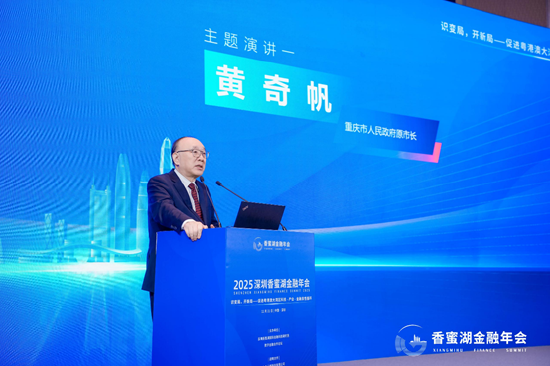
重庆市人民政府原市长黄奇帆:未来十年人民币汇率有望稳步升值 上升到1:6左右
Xin Lang Cai Jing· 2025-12-21 05:01
Group 1 - The second "Shenzhen Xiangmi Lake Financial Annual Conference" will be held on December 20-21, 2025, in Futian District, Shenzhen, focusing on the theme of promoting a virtuous cycle of technology, industry, and finance in the Guangdong-Hong Kong-Macao Greater Bay Area [1][3] - Huang Qifan, former mayor of Chongqing, believes that the RMB to USD exchange rate will rise from over 1:7 to around 1:6 in the next ten years [3][5] - By 2035, while the per capita GDP in RMB may not double, it is expected to double when converted to USD, increasing from the current $13,000 to between $25,000 and $26,000 [3][5] - An appropriate increase in the exchange rate will facilitate imports, allowing the same amount of money to purchase more foreign goods, and will also help adjust export growth to some extent [5]