人工智能科研

Search documents
斯坦福人均≈0.1张GPU,学术界算力遭“屠杀”,LeCun急了
3 6 Ke· 2025-12-09 03:28
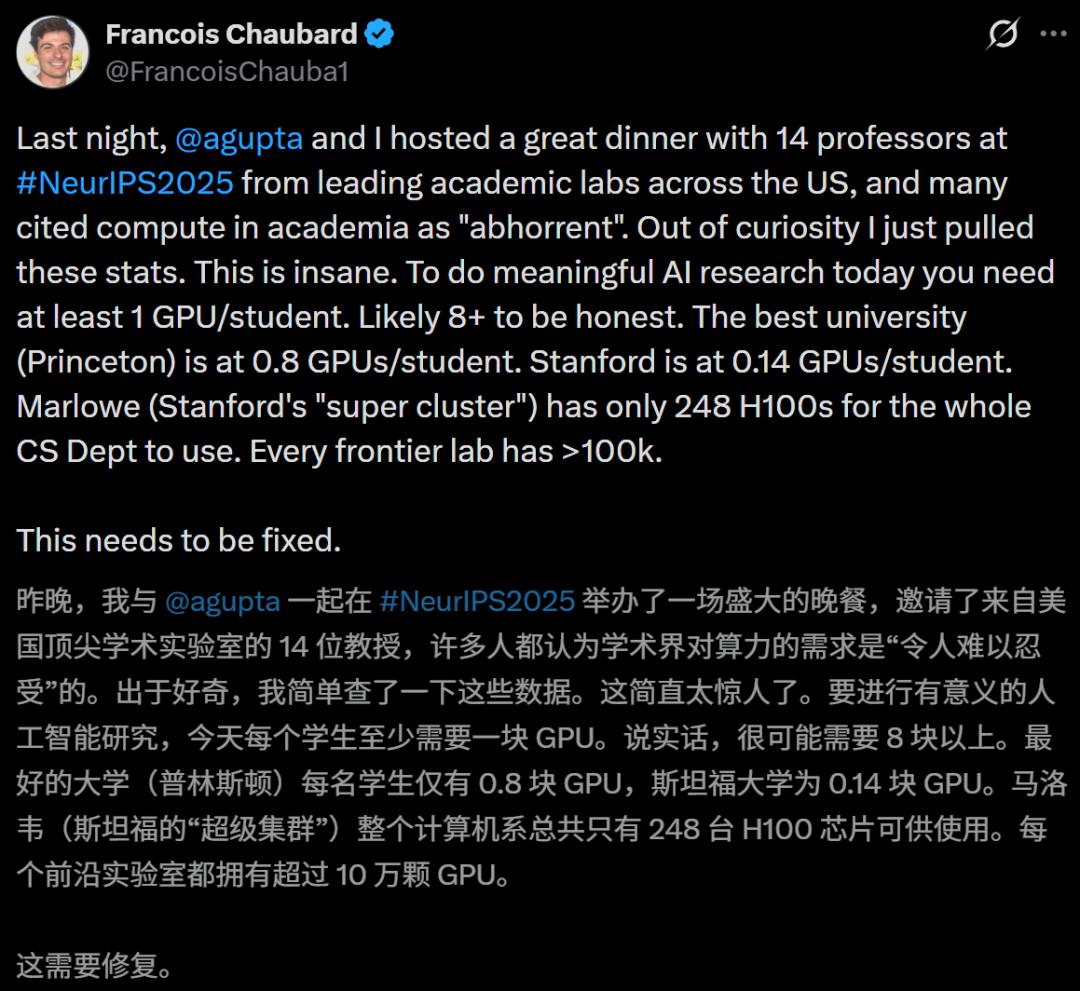
Core Insights - The academic sector is facing a severe GPU shortage, with many top universities having insufficient resources for AI research compared to industry giants [1][12][17] - The disparity in computational resources between academia and industry is leading to a talent drain, as researchers prefer to work in industry due to better access to GPUs [12][16][20] Group 1: GPU Availability in Academia - Top universities like Princeton and Stanford have an average of 0.8 and 0.14 GPUs per researcher, respectively, which is far below the required amount for substantial AI research [4][3] - Major tech companies have access to tens of thousands of GPUs, with Microsoft's Fairwater Atlanta data center capable of running 23 times the training of GPT-4 in a month [7][12] - Some universities, like the University of Texas at Austin, are investing heavily in AI infrastructure, acquiring over 5,000 NVIDIA GPUs to enhance their research capabilities [27][28] Group 2: Impact on Research and Education - The GPU shortage is reshaping how computer science and engineering are taught, with universities increasingly incorporating GPU-related courses into their programs [15][16] - The lack of resources is making it difficult for academic researchers to conduct experiments, as they often have to queue for GPU access and deal with limited operational hours [21][20] - Some universities are attempting to mitigate the GPU shortage by establishing dedicated AI facilities, such as Cal Poly's AI factory equipped with NVIDIA DGX systems [30][33] Group 3: Talent Migration - The widening gap in computational resources is causing academic researchers to reconsider their career paths, with many opting for industry positions where resources are more abundant [16][12] - The trend is evident in discussions among graduate students, who express frustration over the lack of access to high-performance GPUs for their projects [35][36]

下半年CCF会议“僧多粥少”?如何做到“一发入魂”?大佬早都玩明白了
自动驾驶之心· 2025-06-29 11:33
Core Viewpoint - The article emphasizes the importance of timely submission and high-quality research papers for researchers in the field of autonomous driving, highlighting the challenges faced and the solutions offered through a specialized 1v1 guidance program for AI research papers [2]. Group 1: Pain Points Addressed - The program addresses the lack of guidance for students, helping them establish a clear research framework and improve their practical skills [6]. - It assists students in developing innovative ideas and understanding the research process, ensuring their research direction is forward-looking and innovative [13]. - The program provides comprehensive support throughout the research paper process, from topic selection to submission [5][11]. Group 2: Course Content - The guidance includes assistance in the topic selection phase, where mentors help students brainstorm ideas or provide direct suggestions [5]. - During the experimental phase, mentors guide students through experimental design, model building, and validation of ideas [7]. - In the writing phase, mentors help students craft compelling research papers that stand out to reviewers [9]. - The submission phase involves recommending suitable journals and assisting with precise submissions [11]. Group 3: Course Structure and Benefits - The course is structured with a core guidance period followed by a maintenance period, with a total guidance cycle ranging from 3 to 18 months depending on the publication target [23]. - Students will learn to produce high-quality papers, master the research process, and enhance their coding and project implementation skills [22]. - The program includes personalized communication with mentors and a structured approach to addressing student queries [26].