人工智能资本内循环

Search documents
AI巨头的“无限流”订单,还能玩多久?
3 6 Ke· 2025-10-15 01:51
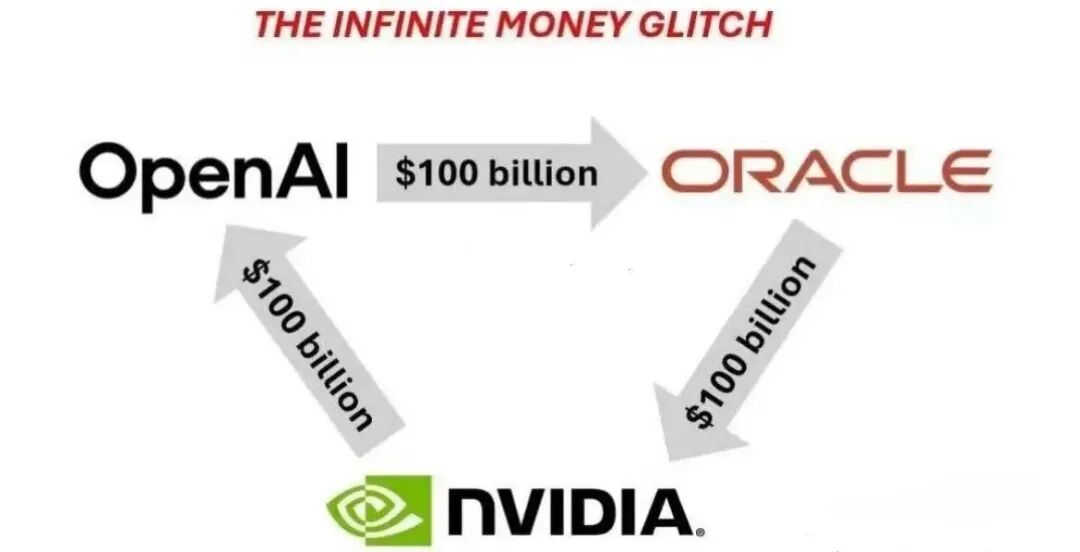
Core Insights - The article discusses the unprecedented capital frenzy driven by the soaring stock prices of tech giants and the valuations of AI startups, highlighting a complex capital loop rather than genuine market demand [1][6] - A triangular capital loop involving OpenAI, Oracle, and Nvidia exemplifies this internal capital cycle, where investments and contracts create a self-reinforcing ecosystem [2][5] Capital Loop Dynamics - Nvidia plans to invest up to $100 billion in OpenAI, which will be disbursed as OpenAI deploys its data centers [2] - OpenAI commits to paying Oracle $300 billion over five years for cloud services necessary for projects like "Project Stargate" [1] - Oracle, in turn, places orders worth hundreds of billions with Nvidia to meet OpenAI's computing needs, creating a closed-loop system where funds circulate among the three entities [2][5] Financial Commitments and Strategic Goals - The total commitments for AI infrastructure and chip supply from OpenAI and its partners exceed $1 trillion, indicating a massive internal capital cycle [5][6] - Key projects include "Project Stargate" with a commitment of up to $500 billion and chip supply agreements exceeding $200 billion [7] Growth Logic - The growth cycle begins with substantial capital injections from major players like Microsoft, Google, and Nvidia into leading AI companies [8] - AI startups utilize these investments to pay for expensive cloud services and hardware, which in turn boosts the revenues of cloud giants [9] - This results in rising valuations for AI companies and reinforces the narrative of an "AI revolution," attracting more capital into the market [10][11] Potential Challenges - There is a disconnect between computing supply and actual market demand, raising questions about the sustainability of the massive investments [13] - Regulatory scrutiny from bodies like the FTC and CMA may challenge the bundled investment and contract model, potentially stifling innovation [14] - Macroeconomic factors, such as high interest rates, could dampen investment appetite, putting pressure on AI startups reliant on external funding [15] Future Scenarios - The article outlines three potential outcomes for the current capital cycle: a "soft landing" with the emergence of profitable AI applications, a "hard landing" with market corrections, or "regulatory reshaping" that alters the competitive landscape [22][26] - Key indicators to monitor include the actual growth rates of cloud providers after removing internal cycle effects, adoption rates of AI applications, and developments in antitrust investigations [28][30]