人类与机器智能协同进化

Search documents
黄仁勋GTC开场:「AI-XR Scientist」来了
3 6 Ke· 2025-11-20 02:21
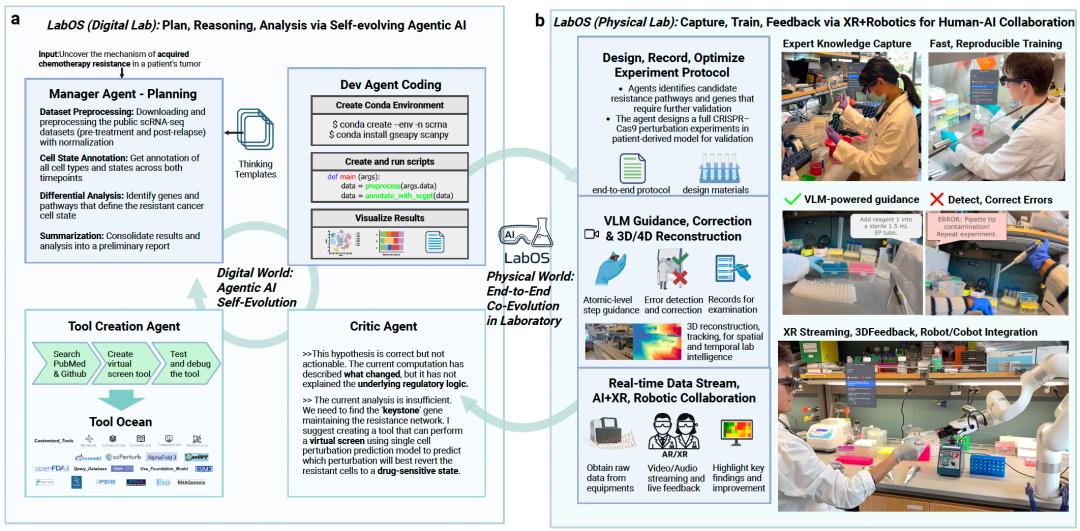
Core Insights - The article discusses the groundbreaking LabOS platform, which integrates AI and XR technology to create a collaborative environment for scientific research, enabling AI to not only think but also "see," "guide," and "operate" in real experiments [2][24]. Group 1: LabOS Overview - LabOS is a collaborative AI platform developed by Stanford and Princeton universities in partnership with NVIDIA, marking the first integration of AI with XR technology for scientific research [2][3]. - The platform creates an end-to-end closed loop from hypothesis generation to experimental validation, significantly enhancing the efficiency and cost-effectiveness of scientific research [2][3]. Group 2: Technological Innovations - LabOS combines self-evolving AI agents with XR technology, allowing for seamless collaboration between AI, human scientists, and robotic systems in real laboratory settings [5][10]. - The system includes a specialized visual language model (LabOS-VLM) trained on over 200 first-person experimental videos, improving the accuracy of error detection and operational guidance in laboratory tasks [6][9]. Group 3: Practical Applications - LabOS has demonstrated its capabilities in three biomedical research cases, including the autonomous discovery of new cancer immunotherapy targets and the generation and validation of scientific hypotheses [15][19]. - The platform enhances reproducibility in complex experiments by capturing expert knowledge and standardizing procedures, thus facilitating skill transfer to new researchers [22][24]. Group 4: Future Implications - The introduction of LabOS signifies a paradigm shift in scientific discovery, aiming to expand the boundaries of science through collaboration between AI and human researchers [24]. - The system is expected to accelerate the pace of scientific discovery by allowing AI to actively participate in every experimental phase, learning from both successes and failures [24].