LabOS

Search documents
科研人有自己的“吃虾”方式!斯坦福普林斯顿最新开源,仅需一行指令
量子位· 2026-03-15 04:38
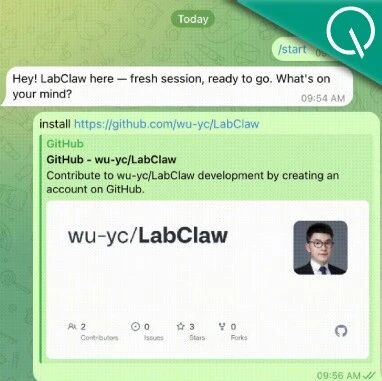
Core Viewpoint - The article discusses the introduction of LabClaw, an AI-driven tool designed to automate various aspects of scientific research, significantly enhancing efficiency and reducing the workload for researchers [1][4]. Group 1: LabClaw Overview - LabClaw is described as a "skill package" for AI, enabling researchers to utilize over 200 skills related to biomedical research with a simple command [3][12]. - The skills are categorized into various fields, including Biology & Life Sciences, LabOS & Automation, Pharmacy & Drug Discovery, and more, with a total of 211 skills available [12]. - Each skill provides guidance on when and how to use it, as well as the expected outcomes, facilitating a streamlined research process [12]. Group 2: Functionality and Applications - LabClaw can automate entire workflows in research, such as single-cell analysis, drug discovery, and clinical trials, by calling upon relevant skills based on the research topic [14][15]. - It can function as an "Always-On Lab Agent," continuously monitoring experimental data and automatically triggering analysis and reporting when anomalies are detected [19][24]. - The integration of LabClaw with LabOS, a dedicated operating system, enhances its capabilities, allowing for real-time collaboration between AI and researchers [28][30]. Group 3: Development and Support - LabClaw is supported by prominent institutions, including Stanford and Princeton, and has received backing from NVIDIA [6][30]. - The development team includes notable figures in the fields of genetics and AI, such as Professor Le Cong and Professor Mengdi Wang, who have significant academic credentials and contributions to their respective fields [35][38]. Group 4: Impact on Research - The introduction of LabClaw is expected to lower the barriers to AI-assisted research, making it accessible with just a single command [44]. - The system's extensibility allows for the addition of new skills as research needs evolve, ensuring that it remains relevant and useful in a rapidly changing scientific landscape [43].

黄仁勋GTC开场:「AI-XR Scientist」来了
3 6 Ke· 2025-11-20 02:21
Core Insights - The article discusses the groundbreaking LabOS platform, which integrates AI and XR technology to create a collaborative environment for scientific research, enabling AI to not only think but also "see," "guide," and "operate" in real experiments [2][24]. Group 1: LabOS Overview - LabOS is a collaborative AI platform developed by Stanford and Princeton universities in partnership with NVIDIA, marking the first integration of AI with XR technology for scientific research [2][3]. - The platform creates an end-to-end closed loop from hypothesis generation to experimental validation, significantly enhancing the efficiency and cost-effectiveness of scientific research [2][3]. Group 2: Technological Innovations - LabOS combines self-evolving AI agents with XR technology, allowing for seamless collaboration between AI, human scientists, and robotic systems in real laboratory settings [5][10]. - The system includes a specialized visual language model (LabOS-VLM) trained on over 200 first-person experimental videos, improving the accuracy of error detection and operational guidance in laboratory tasks [6][9]. Group 3: Practical Applications - LabOS has demonstrated its capabilities in three biomedical research cases, including the autonomous discovery of new cancer immunotherapy targets and the generation and validation of scientific hypotheses [15][19]. - The platform enhances reproducibility in complex experiments by capturing expert knowledge and standardizing procedures, thus facilitating skill transfer to new researchers [22][24]. Group 4: Future Implications - The introduction of LabOS signifies a paradigm shift in scientific discovery, aiming to expand the boundaries of science through collaboration between AI and human researchers [24]. - The system is expected to accelerate the pace of scientific discovery by allowing AI to actively participate in every experimental phase, learning from both successes and failures [24].

黄仁勋GTC开场:「AI-XR Scientist」来了!
机器之心· 2025-11-20 02:07
Core Insights - The article discusses the introduction of LabOS, a groundbreaking AI platform that integrates AI with XR (Extended Reality) to enhance scientific research and experimentation, marking a new era of human-machine collaboration in science [2][4]. Group 1: LabOS Overview - LabOS is the world's first Co-Scientist platform that combines multi-modal perception, self-evolving agents, and XR technology, creating a seamless connection between AI computational reasoning and real-time human-robot collaboration in experiments [4]. - The platform aims to significantly reduce the time and cost of scientific research, with claims that tasks that previously took years can now be completed in weeks, and costs reduced from millions to thousands of dollars [4]. Group 2: AI's Evolution in Laboratories - Traditional scientific AI systems, like AlphaFold, operate in a purely digital realm and are unable to perform physical experiments, which limits research efficiency and reproducibility [6]. - LabOS represents a significant advancement by creating a system that integrates abstract intelligence with physical operations, enabling AI to function as a collaborative scientist in real laboratory settings [6][8]. Group 3: World Model and Visual Understanding - The complexity of laboratory environments necessitates high demands on AI's visual understanding, leading to the development of the LabSuperVision (LSV) benchmark, which assesses AI models' capabilities in laboratory perception and reasoning [13]. - LabOS has been trained to decode visual inputs from XR glasses, achieving a significant improvement in visual reasoning capabilities, with a 235 billion parameter version achieving over 90% accuracy in error detection [13][16]. Group 4: Applications in Biomedical Research - LabOS has demonstrated its capabilities through three advanced biomedical research cases, including the autonomous discovery of new cancer immunotherapy targets, showcasing its end-to-end research capabilities from hypothesis generation to experimental validation [22][25]. - The platform also aids in the mechanism research of biological processes, such as identifying core regulatory genes, and enhances reproducibility in complex wet experiments by capturing expert operations and forming standardized digital processes [29][32]. Group 5: Future Implications - The emergence of LabOS signifies a fundamental shift in the paradigm of scientific discovery, aiming to expand the boundaries of science through collaboration with AI [32]. - The integration of AI and robotics into laboratories is expected to accelerate the pace of scientific discoveries, transforming the traditional reliance on individual expertise into a more scalable and reproducible scientific process [32].
丛乐/王梦迪团队推出AI协作科学家,实时指导和纠正实验操作,让小白秒变实验高手
生物世界· 2025-10-20 09:00
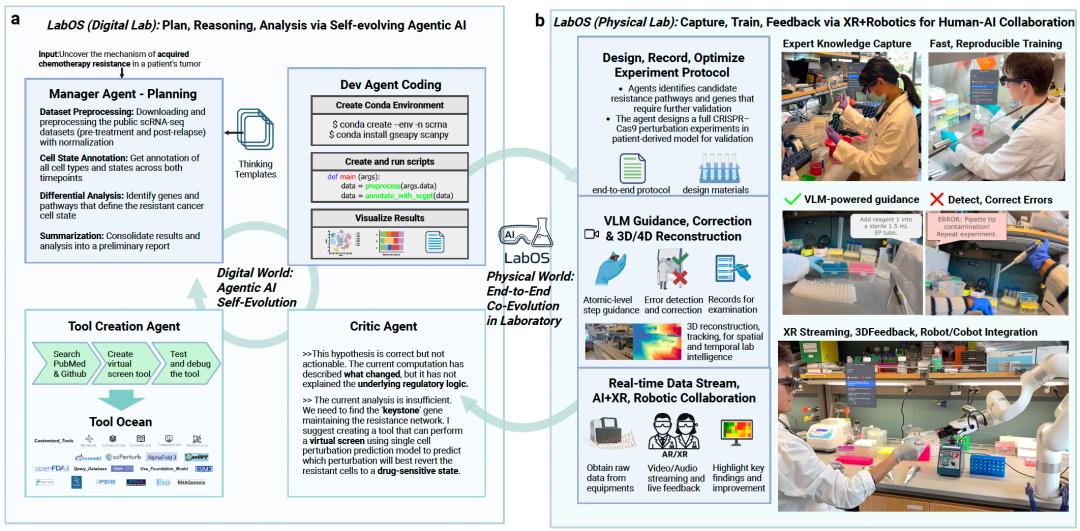
Core Insights - The article discusses the development of LabOS, an AI-XR Co-Scientist platform that integrates artificial intelligence with extended reality technology to enhance scientific research collaboration between AI and human scientists [3][6][29] Group 1: LabOS Overview - LabOS is the first AI Co-Scientist that combines computational reasoning with real-world experiments, utilizing multimodal perception and XR-supported human-machine collaboration [6][9] - The platform consists of four types of AI agents: planning agents, development agents, critique agents, and tool creation agents, enabling a complete research workflow from hypothesis generation to data analysis [9][12] Group 2: Functionality and Applications - LabOS allows AI to "see" what human scientists see, providing real-time assistance during experiments, which transforms laboratories into intelligent collaborative spaces [7][27] - The platform has demonstrated its capabilities in three biomedical scenarios: cancer immunotherapy target discovery, cell fusion mechanism research, and guidance in stem cell engineering [21][23][25] Group 3: Technological Innovations - LabOS incorporates LabSuperVision (LSV) for visual understanding of laboratory environments, achieving over 90% accuracy in error detection during experiments [14][18] - The use of XR glasses facilitates seamless interaction between human scientists and AI, allowing for real-time video transmission and structured guidance [17][20] Group 4: Future Implications - The emergence of LabOS signifies a new era of human-AI collaboration in laboratories, enhancing the speed of discovery and the reproducibility of research [29] - As AI and XR technologies continue to evolve, LabOS is expected to become a standard tool in laboratories, fostering a co-evolution of human intuition and machine learning [29]