
企业国际化经营

Search documents
今日视点:“A+H”扩容不只是上市路径之变
Xin Lang Cai Jing· 2026-02-26 23:00
Core Viewpoint - The acceleration of A-share companies listing in Hong Kong reflects a restructuring of capital and industrial logic, driven by the global reconfiguration of capital flows and China's transition to high-quality economic development [1] Governance Aspect - Companies going international are shifting from product exports to global layouts, increasing compliance risks. The Hong Kong market aligns closely with international standards in information disclosure, corporate governance, and ESG [2] - Choosing "A+H" listing means companies must adhere to regulatory frameworks in both markets, enhancing governance capabilities despite increased operational complexity and compliance costs [2] - This dual regulatory environment compels companies to improve internal control systems, thereby increasing transparency and stability, which is crucial in an uncertain external environment [2] Pricing Aspect - The investor structure differs significantly between A-shares and H-shares, with A-shares dominated by domestic funds and H-shares having a higher proportion of institutional investors focused on profit certainty and cash flow quality [3] - Valuation discrepancies often arise in H-shares due to limited offshore market liquidity and foreign investors' misunderstandings of certain industry cycles and policy environments [3] - The "A+H" structure not only broadens financing channels but also promotes a more rational valuation system, compressing emotional premiums and emphasizing the importance of profit quality [3][4] Industrial Aspect - Hard technology sectors like AI, semiconductors, and renewable energy require sustained R&D investment, making them highly dependent on long-term capital [4] - Multi-market layouts enhance capital acquisition efficiency, supporting long-term R&D and enabling access to patient capital through the Hong Kong market [4] - The "A+H" model serves as a filter for companies, favoring those with technological barriers and clear business models for sustained recognition in both markets [4] Strategic Aspect - The influx of emerging industry companies into the Hong Kong market is optimizing its structure and enhancing its innovation attributes, providing global investors with richer options for allocating Chinese new economy assets [5] - This dual interaction strengthens capital ties and increases the weight of Chinese assets in global portfolios, making "A+H" expansion a structural transformation [5][6] - The long-term significance of "A+H" expansion lies in reshaping the growth paradigm of Chinese enterprises and the international pricing coordinates of Chinese assets, with a focus on generating real profits and cash flows within a global regulatory framework [6]
60余家石化企业上榜中企500强
Zhong Guo Hua Gong Bao· 2025-09-17 02:29
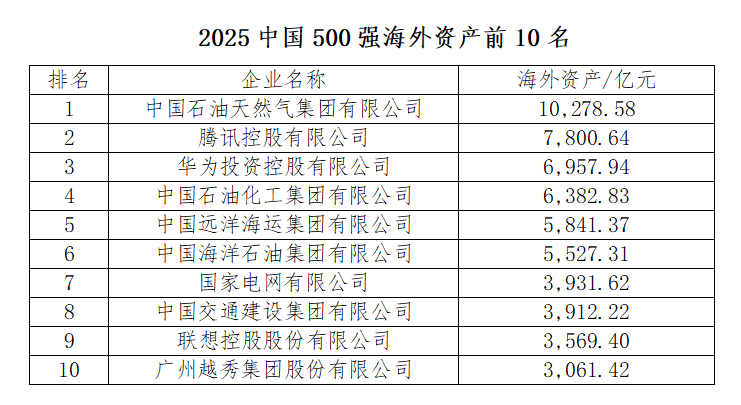
Group 1 - The 2025 China Enterprise 500 list was released, highlighting over 60 oil and chemical companies, with the total revenue of the top 500 enterprises reaching 110.15 trillion yuan and total assets at 460.85 trillion yuan, marking a 7.46% increase from the previous year [1] - Oil and chemical companies accounted for 12% of the total list, underscoring their role as a pillar of the national economy and a stabilizing force for industrial economic growth [1] - China National Petroleum Corporation and China Petroleum & Chemical Corporation ranked second and third, with revenues of 29,690 billion yuan and 29,320 billion yuan respectively [1] Group 2 - Innovation is crucial for enterprise development, with several petrochemical companies, including Sinopec and PetroChina, listed among the 2025 China Top 100 Innovators [2] - Chinese petrochemical companies are advancing international operations, with overseas assets for China National Petroleum Corporation reaching 1 trillion yuan, leading the 2025 China Top 100 Multinational Companies [2] - The threshold for entering the China Enterprise 500 has increased by over 8.7 billion yuan, with total revenue and assets growing by over 22% and 34% respectively, indicating a significant rise in the scale of enterprises [2]



“中国跨国公司100大”名单出炉 中石油、腾讯、华为排前三
Xin Hua Cai Jing· 2025-09-15 13:01
Core Insights - The "2025 China Top 100 Multinational Companies" has an entry threshold of 22.173 billion yuan, an increase of 2.333 billion yuan from previous years, with an average multinational index of 15.56%, up by 0.21 percentage points year-on-year [1][2] Group 1: Company Performance - The overseas assets and overseas operating income of the top 100 multinational companies in China have increased by 29.74% and 47.44% respectively since the start of the 14th Five-Year Plan [2] - The top 100 multinational companies are distributed across 17 provinces, autonomous regions, and municipalities, with Beijing accounting for 32%, Zhejiang 13%, Guangdong 12%, Shandong 10%, and Shanghai 9%, collectively representing 76% of the total [2] - Among the top 100 multinational companies, there are 59 state-owned or state-controlled companies and 41 private companies [2] Group 2: Industry Distribution - The top 100 multinational companies are primarily concentrated in the following industries: 10 in non-ferrous metallurgy and products, 7 in ferrous metallurgy, 6 in automotive and parts manufacturing, and 5 each in wind and solar equipment manufacturing, civil engineering construction, and power production [2] - Other notable distributions include 4 companies in communication equipment manufacturing, internet services, and diversified investments, and 3 in home appliance manufacturing and telecommunications services [2] Group 3: Methodology - The "China Top 100 Multinational Companies and Multinational Index" is based on voluntary data reported by companies, following standards set by the United Nations Conference on Trade and Development, and has been published for 15 consecutive years [3]

全国人大代表、楚天科技董事长唐岳:提升海外融资便利性 支持企业全球化布局
Zheng Quan Shi Bao Wang· 2025-03-07 18:58
Group 1 - The core viewpoint emphasizes the importance of enhancing overseas financing convenience for Chinese enterprises as part of the 2025 government work report, which includes optimizing financial services such as financing, settlement, and foreign exchange [1] - Since 2015, there has been a shift in domestic macro and financial policies regarding bank loans for overseas investments, moving from leniency to tightening, and recently to some relaxation [1] - The need for improved policies to enhance overseas financing convenience and increase the efficiency of domestic banks in fund allocation is highlighted, particularly for companies facing uncertainties in local financing after overseas mergers and acquisitions [1] Group 2 - Domestic bank loan interest rates are currently declining, and banks have ample credit funds, while Chinese enterprises abroad urgently require financial support [2] - Recommendations include expanding the scale of RMB cross-border direct lending and encouraging capable commercial banks to engage in RMB cross-border financing to mitigate foreign exchange risks [2] - The enhancement of service capabilities of state-owned banks is crucial for supporting the internationalization of Chinese enterprises, with a focus on improving services in credit, performance guarantees, and syndicate loans [2]

