伊朗核问题全面协议

Search documents
军事高压下,能否达成“更好的协议”?
Xin Lang Cai Jing· 2026-02-23 21:43
Core Viewpoint - The Iranian Foreign Minister, Amir-Abdollahian, stated that reaching a "better agreement" than the 2015 nuclear deal is possible, emphasizing Iran's right to peacefully utilize nuclear energy [1] Group 1: Negotiation Developments - A new round of negotiations regarding the nuclear issue is expected to commence, with a meeting scheduled in Geneva between Iranian officials and the U.S. special envoy, Robert Malley [1] - Iran is in the process of drafting a proposal to present to the U.S. [1] Group 2: Diplomatic Relations - The Iranian Foreign Minister expressed optimism about the potential for a swift agreement between Iran and the United States [1]
伊朗:感谢中国
中国能源报· 2025-12-24 03:28
Group 1 - Iran expresses gratitude to China and Russia for their principled stance and faithful commitment during the implementation of the nuclear agreement [1] - China's permanent representative to the UN, Sun Lei, highlights the detrimental impact of the US's unilateral withdrawal from the nuclear agreement in 2018 and subsequent sanctions on Iran [1] - The current situation regarding Iran's nuclear program is seen as detrimental to the international non-proliferation regime and regional stability, prompting calls for urgent negotiations to reach a consensus [1] Group 2 - The article mentions a call for high-quality Chinese suppliers in various energy sectors, including solar, wind, and hydrogen energy, as part of a new opportunity for cooperation with Arab countries [3] - The criteria for selecting suppliers include product quality, reputation, innovation capability, and internationalization level [3]


伊朗:不会屈服
中国能源报· 2025-09-30 11:34
Core Viewpoint - Iran is facing continuous sanctions due to its refusal to yield to Western pressures, as stated by President Pezeshkian, who emphasized that the West's belief in subduing Iran is a mere fantasy [1]. Group 1: Sanctions and International Relations - The "snapback" mechanism of sanctions related to Iran's nuclear deal has been activated, leading to the restoration of UN sanctions against Iran as of September 27, 2023 [1]. - The European Council announced on September 29, 2023, the reimplementation of a series of sanctions against Iran that had been suspended after the 2015 nuclear agreement [1]. - The renewed sanctions include travel bans on individuals, asset freezes for both individuals and entities, and prohibitions on providing funds or economic resources to listed targets [1].

4票赞成、9票反对、2票弃权!联合国安理会未通过,中国、俄罗斯等投赞成票
Mei Ri Jing Ji Xin Wen· 2025-09-19 23:24
Core Points - The UN Security Council voted on September 19 regarding the extension of sanctions relief for Iran, resulting in 4 votes in favor, 9 against, and 2 abstentions, leading to the restoration of sanctions on September 28 [1] - China, Russia, Pakistan, and Algeria voted in favor of extending the relief period, but the lack of 9 votes for approval means sanctions will be reinstated [1] - Despite the failure to pass the resolution, negotiations may still occur during the upcoming high-level meeting of the 80th UN General Assembly [1] Summary by Sections Sanctions and Agreements - The 2015 nuclear deal between Iran and the P5+1 (US, Russia, China, UK, France, Germany) required Iran to limit its nuclear program in exchange for sanctions relief, which was later endorsed by the Security Council through Resolution 2231 [1] - This resolution includes a "snapback" mechanism allowing signatories to respond to Iran's violations, effective until October 18 of this year [1] Recent Developments - On August 28, the foreign ministers of the UK, France, and Germany announced the initiation of the "snapback" mechanism, stating that if the Security Council does not pass a resolution to extend sanctions relief within 30 days, sanctions will be restored [1] - A draft resolution co-authored by China and Russia proposed extending the nuclear deal and Resolution 2231 for an additional six months until April 18, 2026, but it has not yet been put to a vote [1]
伊朗副外长:若“快速恢复制裁”机制启动 则将停止与核监督机构合作
Yang Shi Xin Wen· 2025-08-28 14:25
Core Points - Iran's Deputy Foreign Minister warned that if Europe activates the "snapback sanctions" mechanism, Iran will cease cooperation with the UN nuclear watchdog and will no longer engage in dialogue with European nations [1] - Iran's Foreign Minister stated that the Supreme National Security Council has approved the return of International Atomic Energy Agency (IAEA) inspectors to Iran, but denied reports of a final agreement on a new cooperation framework [1] - The Iranian parliament passed a law to suspend cooperation with the IAEA following a US military strike on its nuclear facilities, which restricts IAEA inspectors' access unless certain security guarantees are met [1] Group 1 - Iran's warning about potential cessation of dialogue with Europe if sanctions are reactivated [1] - Approval for IAEA inspectors to return, but no final agreement on cooperation [1] - Legislative action taken by Iran to limit IAEA access to its nuclear facilities [1] Group 2 - Western nations are pressuring Iran to comply with the nuclear deal by threatening to activate the "snapback sanctions" mechanism [2]
特朗普发帖!“没给伊朗任何好处”
Zheng Quan Shi Bao· 2025-06-30 14:12
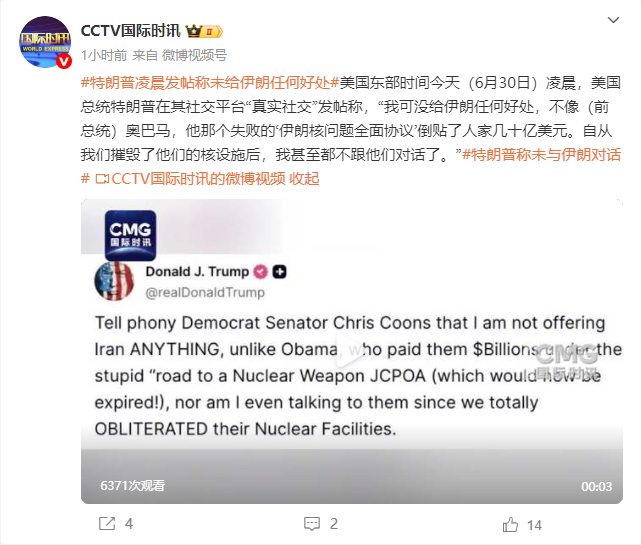
Group 1 - The core viewpoint of the articles revolves around the recent military actions and statements regarding Iran's nuclear facilities, highlighting the contrasting narratives from the U.S. and Iran [1][2][3] - President Trump claims that the U.S. has completely destroyed three of Iran's nuclear facilities, including the Fordow facility, asserting that only rocks remain at the site [2][3] - U.S. intelligence intercepted communications from Iranian officials indicating that the damage from the recent U.S. military strikes on their nuclear program was less severe than expected [2] Group 2 - Trump criticized former President Obama for the Iran nuclear deal, stating that he did not provide any benefits to Iran, unlike Obama, who he claims gave them billions [1] - Iranian Supreme Leader Khamenei declared that Iran has "defeated" the U.S. and Israel in the ongoing conflict, while U.S. and Israeli sources continue to promote the effectiveness of their strikes on Iranian nuclear facilities [2] - There is ongoing uncertainty regarding the status of Iran's nuclear capabilities, including whether they have relocated enriched uranium, with Iranian officials maintaining that their knowledge and political will remain intact [2]
伊朗退出与美国核谈判 与伊以冲突有关?丨国际识局
Zhong Guo Xin Wen Wang· 2025-06-13 15:43
Group 1 - Iran officially announced its withdrawal from nuclear negotiations with the United States following large-scale airstrikes by Israel on Iranian nuclear facilities and military targets, raising international concerns [1] - The negotiations aimed to restore the 2015 Joint Comprehensive Plan of Action (JCPOA), which had previously limited Iran's nuclear activities in exchange for the lifting of international sanctions [2] - The immediate trigger for the breakdown of talks was the recent escalation of conflict between Israel and Iran, with reports indicating that Israeli airstrikes resulted in 78 deaths and 329 injuries in Tehran [3] Group 2 - Israeli military actions reportedly led to the deaths of several Iranian military officials, including the commander of the Islamic Revolutionary Guard Corps [4] - Iran claimed that the airstrikes resulted in the deaths of at least six nuclear scientists, along with civilian casualties [5] - The ongoing conflict is not new, as there have been multiple clashes between Israel and Iran in 2024, with experts suggesting that Israel's actions aim to obstruct U.S.-Iran nuclear negotiations [6] Group 3 - Former U.S. President Trump issued a "final ultimatum" to Iran, stating that they had 60 days to return to the negotiating table, which has now passed without compliance [7] - Trump warned that if Iran refuses to negotiate, Israel may launch "more severe" attacks [8] - Despite the damage caused by Israeli airstrikes, experts believe the effectiveness is limited due to the underground nature of many of Iran's key nuclear facilities, suggesting that Israel may resort to intelligence operations and targeted actions instead [9]
特朗普再挥“签证大棒”:12国公民被限制入境,影响几何?
Di Yi Cai Jing· 2025-06-05 05:35
Core Points - The Trump administration has announced a new travel ban restricting citizens from 12 countries, citing national security concerns [1][3] - The travel ban will take effect on September 9 and includes countries such as Afghanistan, Myanmar, Iran, and Yemen [3][4] - The ban is seen as a continuation of previous policies aimed at controlling immigration from nations deemed security threats [4][5] Group 1: Travel Ban Details - The travel ban includes comprehensive entry restrictions for citizens from Afghanistan, Myanmar, Chad, Congo (Brazzaville), Equatorial Guinea, Eritrea, Haiti, Iran, Libya, Somalia, Sudan, and Yemen [3][4] - Some countries, including Burundi, Cuba, Laos, Sierra Leone, Togo, Turkmenistan, and Venezuela, will face partial restrictions [3] - The ban allows for certain exemptions, including U.S. permanent residents and dual nationals from affected countries [3][4] Group 2: Historical Context and Legal Challenges - The travel ban follows a similar order from 2017, which faced numerous legal challenges before being upheld by the Supreme Court in 2018 [5] - In the fiscal year 2016, there were 72,000 approved applications from the affected countries, which dropped to approximately 14,600 in the fiscal year 2017-2018, marking an 80% decrease [5] - The current travel ban may also face legal challenges similar to those encountered in previous iterations [5] Group 3: Political Implications - The announcement of the travel ban coincided with recent violent incidents in the U.S., which the administration used to justify the restrictions [3] - The ban reflects ongoing tensions in U.S. foreign relations, particularly with Iran, which remains under negotiation for a nuclear agreement [6]
特朗普不许伊朗开展铀浓缩活动 伊朗准备拒绝美方新提案
Xin Hua She· 2025-06-03 12:05
Core Viewpoint - The U.S. President Donald Trump stated that Iran will not be allowed to conduct any uranium enrichment activities, while Iranian officials indicated readiness to reject a new proposal from the U.S. regarding the nuclear deal due to unmet concerns [1][2][4]. Group 1: U.S. Position - Trump emphasized on social media that under a potential agreement, Iran would not be permitted to engage in any uranium enrichment activities [2]. - The U.S. proposal, presented by Middle East envoy Steven Wittekopf, suggested allowing Iran to continue low-level uranium enrichment for civilian purposes, contingent on closing underground facilities [4]. - Trump's statements appear to downplay Wittekopf's proposal, which includes significant compromises that may not satisfy Israel and pro-Israel U.S. lawmakers [4]. Group 2: Iranian Response - Iranian officials accused the U.S. of not changing its stance on uranium enrichment and failing to clarify sanctions relief, leading to a planned rejection of the proposal [7]. - Iran's Foreign Minister Abbas Araghchi indicated that a formal response to the U.S. proposal would be forthcoming [7]. - Iranian officials noted that the latest proposal contradicts the latest consensus reached in the fifth round of indirect talks, with the U.S. changing its position being a major obstacle to successful negotiations [7]. Group 3: Historical Context - The 2015 nuclear deal required Iran to limit its nuclear program in exchange for sanctions relief, but the U.S. withdrew from the agreement in 2018 and reinstated sanctions [5]. - Since May 2019, Iran has gradually ceased compliance with parts of the agreement, although it claims that its actions are reversible [5]. - Following Trump's re-election in January, efforts to reach a new agreement have seen five rounds of indirect talks, but core issues remain unresolved [5].