优先购买权

Search documents
私募股权基金原状分配的争议问题及其化解路径
Sou Hu Cai Jing· 2025-11-10 12:08
Core Viewpoint - The article analyzes the controversies surrounding the original distribution of private equity funds and attempts to propose solutions for effective exits in the current economic cycle [2][3]. Group 1: Current Situation of Private Equity Fund Exits - In recent years, the wave of exits from private equity funds has become a dominant theme in the investment market, driven by the need for short-term project completion and risk reduction [3]. - The existing policies provide a pathway for original distribution, but the lack of clear operational norms leads to various disputes during the process [3][4]. Group 2: Controversies in Original Distribution - The issue of whether other shareholders of the target company have a preemptive right during original distribution is debated, with two main viewpoints emerging [5]. - One viewpoint argues that original distribution is not a transfer of shares in the traditional sense and should not be subject to the same rules as share transfers, while the other believes it should be treated similarly to share transfers [5][6]. Group 3: Recommendations for Smooth Implementation - It is suggested that private equity funds clarify in investment documents that other shareholders agree to waive their preemptive rights during original distribution [10]. - To address the limitation on the number of shareholders, options include adjusting the distribution plan or establishing a holding platform to consolidate shares [12][13]. Group 4: Special Shareholder Rights - The article discusses whether the transferee of shares in original distribution automatically inherits special shareholder rights previously held by the private equity fund [14][15]. - It concludes that such rights do not automatically transfer and must be agreed upon separately by the parties involved [15][18]. Group 5: Issues Related to Joint-Stock Companies - The article highlights that company bylaws can impose restrictions on share transfers, which must be adhered to during original distribution [20]. - It also addresses the challenges posed by restricted shares, suggesting that judicial enforcement may be necessary to facilitate the transfer process [21]. Group 6: Conclusion - The issues surrounding original distribution in private equity funds are critical for determining the success of exit strategies, impacting multiple stakeholders and the overall market order [22]. - Recommendations include establishing clear conditions for original distribution in fund setup and investment documents to reduce uncertainties and ensure smooth exit pathways [22].

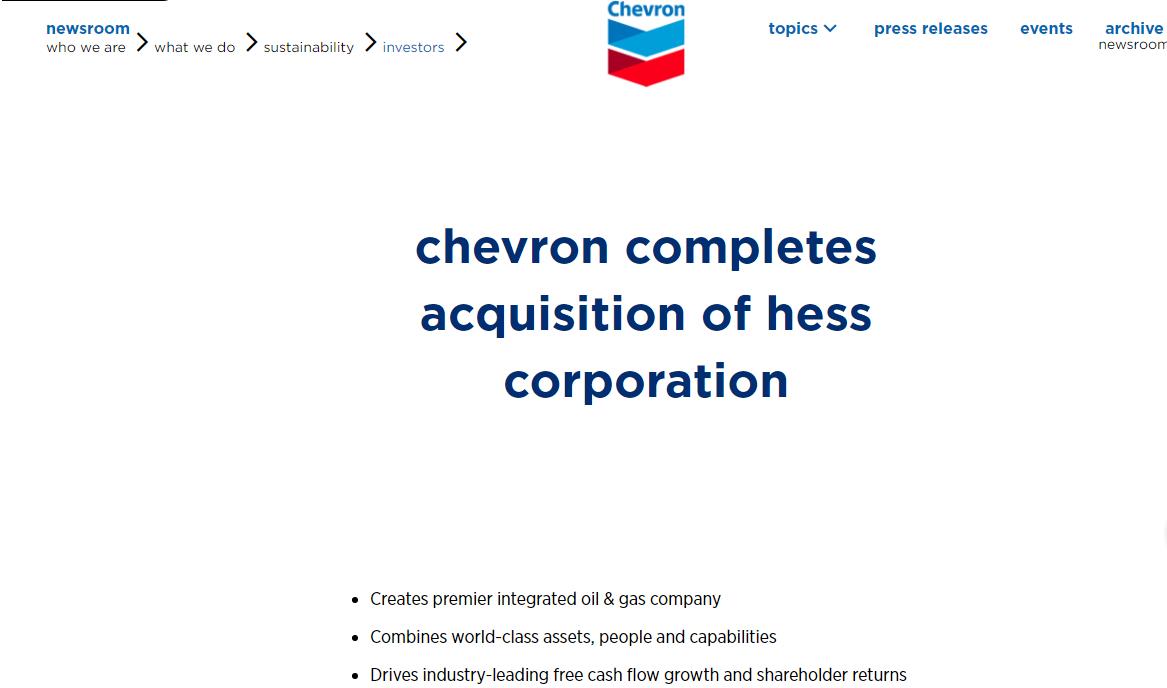
拿下圭亚那超级油田!雪佛龙530亿美元完成收购赫斯
Di Yi Cai Jing· 2025-07-18 23:18
Core Viewpoint - Chevron has successfully completed the acquisition of Hess for $53 billion after winning a significant arbitration case against ExxonMobil, securing rights to one of the most important oil fields in Guyana [1][4]. Group 1: Acquisition Details - The acquisition of Hess is not just another major deal in the oil industry; it centers around Hess's 30% stake in the Stabroek block, which contains over 11 billion barrels of oil reserves [2]. - ExxonMobil claims it has a right of first refusal based on a joint operating agreement, which Chevron and Hess dispute, arguing that the agreement does not apply to this case [3]. Group 2: Arbitration Outcome - The International Chamber of Commerce ruled in favor of Chevron, allowing the transaction to proceed, despite ExxonMobil's disagreement with the interpretation of the ruling [4]. - ExxonMobil's CEO stated that the company is reviewing the decision to ensure it can prevail in future disputes [4]. Group 3: Industry Implications - Chevron's CEO indicated that the integration of Hess will take several months, and the acquisition is expected to optimize Chevron's asset structure significantly [5][6]. - The acquisition is seen as a victory for shareholders of both Hess and Chevron, as it eliminates uncertainty and enhances Chevron's portfolio, particularly in Guyana [6]. Group 4: Financial Projections - Post-merger, Chevron's capital expenditure budget is projected to be between $19 billion and $22 billion, with expected operational cost synergies of $1 billion by the end of 2025 [8].